
Against the backdrop of tensions around the Strait of Hormuz and new risks to global energy supplies, the European Union must treat energy not only as a climate or crisis issue, but also as a fundamental element of security and defence. To achieve this, the EU needs to accelerate the development of its own energy generation, reduce bureaucratic barriers, and lessen its dependence on external suppliers of fossil fuels.
This was stated in a comment to Guildhall by Markéta Gregorová, a MEP from the Czech Republic.
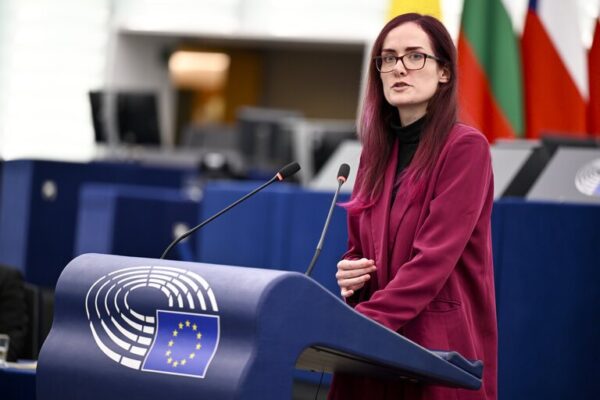
— Recent tensions around the Strait of Hormuz have once again exposed Europe’s vulnerability to external energy shocks. Does this mean that energy security must now be treated as a key element of European security and defence preparedness?
— Energy security has always been a security issue, not just a matter of crisis management or environmental policy. In this sense, Ukraine’s experience has been very instructive.
Last winter, even the capacities Ukraine had managed to build — for example in local decentralized renewable energy — were still insufficient. But it was still a beginning, because Russia continues to strike Ukraine’s energy infrastructure very heavily.
This is precisely the direction in which, in my view, the European Union should move. Fossil fuels too often end up in the hands of adversaries or simply authoritarian regimes that can dictate any price they want. If we build our own capacities — usually renewables or nuclear generation — then we become independent, or at least more independent, from those who control fossil resources.
— What concrete steps should Europe take in the coming years to strengthen its energy independence and reduce reliance on politically unstable and hostile external suppliers?
— First of all, part of the permitting procedures must be simplified and bureaucracy must be reduced.
There are still EU countries where it takes years to get approval to install solar panels on your house or to build other renewable energy facilities, such as wind turbines. That is absurd, because these capacities are relatively cheap and can be built quickly.
There need to be dedicated acceleration zones where such projects can be implemented without unnecessary delays. In addition, funding is needed for private households that want to install solar panels and then share the energy they produce with neighbours and local communities.
This significantly increases resilience. But that is not the only issue. It is also important to build a truly integrated energy market and strengthen interconnections between grids. At the moment, only a limited share of EU energy grids is genuinely interconnected on a pan-European level, and that is clearly not enough.
If, for example, one country lacks wind but a neighbouring country has enough of it, fully integrated grids help everyone. At the moment, that level of connectivity is still missing. That is why Europe should support the development of local renewables, diversification, and grid interconnection as quickly as possible and with as little bureaucracy as possible, because this directly increases security.
— The green transition is important, and this is well understood in Ukraine. But can Europe afford to focus only on decarbonisation if its armed forces, defence industry, and critical infrastructure still depend on stable and controllable energy supplies?
— Decarbonisation goals may indeed need to be adjusted in light of current security needs. That is the reality. Unfortunately, there is always a new challenge, a new crisis, that we have to respond to.
At the same time, the argument that decarbonisation should not be pursued at all does not seem correct. Efforts to stop global warming must continue, otherwise even our food resources may come under threat.
So this is about balancing priorities. Some goals and some bureaucratic procedures are indeed too rigid, and pressure in those areas can certainly be eased. But as I have already said, a key part of energy security is diversification, as well as the development of nuclear and renewable energy.
And that in itself already supports decarbonisation goals. These directions can go hand in hand. This is not about some kind of “green tanks,” as some people mockingly put it. It is about strengthening both energy security and environmental sustainability at the same time.
— How do you assess the idea of increasing domestic oil and gas production in Europe as part of a broader strategy of energy security, strategic resilience, and defence preparedness?
— Europe does not have that many oil reserves. Of course, there is constant dialogue with Norway, because it is a very important source, and it is also a democratic country. In itself, that is already something of a rarity in the oil sector.
But Norway alone is not enough to ensure Europe’s full independence in terms of oil. That is why I emphasize the need to find alternatives to fossil fuels.
First, such resources are most often controlled by authoritarian regimes, which creates dependency. Second, and this is also very important, they are being depleted. That is exactly why they are not renewable resources: their volume is finite.
If the question is whether Europe should expand, for example, coal mining, my answer would be no. That is a dead end. What is needed is a long-term strategy: diversified sources, ideally cheap, quick to deploy, and renewable. That means sun, wind, water, and nuclear energy. Coal does not belong in that category.
— If we look more broadly — not only at Europe itself, but at the West as a whole and at the EU’s partners — should they increase oil and gas production in order to help the European Union?
— That depends entirely on who is actually considered the West or a partner in such a scenario.
At the moment, there are many discussions within the European Union about European sovereignty and autonomy in strategic sectors, including resources. And this is indeed a very important issue. Who started the war with Iran? The United States. These are Europe’s partners, yet they did not consult the EU. They knew such actions would lead to higher prices.
Moreover, some argue that Donald Trump did this deliberately: when the Strait of Hormuz is blocked, who sells very expensive oil to Europe? The United States. That means the U.S. profits from it.
So when asked whether Western partners should help the EU, a counter-question arises: who is really a partner today if traditional Western allies themselves are provoking higher energy prices?
That is exactly why Europe should not depend on any partners. Europe should coordinate internally. Ideally, Ukraine should also be part of that space. But at this point, it is difficult to rely on the idea that someone from outside genuinely wants to be such a partner.
— You already mentioned that the EU’s climate and energy policy should not undermine the capabilities of the armed forces and the defence industry. To what extent does the current Green Deal framework actually take military interests into account?
— I am not a Green Deal expert. My field is security, not every detail of the legislation.
But in most of the existing acts connected with the Green Deal, including CBAM — the Carbon Border Adjustment Mechanism — as well as various rules on steel production, building standards, transport requirements, and the phase-out of internal combustion engines, the military sphere is in most cases exempt from these regulations.
Military equipment and military personnel are exempt in many cases. There are certain rules where some elements are still covered, but these are more the exception than the rule. In most cases, the exemption applies.
Many people simply do not know this. Perhaps this is again the result of propaganda around the claim that the Green Deal is inherently harmful. But in practice, the picture is more complex.
Exclusively for Guildhall.
Только главные новости в нашем Telegram, Facebook и GoogleNews!
Tweet