
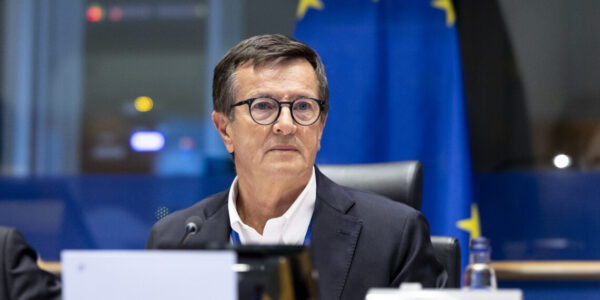
Italian S&D MEP Giorgio Gori told Guildhall that Russia’s actions toward Georgia and Armenia should be recognized as part of a systematic policy of imperial expansion, pursued through legal, military and political instruments.
How do you assess Russia’s recent actions toward Georgia and Armenia?
Russia’s actions toward Georgia and Armenia are deeply alarming and must be called by their real name: a systematic policy of imperial expansion, pursued through legal, military and political instruments.
The ratification of the treaty with South Ossetia is not a bilateral agreement between sovereign states — it is a further step in the slow-motion annexation of Georgian territory, in open violation of international law and of Russia’s own commitments under the 2008 ceasefire agreement.
Putin’s threatening remarks toward Armenia are equally revealing: any country that dares to choose its own path — toward Europe, toward democracy, toward sovereignty — is warned that it will face consequences. This is not the language of a partner. It is the language of an empire that cannot tolerate free choices on its periphery.
Dugin’s writings are not mere academic provocation: they reflect a strategic doctrine that has been consistently translated into action, from Chechnya to Georgia, from Ukraine to Moldova. We must stop treating Russian expansionism as a series of isolated crises and recognize it for what it is — a coherent, long-term project.
What should be the European Union’s response to these developments?
The European Union must respond with strategic clarity and political courage — two qualities that have too often been in short supply.
First, the EU must accelerate and deepen its engagement with Georgia and Armenia, making unmistakably clear that the European path remains open to their peoples, regardless of Russian pressure.
The Georgian people, who have demonstrated their European aspirations in the streets at great personal cost, deserve our solidarity. For Armenia, the EU should intensify its partnership frameworks and send an unambiguous signal that rapprochement with Europe is a sovereign right, not a provocation.
Second, Brussels must develop a genuine neighbourhood security strategy — one that goes beyond trade agreements and visa liberalisation, and addresses the real vulnerabilities that Russia exploits.
Finally, the EU must speak with one voice. Internal divisions — whether driven by economic interests or misplaced notions of “strategic balance” — are precisely what Moscow counts on.
What measures of pressure could be applied to compel the Russian Federation to abandon its expansionist ambitions?
There are no easy levers, and we should be honest about that. But there are effective ones, if the political will exists to use them consistently.
On the economic front, existing sanctions must be rigorously enforced — with particular attention to circumvention routes through third countries — and extended to target the sectors that directly finance Russia’s military capacity.
On the political front, Russia’s continued occupation of Georgian and Ukrainian territories must be kept permanently on the international agenda: no normalisation, no “frozen conflict” rhetoric that implicitly accepts the status quo.
On the energy front, Europe must complete its structural decoupling from Russian fossil fuels — not as a temporary emergency measure, but as a permanent strategic choice, because energy dependence is the single most powerful tool of Russian leverage over European decision-making.
And on the broader normative front, we must actively support — financially and diplomatically — civil society, independent media and democratic movements in the countries under its pressure.
History shows that empires do not abandon expansionism because they are asked politely. They do so when the costs become unsustainable and when the peoples within their sphere of influence choose a different future. Our task is to make both of those outcomes more likely.
Exclusively for Guildhall.
Только главные новости в нашем Telegram, Facebook и GoogleNews!
Tweet