
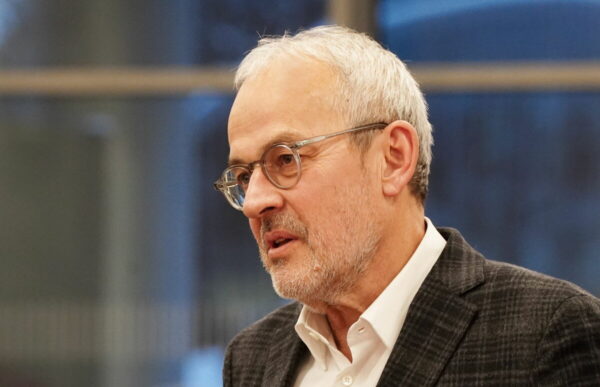
Ukraine’s future in Europe is not only a matter of solidarity with a country at war, but a question of Europe’s own strategic future, Roberts Zīle argues in this interview with Guildhall. The Vice-President of the European Parliament says Ukraine already belongs to Europe politically and geopolitically, while its battlefield experience, resilience, and military know-how could make the European Union itself stronger and more secure. At the same time, he warns that Europe must move faster — in strengthening sanctions enforcement, reducing strategic vulnerabilities, and giving Ukraine a credible path forward — because delay would not only weaken Ukraine, but Europe as well.
— Mr. Zīle, is it already possible to draw conclusions about how the war in the Middle East has affected the European Union, especially its energy security, or is it still too early and we should wait for the situation to unfold further?
— As we are all following this issue, it is clear that it has, at least to some extent, diverted international attention from Russia’s aggression against Ukraine. At the same time, everyone here in Brussels, meaning the European institutions, is closely watching developments in the Gulf. I would say that no one yet has a full answer.
I have also had several discussions with people back home in Latvia. We already see problems, for example for our aviation sector. Companies are under pressure because fuel costs have risen sharply. This creates difficulties not only for airlines, but also for consumers who are already feeling the impact through fuel prices. And, of course, no one yet knows how the situation in the Gulf will end.
Even the one person who should have a clear plan — the President of the United States — keeps making statements that do not clearly show what the strategy is. So we still do not know how this will finish.
What is clear is that we must be ready for higher prices and possibly shortages of some important raw materials, mainly energy-related ones, but also others such as helium from Gulf countries. All of this will affect the global market.
— The European Union is an absolutely strategic and key partner for Ukraine, so I would like to go deeper specifically into the EU and Ukraine perspective on this issue. It is obvious that without energy independence there can be no real defence security. Our armies are still heavily dependent on fossil fuels, and unfortunately I think this dependence will remain for the next 30 or 40 years.
This situation, when the Strait of Hormuz was blocked and Russian troops continued to concentrate on the borders of the European Union, raised an important question for us: does the EU fully realize that energy independence is now directly linked to security? And that in order to protect ourselves, we must be energy secure at least for the needs of our armed forces?
— Of course, I do not have all the information, but I know that there are military planners at NATO headquarters here in Brussels and also in every member state. So I hope that they are taking reserve issues seriously, at least with regard to essential needs.
We also have civilian rules requiring strategic reserves for a certain period, although there are always complications. Sometimes reserves exist more on paper than in reality. I am not digging deeply into that issue, but this crisis is clearly another lesson: even events that do not happen close to us can still have a major impact on us, including from a defence perspective.
I cannot say that everyone fully understands how dramatic this issue is for the defence and security of the European Union, especially for the border countries. But in countries such as the Baltic states, Finland, and Poland, I think they do understand it and are doing the maximum.
I am currently also working in Parliament on the regulation on military mobility. This proposal is meant to remove the many bureaucratic obstacles that still exist for military convoys moving across Europe. We need to finalize it this year. It is not directly about energy, but it is related to energy because if you want troops to move quickly in a crisis, you also need a functioning supply system.
You need hubs with energy resources and other necessary support for the military. We are working on that, and I hope there will be understanding in Parliament, on the government side, and in the Council that this should be fast-tracked. By European standards, “fast-track” means finalizing it within a year. So we will work on it this year. But the whole issue also shows how quickly — or how slowly — important decisions in Europe can move.
— We do have the United States as a partner supplying the European Union with oil. We also have other partners across the globe. But we can see that autocracies, like Iran with the Strait of Hormuz, use leverage against the United States and, in fact, against the entire democratic world that remains dependent on oil from the Middle East. So in one way or another, this dependence on largely non-democratic suppliers creates leverage over the European Union, just as it did in 1973 during the Yom Kippur War.
Do you see any realistic routes for the European Union to get rid of that fossil-fuel dependence, specifically from a security point of view — from the perspective of simply fuelling tanks, jets, and other military needs?
— In the end, armies need diesel and jet fuel, and that means you need oil and functioning refineries. At a minimum, if you have a refinery, it must be supplied with raw materials continuously in order to maintain capacity. This is not a business you can stop overnight and then restart easily once the raw material is gone. It simply does not work that way.
That is why you need a permanent flow of oil or ready-made products. For the European Union, even taking into account Norway and some limited production elsewhere, that is still not enough to cover what would be necessary for Europe’s broader military needs.
So we are dependent on countries that are not always democratic — Gulf countries, for example. We also see difficulties with contractual obligations and supply flows. Some countries are looking to Algeria and others as alternatives. But I have been informed that in countries like Algeria, political arguments are also used in energy pricing and conditions. Governments seen as being on one side of the Middle East conflict may be treated differently from governments seen as being on the other side.
So we have to understand that countries with fossil-fuel resources that Europe still needs for its security and civilian life will, unfortunately, play political cards from time to time. Europe must be ready for that.
— Mr. Zīle, Iran is not only a partner of Russia — Russia is also a partner of Iran. It seems to me that this is especially true when it comes to the Iranian nuclear program, which has been heavily supported by Rosatom, the Russian state nuclear corporation. This is slightly beyond our core topic, but do you share that assessment, or am I wrong?
— There is some information coming from reliable media that Russia may have supplied Iran with intelligence information. If that is true, it is obviously bad news, especially for the United States, because it could give Iran better opportunities to target what it wants to damage.
I do not know whether that is true or not. But if it is true, then of course it should be noticed both by the United States and by the European side, and lessons should be drawn from it.
At the same time, we also hear voices at a high political level in some EU member states saying that perhaps Europe should rethink its position and start buying Russian fossil energy resources — oil and gas — again. That is how Europe works. It is a union of 27 democracies with different political leaderships. And democracy is not always the fastest or most rational way of ruling.
— But still, as Churchill said, democracy is not perfect, yet it is the best we have. It is still the only way.
— I agree. I am definitely on the side of democracy.
And sometimes democracy works well. For example, elections can remove politicians — even quite autocratic ones — from power quickly and in a democratic way. So yes, democracy can also perform well.
— You have already described part of the issue. But there is also a second part: by supporting Iran, including its nuclear ambitions, Russia has effectively helped create the conditions that led to this war. If there had been no Iranian nuclear issue, there might not have been a war against Iran. So Russia has, in a sense, helped create the cause of the conflict. Do you think Russia is now trying to use this war — and the energy crisis around it — specifically against the European Union?
— I think Russia is applying pressure on many different levels, including through elements of hybrid warfare against the European Union. That is clear.
We are not naive about this, especially in Eastern Europe, or in what we now often call the eastern border countries — those close to Russia and Belarus. We are not naive. But sometimes, the farther you are from Moscow, the more likely it is that some ruling parties in Western Europe remain, at least to some degree, naive.
— Do you think Russia really wants peace in its war against Ukraine? There have been multiple rounds of negotiations, including with US participation. What is your view? Does Russia genuinely want peace, or at least some kind of settlement?
— No, of course not. I think Russia wants victory over Ukraine. Everything depends on how far Ukraine allows Russia to go. Ukraine’s heroic resistance has prevented Russia from achieving even what it presented as a minimum goal, including full control over the four so-called occupied regions.
That shows Russia still cannot present even a minimal version of victory. And that is why I believe Putin’s administration will continue the war in order to try to deliver something that can be sold as success.
The only thing Europe can really do is increase pressure. The European Union is not in a position to organize negotiations the way the United States can. At least for now, those negotiation efforts seem to have stopped, or almost stopped, judging from public information. The EU is not likely to be in a position to organize similar negotiations between Ukraine and Russia. Ukraine might be ready, but I do not think Russia has any reason to accept the EU as an intermediary, because I believe it has very different plans regarding the European Union itself.
— I fully agree that Russia is not moving willingly toward a settlement. So we come back to the formula “peace through strength,” right? It seems that this is the only way to force Russia toward peace. And I personally believe that the European Union plays an absolutely crucial role here, especially at a time of crisis in global political leadership.
So let me ask the main question of this conversation: what leverage does the European Union still have that could and should be applied to Russia in order to create the necessary pressure?
— I think there are at least two instruments that Ukraine has been waiting for for a long time. One is a major financial package for Ukraine, which has been blocked by the Hungarian government. The second is the 20th package of sanctions, which also, in my view, should move forward very soon.
These two issues should finally be resolved for Ukraine’s needs. It means providing the financial blood flow needed for Ukraine’s economy, for the military sector, and for civilian life. And on sanctions, we have to keep moving toward stronger positions in the future.
Economically, this is our main instrument of influence on Russia. At the same time, Europe must continue strengthening the military capacities of its member states’ armies — not a “European army,” but the armies of member states within the NATO framework.
Whatever one thinks about the current instability, including statements coming from the US administration in the context of the Gulf crisis and other issues, the United States remains the crucial partner in NATO. This is recognized by the absolute majority of member states, especially those closer to Russia. That is a crucial point.
— During the Soviet era, one of the key aims of Soviet intelligence was to push the United States out of Europe — to undermine the transatlantic relationship. And today, unfortunately, that logic still matters. So we definitely have to resist it and strengthen our cooperation. There is no other way.
The United States is also a partner in the sanctions regime and a partner both for the European Union and for Ukraine. If we speak about EU sanctions against Russia, which do work to an extent, I have noticed a significant gap between the number of identified cases of sanctions circumvention — several thousand, according to various investigations — and the number of real criminal cases, which is tiny by comparison. So what is the problem? Is it enforcement? How do you see it?
— Yes, of course, it is a problem of enforcement, because enforcement happens at the level of the member states.
Take our situation as a border country with Russia and Belarus. We have freight flows to customers at the borders, and they are checked. Sometimes sanctioned items are found — goods sent by somebody from the West through our territory. Then law-enforcement action should follow. But I am not conducting investigations myself, and I cannot say that the result is always guaranteed.
In Latvia, for example, we are pushing the government because Latvian business still trades with Russia. It has decreased, but it is still significant. And we would like to go further even on a bilateral basis.
At the same time, some in the Latvian business community say: why should we stop even unsanctioned goods if other EU countries, such as Poland or Germany, will simply continue serving those same markets? In other words, our companies would lose business while others would benefit.
That is precisely why member states must set an example and take serious decisions not to help the Russian economy. That is how it should be done.
At the EU level, sanction lists are complicated from a business point of view. Names can be removed, schemes change, and then there is also the shadow fleet and similar mechanisms.
— But there is also the EU-level prosecutor’s office, whose powers in sanctions cases seem rather limited. Do you think there is a need to look again at the powers of the European Public Prosecutor’s Office in this area?
— It is not an easy question, because it would mean that member states give part of their legal authority to the European level. That has already been a very difficult debate both in Parliament and among governments.
As far as I know, the European Public Prosecutor’s Office is currently focused mainly on crimes involving EU money and the misuse of EU funds. I am not a lawyer — I am a politician and an economist — so I do not want to go too far. But as far as I understand it, they are not currently focused on sanctions-related cases as such.
They are active, certainly. But if we are talking about giving Brussels more power to prosecute companies that still send sanctioned goods to Russia, I think many member states — whether we are talking about enterprises from Germany, Poland, or elsewhere — would not be very ready to hand that power over to Brussels.
— I appreciate your answer, because this gap is indeed a serious issue, and it does need discussion. I believe that through joint efforts we can find ways to create that additional pressure.
Let me finish with a broader question. Ukraine is now trying to define its strategic place in Europe and in the world. Some say Ukraine should become a kind of NATO outpost in Eastern Europe, others formulate it differently. From your personal point of view, what should Ukraine’s place be in relation to the European Union while it is on its path toward membership?
— My opinion — and I think this reflects the majority view in Parliament — is that there is majority support here for Ukraine’s accession to the European Union, and not sometime in the distant future, but as quickly as possible. We will maintain this political will in Parliament as much as we can, especially MEPs from the Baltics, Finland, Poland, and others.
Of course, there may be issues related to financial resources, spending, agricultural policy under current EU rules, and some other matters. There may need to be transitional periods or legal arrangements. But the essential point is political and geopolitical: Ukraine is no longer in Russia’s sphere of influence. Ukraine belongs to Europe.
At the same time, in my opinion, the defence of the European Union would gain significantly from Ukraine’s accession. The knowledge and skills that Ukraine has acquired in this very painful and difficult war — especially in drone warfare and modern warfare more broadly — are incomparable.
Even in Brussels, we have seen how vulnerable Europe still is to such threats. That only underlines how valuable Ukraine’s experience is for Europe.
So this is also Ukraine’s path to Europe. And I still think that if Europeans delay too long in delivering that path, public opinion in Ukraine could begin to change. That would be a very bad situation.
So we in Europe must do our own homework and preserve a strong sense that Ukrainians belong to Europe.
— By our joint efforts, we will do everything to make that public opinion in Ukraine stronger, not weaker. Mr. Zīle, thank you very much for this insightful and important conversation. We would be glad to speak with you again.
— Thank you very much. Good luck.
Exclusively for Guildhall.
Только главные новости в нашем Telegram, Facebook и GoogleNews!
Tweet