
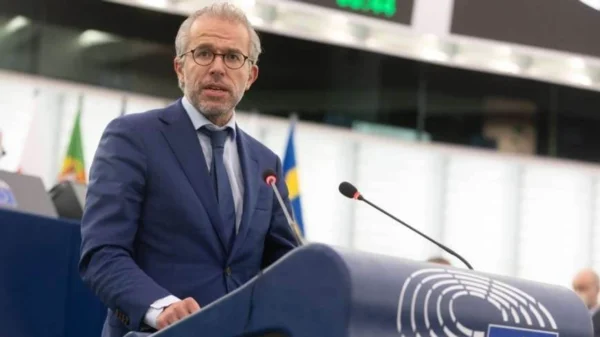
In an interview with Guildhall, Dutch MEP Thijs Reuten said weak enforcement remains one of the key problems of the EU’s sanctions policy against Russia, but stressed that the issue goes beyond prosecution alone. Companies, he argued, must not hide behind formal legality if there is a real risk that dual-use goods exported via third countries will ultimately end up in Russia and be used against Ukraine.
— I came to that conclusion from the gap between the number of sanctions violations and the number of actual criminal convictions. There are thousands of violations, but only a few dozen real convictions. Of course, that encourages Russia and its partners to keep doing what they are doing. This is my assessment, and I may be wrong, so I would appreciate your view and any thoughts on how this could be improved.
— On the latter, I am not sure I have a straightforward solution. But although your basic research is based on 2024 data, I do not think there is much reason to be optimistic about the current situation either. There are a couple of problems.
Generally speaking, there is a problem with the enforcement of sanctions across the board — from broad sectoral sanctions to individual ones. Sanctions targeting persons, such as travel bans or restrictions on personal assets, are probably enforced best, largely because they are also the easiest to enforce. You can flag someone in the system and make it very difficult for them to travel or carry out transactions.
But if you look more closely, as you did for 2024, you see that prosecution itself is clearly part of the problem. The question is whether governments in different Member States actually have sufficient prosecutorial capacity to pursue these cases, because there is clearly a gap between obvious cases of sanctions evasion and circumvention, on the one hand, and actual prosecution, on the other.
Then there is the issue of evidence. Why is prosecution so difficult? Because you need solid evidence that will stand up in court and lead to a successful conviction.
The third element is the chance of getting caught. That is not only a matter of enforcement in the narrow sense; it is also a broader problem across society and among the organisations that continue to circumvent sanctions and keep trying. If the chances of getting caught are too low, that becomes an incentive in itself to continue. People think: yes, maybe there is a chance I will be caught, but it is not that high, so let us take the risk.
And the last point I want to make is the moral issue. I must be honest: I am fed up with the number of companies in EU Member States that continue to export while knowing full well that, yes, exporting to Kyrgyzstan or Kazakhstan may formally be legal, but they know perfectly well that those goods may ultimately end up in Russia, including in products or weapons.
What I am tired of is the lack of moral standing among those companies. Regardless of whether something is formally legal or illegal, they should ask themselves: what exactly am I doing? Because we are collectively trying to resist Russia’s aggression and support Ukraine as much as possible.
At the same time, I also want to be fair. There are companies that do take responsibility. They scrutinise their trade relations carefully, seek legal advice, and say: even if this is technically legal, we do not want to do it because we do not want to risk contributing to this. So there are responsible companies too.
But I am tired of the atmosphere in which some people say: yes, but we also have to think about our business interests. Of course business matters — but this is of a different order. We are together trying to confront Russia’s aggression and support Ukraine. And this becomes even more important when we see that, for example, the United States, instead of tightening sanctions, is easing them.
— So in that case, it still comes back to a mechanism that would make it possible to prove at least whether a company knew — or, if that cannot be proven, whether it should have known. So again, it comes back to the mechanism.
— Yes, but I want to separate two things.
One is the legal track. And yes, that requires a great deal of work. You have to investigate, gather evidence, and prove before a court that the company could have known it was acting contrary to the sanctions regime, and that there actually was a sanctions regime covering those goods. That is the legal part. I understand that it is difficult, and I do not expect it to be solved easily. It will remain complicated.
But there is another side to this. My point is also that companies themselves must take responsibility. They must scrutinise their own relationships and trade links. If something is clearly prohibited under the sanctions regime, then there is no discussion — and then, yes, we still have the problem of prosecution, convictions, fines, and so on.
But there is also a bigger problem: a large number of goods, as we know, are dual-use goods that may not even be illegal to export. Even then, companies should still ask themselves what their responsibility is.
What is my responsibility as a company that relies on the freedom and stability we have in Europe — and relies on our collective effort to support Ukraine and defeat Russia’s aggression? What is my responsibility as a company enjoying that freedom and stability when it comes to doing everything possible to ensure that dual-use goods, which may formally be legal to export, do not end up in weapons used against Ukraine?
That is my simple answer — and also my simple call to all European and non-European companies trading in goods that may still be legally exportable: they must ask themselves what the chances are that those goods ultimately end up in Russia.
Exclusively for Guildhall.
Только главные новости в нашем Telegram, Facebook и GoogleNews!
Tweet