
Russia’s repeated claims that it is ready to end the war against Ukraine should not be taken at face value, Czech MEP Veronika Vrecionová argues in this interview with Guildhall. She says Moscow is using negotiations tactically — to buy time, consolidate territorial gains, weaken Western unity, and test how far support for Ukraine can be eroded — while the current escalation in the Middle East is creating additional strategic advantages for the Kremlin by diverting attention and straining Western military resources.
Vrecionová also argues that the West already has the necessary tools to raise the cost of Russian aggression, but has not yet used them with sufficient strength, consistency, and political will. Vrecionová is a Czech MEP from the European Conservatives and Reformists Group, serves as Chair of the European Parliament’s Committee on Agriculture and Rural Development, and is a member of the ECR Group Bureau.
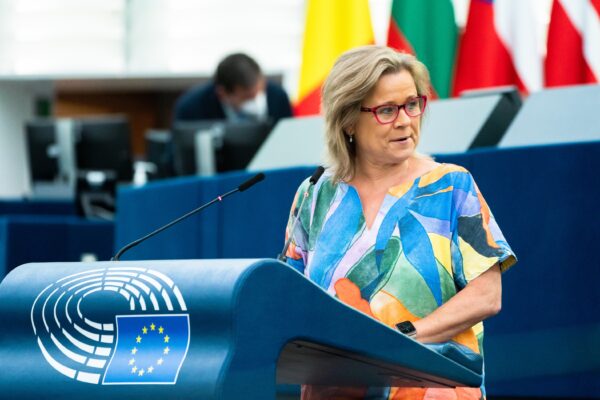
— On the fourth anniversary of Russia’s full-scale war against Ukraine, a negotiation process initiated by the United States is ongoing. The Russian Federation claims it is ready to end the war. Based on your assessment of Russia’s actions, do you see genuine readiness on Russia’s part to stop the war?
— Russia’s behaviour leaves little room for illusion. Similar declarations about readiness to negotiate or end the war have been made repeatedly in the past, yet they have consistently been followed by further escalation rather than any meaningful steps towards peace. This pattern speaks for itself.
— In your view, is Russia using the negotiations to pursue other objectives?
— Russia is clearly using negotiations as a tactical tool rather than a genuine path to peace. Its aim is to buy time, consolidate territorial gains, and weaken Western unity, while also testing how far support for Ukraine can be eroded and shaping public opinion in Europe. In reality, negotiations have become just another instrument of its war.
— How do you assess the impact of the armed conflict in the Middle East on the Russia–Ukraine war? In your view, could Russia gain any advantages from this escalation — for example, by diverting attention away from Ukraine and reducing support for Ukraine?
— Escalation in the Middle East creates clear strategic advantages for Russia, as it diverts political attention, particularly in the United States and parts of Europe, away from Ukraine. It also puts additional pressure on Western resources, including critical military supplies such as ammunition and air defence systems needed by Ukraine. At the same time, Russia exploits the situation in its information campaigns, portraying the West as selective in its commitment to international law. In effect, any fragmentation of attention, resources, and political unity works to Russia’s advantage, and the current escalation contributes directly to that.
— Historical experience suggests that an aggressor is typically compelled to end a war either by military means, economic means, or — most often — by a combination of both. The West has supported Ukraine extensively militarily and economically, yet Russia shows no intention of ending the war. In your view, what additional tools does the West have that have not yet been used to compel Russia to make peace?
— The issue is not that the West lacks tools, but that it has not used them with sufficient strength and consistency. Sanctions remain incomplete and too easily circumvented, particularly in energy and dual-use goods. Enforcement must be significantly tightened, and loopholes systematically closed. At the same time, support for Ukraine needs to be stronger, more predictable, and long-term. Only a sustained combination of tougher economic pressure and more decisive military backing will increase the cost of aggression for Russia.
— The current scale of military assistance to Ukraine appears sufficient primarily for defence. Do you see prospects for a sharp, substantial increase in EU military support for Ukraine? What would be required to make that possible?
— A substantial increase in EU military support is possible, but it ultimately depends on political will. Europe has the capacity but has been too slow to act. What is needed is faster defence production, better coordination, and long-term commitments. Without this, support will remain sufficient only for defence rather than changing the situation on the ground.
— In terms of pressure, it is widely noted that roughly 60% of Russia’s state budget depends on hydrocarbon revenues. What additional instruments does the European Union have to increase pressure on Russia’s oil and gas sector?
— The EU still has significant leverage over Russia’s energy revenues, but it is not using it fully. The priority should be stricter enforcement of existing measures, particularly the oil price cap, and closing loopholes that allow indirect imports via third countries. At the same time, the EU should further reduce any remaining dependence on Russian fossil fuels and target shadow fleets and intermediaries that help circumvent sanctions. As long as energy revenues continue to flow, Russia retains the means to sustain its war.
— Has the European Union defined what “victory” means in this war? Has such an objective been formally articulated and adopted?
— The European Union should not be the one defining what “victory” means. This is for Ukraine to decide. Our role is to support Ukraine in achieving a just outcome on its own terms, and to stand firmly behind it for as long as it takes.
Exclusively for Guildhall.
Только главные новости в нашем Telegram, Facebook и GoogleNews!
Tweet