
Against the backdrop of threats surrounding the Strait of Hormuz and new risks to global energy supplies, Europe is becoming ever more acutely aware of the link between energy and security. The EU has already paid a high price for its dependence on external suppliers and must now accelerate its energy autonomy, develop interconnections, diversify supplies, and at the same time seek a long-term alternative to fossil fuels.
This was stated in an interview with Guildhall by Irish MEP Barry Andrews, a representative of the Renew Europe Group.
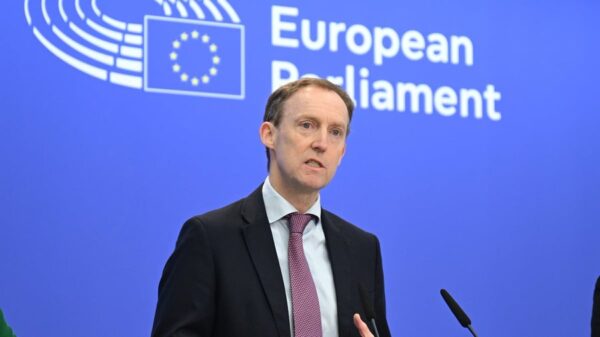
— The situation around the Strait of Hormuz has once again highlighted the West’s vulnerability due to its dependence on energy supplies, mostly from non-democratic countries. If we look at this specifically from a security perspective, can it be said that without energy independence there can be neither security nor defence? Do Europe’s political elites understand this?
— Yes, absolutely. When my professional career began after college, my first job was teaching history. And anyone who has studied the history of the last hundred years knows that energy and security are closely linked. A huge number of conflicts over access to energy resources have taken place during that time.
So this link is absolutely obvious. And in Europe, this is understood very well. A very bad bet was made on Russian hydrocarbons, and it turned out to be a serious mistake.
Since the Green Deal was launched, and then after the illegal invasion of Ukraine, Europe’s drive for energy security has, if I may put it that way, been sharply accelerated. And this issue is directly connected to security as such.
If one looks carefully at the broader security picture in the European Union, it becomes clear that another bad bet was made as well — on American security guarantees. And these two mistakes are now coming back to haunt Europe. That is why Europe is moving very actively towards energy autonomy. And this is directly linked to the question of protecting the borders and ensuring the security and defence of the European Union.
Very recently, there was a meeting at which these connections were discussed with NATO representatives and with those working on synthetic fuels. In addition, work is under way as one of the negotiators on the next Connecting Europe Facility — a €30 billion fund intended to improve energy infrastructure across the EU. And security will be closely linked to that process.
— If we look specifically from a military perspective — through the need to fuel tanks and aircraft in the event of war in Europe — what changes should European energy policy undergo?
— A whole range of legislative initiatives is currently passing through the European Parliament and the Council of the European Union. In essence, Europe is making a bet on electrification — in households, in industry, in heating, and in transport. This is the conceptual foundation for the modernisation of Europe’s energy grid.
The point is constantly made that the transition from fossil fuels to renewables is impossible without the development of electricity transmission. This is about the ability to move electricity across the entire EU.
Where Ireland is located, far to the west of Europe, out in the Atlantic Ocean, there are some of the strongest offshore winds in the European Union. And very often the wind is there, but there is nowhere to sell that electricity because interconnections are insufficient.
The same is true in southern Europe, where the potential for solar energy is enormous. But those countries also cannot constantly use all the electricity they generate. If a truly interconnected grid can be created across the entire EU, then it will be possible to radically change the energy map of Europe, deepen energy autonomy, and sharply reduce the vulnerability associated with dependence on regions where conflicts occur constantly.
This is truly one of the most important issues, and it is a good thing to be able to participate in this legislative process in the European Parliament.
— We remember 1973 and the Yom Kippur War, when countries that supported Israel were hit by an oil shock from Arab states. Today, a similar risk is back on the table. But the green transition is a long-term perspective, not a short sprint. What can be done in the short and medium term specifically for the needs of the military and security?
— Yes, that is a fair point. The year 1973 is remembered very well — I was six years old then, and I still remember queuing for petrol with my father.
And just the other day there was a conversation with a supplier of heating fuel, because at home we use oil-fired heating. They said people are calling in tears, dipping into their savings to pay for heating oil. So almost sixty years have passed, and yet the same themes keep returning.
From a military point of view, Ukraine’s experience is especially tragic, because Putin is deliberately striking energy security. It is an obvious war crime and at the same time a very clear scenario for Europe: if an attack were to happen, how vulnerable would Europe itself and its energy infrastructure be?
Europe has almost no reserves of fossil fuel of its own. There are some refining capacities, but there are no hydrocarbon reserves comparable to those in Russia or the Gulf states. That is why synthetic fuel is now being actively discussed in the military context.
For example, for an F-35 fighter jet to fly for two hours, around eight tonnes of fuel are required. The scale of consumption is enormous. But synthetic fuel has one important advantage: its production can be distributed across many sites rather than concentrated at a single refinery, which is an obvious target for attack.
There is also a major discussion about hydrogen and its possible role as an alternative fuel source. But these are, in reality, medium- to long-term solutions. That is why Europe is now trying to expand gas storage, liquefied natural gas storage capacity — that is, LNG — and to diversify supplies, including towards Central Asia and other regions with which such close commercial relations in fossil fuels did not previously exist.
In addition, a significant share of LNG imports comes from the United States. And that reality cannot be avoided for now: fossil fuels will still be necessary for some time, especially for military security. Precisely military security — because of the vulnerability so tragically demonstrated in Ukraine’s case.
— There are democratic countries in the West — Norway, Canada, the Netherlands, the United States, Brazil and others — which, according to a number of studies, are able to increase oil and gas production. To what extent can that be a solution in the short term?
— It can only be a short-term solution — and nothing more. Because it is necessary to think not only about the current crisis, but also about medium- and long-term vulnerability. The year 1973 has already been mentioned, and now we are effectively experiencing the same thing again in 2026.
If Europe continues to invest in fossil fuel infrastructure in the medium and long term, that will simply lock in this vulnerability for future generations. There is now an opportunity to move towards electrification. And the wrong signals must not be sent to the market, nor the wrong incentives created, as if Europe were prepared to take a step backwards.
But if we speak specifically about the military sphere, there is a separate argument here. For example, military emissions are not counted in the same way as civilian ones. And it is very important to preserve that carve-out. The army’s contribution to overall emissions reduction should not be overstated.
I recently came across figures showing that the French Air Force uses roughly one tenth of the fuel consumed by Air France. So this is not about a massive share in climate terms, but above all about the vulnerability that needs to be addressed. That is why diversification of supply is so important.
And that is precisely why synthetic fuel is of such interest — as a way to distribute production and thereby reduce dependence on one major refinery, which is clearly a vulnerable target.
— And the final question concerns nuclear energy. It is a clean source of energy, but over the past 30 years its role has noticeably declined for various reasons. Today some European politicians say that Europe should once again seriously rely on nuclear energy. What do you think about that?
— Nuclear energy is sometimes discussed as though building a nuclear plant were like setting up an ordinary oil refinery. But it is far more complicated, much more expensive, and much more long-term. There are practically no examples of nuclear power plants being built strictly on time and within the original budget. We are talking about a horizon of ten years or more.
But that does not mean that nuclear energy has no role to play. It is obvious that for a number of EU member states, nuclear power is almost a matter of faith. And that must be respected.
At the same time, it is important to look at technological development. Small modular reactors are undoubtedly part of the solution — there is no doubt about that.
For example, Ireland effectively buys electricity generated by nuclear power, while domestic legislation does not allow such electricity to be generated on Irish territory. That looks rather hypocritical: using nuclear electricity is acceptable, but hosting such generation at home is not. That position can hardly be considered sustainable in the long term.
Moreover, without nuclear energy, it will most likely not be possible to achieve emissions reduction targets. That is, in essence, a widely understood fact. But at the same time, it is necessary to take into account how expensive it is and how long-term a solution it is. Therefore, Europe must continue to very actively develop renewable generation, while in the military sphere it must simultaneously continue to work carefully on the issue of synthetic fuel.
— Well, all that remains is to wish that the path towards energy independence and security proves successful. Mr Andrews, thank you once again for your time and for this substantive conversation.
— It has, as always, been a pleasure for me. And I want to wish you safety. What you are doing for your people and for Europe as a whole is deeply appreciated. And I hope that the day will come when, together with colleagues in the European Parliament, we will be able to stand shoulder to shoulder in Ukraine.
Exclusively for Guildhall.
#Barry Andrews #Defense #energy #energy security #EU #European Parliament #Ireland #nuclear power #Renew Europe #Strait of Hormuz
Только главные новости в нашем Telegram, Facebook и GoogleNews!
TweetЧитайте также
-
Foreign Affairs Committee Chair McAllister: Kremlin’s Breaches of Neighbours’ Sovereignty Undermine European Security -
MEP Gori: Russia’s Pressure on Georgia and Armenia Is Imperial Expansion -
MEP Verougstraete: Russia Views Its Neighbours as Territories Within Its Sphere of Influence -
MEP Bloss: Europe Must Cut Kremlin Energy Money to Defend Georgia and Armenia -
The European Public Prosecutor’s Office Should Ensure a Unified Approach to Sanctions Cases — Danish MP -
European Parliament Supports Expanding the Powers of the European Public Prosecutor’s Office -
Powers in Cases of Sanctions Violations Should Be Fully Transferred to the European Public Prosecutor’s Office — MEP -
EU Should Expand Powers of Special Prosecutor for Sanctions Cases — Lithuanian MP -
Thijs Reuten: Even legally exportable goods must not end up feeding Russia’s war machine -
Nicolae Tibrigan: Romania’s far-right AUR could gain de facto power without entering government