
Europe’s energy independence is impossible without the accelerated development of nuclear energy, as reliance on fossil fuels will not eliminate the EU’s external vulnerability.
This was stated in an interview with Guildhall by Atte Harjanne, a member of the Finnish Parliament.
In the interview, he stressed that the EU must rapidly expand its own low-carbon generation capacity, develop wind, solar and synthetic fuels, and reduce dependence on the global oil market, which continues to finance the war economies of authoritarian regimes.
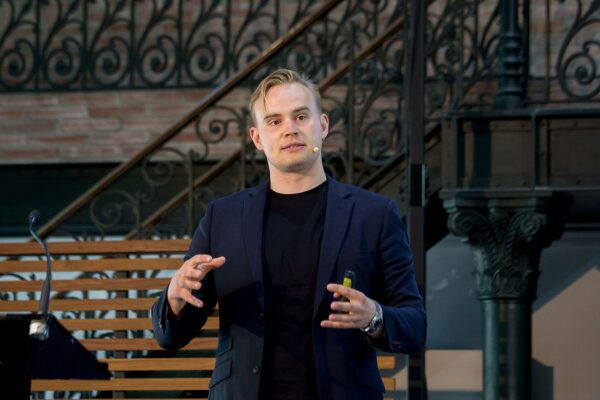
— What concrete steps should Europe take in the next 3–5 years to achieve greater energy independence and reduce its vulnerability to external energy shocks?
— The key step should be a sharp acceleration of the energy transition. The war around Iran has once again shown the scale of the problem, but it is also important to understand something else: every drop of oil still consumed in the world ultimately helps Russia sustain its war economy.
So this is not only about our own energy independence, sovereignty and security of supply. Accelerating the global transition as a whole is also in Europe’s interest.
— And what exactly should Europe do to avoid, for example, helping Russia earn money for the war?
— Of course, all sanctions must be maintained and intensified. Measures against the shadow fleet and sanctions evasion schemes must also be expanded. But the problem is that as long as global demand for oil remains high, and if the Strait of Hormuz comes under threat, fossil fuels immediately become more expensive on the global market. That is bad for both Europe and Ukraine.
So sanctions are only part of the answer. It is equally important to reduce demand for oil itself, because the economic power of oil continues to sustain such regimes.
— What changes in EU and national energy policies are needed in the coming years to strengthen energy independence? And should Europe reconsider the balance between decarbonisation, affordability, industrial competitiveness and security of supply?
— I believe decarbonisation should go hand in hand with the rapid expansion of wind, solar and nuclear power. It is very important to preserve a strong emissions trading system. But at the same time, Europe needs to pool resources and simplify regulation in the field of nuclear development, while also investing much more actively in small modular reactors.
The level of ambition needs to be significantly higher. Europe must ensure that new low-carbon generation capacity is built faster and faster.
Part of that effort must also be the ability to produce synthetic liquid fuels. That, of course, requires primary energy — meaning even more wind, nuclear and solar power. But this is exactly what can gradually decouple transport, aviation and the military from imported oil.
That is why synthetic fuel production is one of the truly important pathways, and it needs to be scaled up quickly. This once again underlines how critical it is to expand Europe’s own energy production.
— How do you assess the idea of increasing domestic oil and gas production in Western countries as a way to strengthen energy security, reduce exposure to geopolitical disruptions, and support defence and industrial resilience?
— If we look at Europe as a whole, there simply are not many available resources. The situation is different in the United States, but in Europe there are very few reserves that would be economically viable to develop, for example through fracking. That would require huge investments and would cause serious social problems.
Investing in Europe’s fossil energy systems is a dead end. There is also another danger: if Europe falls even further behind China in clean energy technologies, we will ultimately become dependent first on imports of fossil fuels and then on China in the field of clean energy.
So Europe must build its own capacity to create a decarbonised energy system as quickly as possible.
— And if we are talking not only about the EU, but, for example, the United States or Latin American countries: could they increase oil and gas production to help Europe and the world?
— I doubt it. From what can be seen now, the current US administration is not something Europe can rely on in this matter. One would like to count on support from the United States and its administrations, but I would not build a strategy around that. I think people in Ukraine understand that very well too.
As for other countries, the problem is that the climate crisis has not disappeared. Maintaining a global economy based on fossil fuels ultimately still strengthens the position of countries such as Russia and Iran, while also preserving the strategic importance of the Middle East, because that is where a large share of oil production is already concentrated.
That is why any global move away from dependence on fossil fuels benefits Europe in many ways. This must remain the main direction.
— But if a serious security crisis arises, should Europe rely primarily on long-term transition goals, or on energy sources and infrastructure capable of delivering controllable, immediate and scalable output under pressure?
— If we are talking about very short-term solutions, then any sources may be considered — but only if they do not undermine the rapid course toward decarbonisation.
We have historical examples showing that rapid change is possible. After the oil crisis of the 1970s, France built almost 60 nuclear reactors in about 15 years. Denmark, after that crisis, effectively created an entire wind power industry.
So it is important to understand that this will not deliver results in a week, a month, or even a year. But this is precisely the strategic task that must begin immediately, alongside improvements in energy efficiency and the search for alternatives in those sectors where fossil fuels are still needed.
But those can only be short-term solutions. Nothing done in that direction should come at the expense of strategic decarbonisation efforts.
Exclusively for Guildhall.
Только главные новости в нашем Telegram, Facebook и GoogleNews!
Tweet