
Russia is not demonstrating any real readiness to end the war and is using negotiation rhetoric as cover: in the European Parliament, it is believed that Moscow is systematically lying — both before the start of the full-scale invasion and now — while in the Russian public sphere the discussion is not about peace, but about “sovereignty” and war as part of state identity. Against this backdrop, the European Union (EU) emphasizes the need to continue supporting Ukraine while at the same time increasing pressure on Russia through sanctions, including personal restrictions, as well as through preventing sanctions circumvention — above all in the oil and gas sector, including efforts against the “shadow fleet.”
Particular attention is being paid to expanding military assistance under the “Danish model” — cooperation between the defense industries of EU countries and Ukraine’s defense sector — as well as deepening cooperation in the digital sphere and cybersecurity. Another important direction mentioned is countering Russian disinformation, including systematic efforts to bring information into Russia itself.
This was stated in a major interview with the Guildhall news agency by Member of the European Parliament Helmut Brandstätter.
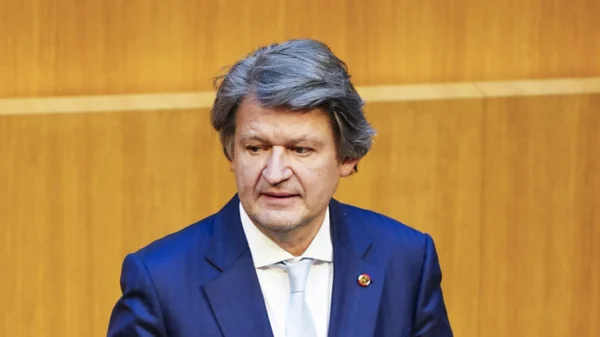
Mr. Brandstätter, good afternoon. Thank you for joining us.
— Good afternoon. Thank you very much for the invitation.
Against the backdrop of the anniversary of Russia’s full-scale war against Ukraine, the negotiation process initiated by the United States is continuing. The Russian Federation claims it is ready to end the war. Based on Russia’s actions, do you see any signs that Moscow is genuinely prepared to stop its aggression?
— To put it plainly, Russia is lying. It was lying even before the full-scale attack on Ukraine four years ago — when it insisted there would be no invasion. Some of its “mouthpieces” in Europe repeated the same line.
Now, four years later, there is still no sign of peace in Russia’s information space. Russian media are not talking about peace, but about “sovereignty” and about Russia supposedly being “better than others.” Moreover, one of the propagandists, Vladimir Solovyov, has even said that Russia supposedly “needs war” for its own identity. It sounds sick, but that is exactly how it is being framed.
So the conclusion is clear: the overwhelming majority in the European Parliament must continue to support Ukraine by every available means — without hesitation. At the same time, Americans must be persuaded that they, too, have to support Ukraine, because that support, as is well known, no longer looks the way it once did.
There is also no confidence in U.S. special envoy Witkoff: he comes without an interpreter and relies on Putin’s interpreter. What can he possibly understand in such a situation? He could not even name the four Ukrainian regions — and that is very telling. The impression, therefore, is that Europe is now being left on its own. Ukraine is part of Europe, and action must be taken together.
Do you believe Russia is using the negotiation process to pursue other goals?
— Yes. The key objective, it seems, is “deals.” In this context, Kirill Dmitriev is mentioned — a figure from the financial bloc who is described as being close to Putin. According to available information, he is also in Geneva and is precisely the one promoting such “arrangements.”
President Trump likes to present himself as a “dealmaker.” And when the word “deal” is used, it often means money. The main risk is that a certain logic may emerge: “There are territories in Ukraine — let us divide them up among ourselves, or among companies from Russia and the United States.” This must be watched very carefully, and it must be explained clearly. First, this is about Ukraine, and no decisions can be made without Ukraine. Second, Russia must ultimately pay for the destruction.
During numerous trips to Ukraine, it has been possible to see the scale of the devastation firsthand. Ukrainians, of course, know this better than anyone. But it is important that this is also understood in the United States. A couple of years ago, estimates of the damage were already being voiced in the hundreds of billions of dollars — around $500 billion. Now it is obvious that the figure is even higher. And, of course, Russian assets in Europe must be mobilized — a discussion about this is inevitable.
History shows that an aggressor is usually forced to end a war either by military means, by economic means, or — more often than not — by a combination of both. The West supports Ukraine with military and economic resources, but Russia shows no intention of ending the war. What additional instruments still remain at the West’s disposal that have not yet been fully used to force Russia toward peace?
— Sanctions are already in place, and the 20th sanctions package is being prepared. Economic sanctions matter. Those who say sanctions “do not work” are mistaken: they do. If one listens to the head of Russia’s central financial bloc, she herself acknowledges that sanctions matter.
The next step is crucial: broader personal sanctions are needed. It is hard to understand why the sons and daughters of people involved in war crimes are still able to study and live in Europe, enjoy carefree lives, and at the same time mock the tragedy unfolding in Ukraine. That must stop.
Another point is that as long as many Russians still have the opportunity to travel to Europe, the price of the war is felt less acutely inside Russia. If those opportunities are reduced, more people will begin to understand the consequences.
There is also another avenue, one that has been discussed, among others, with representatives of the Russian opposition: systematic work must be built to get information into Russia. Russia spends billions on disinformation in Europe, and unfortunately a considerable number of Europeans believe Russian lies. What is needed is not disinformation, but information — and it must be spread.
This could involve creating a kind of editorial office or information center that would prepare materials for audiences inside Russia. Yes, the Kremlin tries to restrict access to Telegram, but there are ways around this — for example, VPNs and other means of access. Ukraine also has plenty of people who speak Russian, and that is a practical resource as well.
The task is to convey to at least part of the Russian audience what Russian troops are doing, how they treat people, and what is happening to the soldiers themselves. It is enough to see how officers treat their subordinates: soldiers are treated as expendable material. Of course, it is impossible to reach everyone. But two steps appear essential: expanding sanctions to cover a much larger number of Russians and building systematic efforts to inform people inside Russia.
Assuming that the current scale of military assistance to Ukraine is broadly sufficient for defense, do you see any prospects for a sharp and substantial increase in EU military support? And what would be needed to make that possible?
— There is disappointment with Chancellor Merz: during the election campaign he promised Taurus missiles, but now there have been no deliveries — that is one point.
But there is also a positive example. In Copenhagen, it was possible to hear about the so-called “Danish model.” The idea is that the Danish defense industry works together with the Ukrainian defense industry. Ukraine’s defense sector is strong and is becoming even stronger because of the experience Ukraine is being forced to gain in war. The “Danish model” needs far more active support, and it would be good if more countries followed the same approach.
It is also important to expand cooperation in the digital sphere. Even back during work in the Austrian parliament, advice was once given to one of the relevant officials: “Go to Kyiv — there is a great deal to learn there.” At the time, this was not believed, but after the trip it became clear that there are areas in which Ukraine is ahead. This is also directly linked to resilience against cyberattacks. Cooperation here could be developed much more effectively.
In the context of pressure on Russia, it is well known that a significant share of the Russian state budget depends on hydrocarbon revenues. What additional instruments does the EU have to increase pressure on Russia’s oil and gas sector?
— One can now see what Viktor Orbán is doing. For example, there are claims that he supposedly “fears a Ukrainian attack on Hungary.” This looks like an extremely poor product of an election campaign. Election campaigns are often irrational, but there is hope that Hungarian voters will not believe this.
Yes, Russian oil is still being bought — that is known. But Europe has significantly reduced its dependence, including on Russian gas. Still, that is only part of the task. Next come the “shadow fleet” and the role of India. There is also room for the United States to act here: it is important to ensure that third countries do not continue buying Russian oil either.
Europe has already reduced its purchases, but they need to be reduced further — without question. The “shadow fleet” is a critically important issue. And third, countries including India must be persuaded not to buy Russian oil. China will be a more difficult case, but there are other states where work still needs to be done in order to reduce demand for Russian energy resources.
Has the EU defined what exactly “victory” in this war means, and has such a benchmark been formally articulated and approved?
— The position here is that it is for Ukrainians to decide what exactly victory means. In Europe, one often hears questions such as: “Why do Ukrainians keep fighting if there is so much destruction in some parts of Donbas — why return there?” People do not understand why Ukraine does not simply “surrender.”
And the answer is always the same: Ukrainians do not want to live as Putin’s slaves. This is the phrase heard most often in Ukraine: “We do not want to live as Putin’s slaves.” Ukrainians understand what that means, because they see what is happening now and they know how Putin’s system works. Ukraine does not want to live by those rules.
So what exactly constitutes victory is for Ukraine to decide. That is the responsibility of the President of Ukraine and his team. Negotiations are ongoing, and one can only hope that they will lead to results. But there is a fear: as long as Putin believes he can finance this war, he will not stop. More than that, he is already trying to present this war as the “most important” and the “most successful” one for Russia — which sounds absurd.
Putin has also called the collapse of the Soviet Union “the greatest catastrophe of the 20th century.” After the First World War, the Holocaust, and the Second World War, that statement alone shows how he thinks about history. A recent article in the British newspaper The Guardian analyzed what the intelligence services knew before the invasion, as well as how Putin’s behavior changed during the COVID crisis: isolation, fear, immersion in history books, and a sense of some kind of “historical mission.” It is impossible to get inside his head, but one conclusion is clear: he may be thinking about many things, but certainly not about peace.
Mr. Brandstätter, thank you for taking the time to speak with us. All the very best to you.
— Thank you. And it is important to stress that there is a huge majority here that thinks about Ukraine and wants to support it. Many Members travel regularly to Kyiv, but it is not only politicians — ordinary people do as well. Recently, I spoke with an acquaintance: he is changing jobs and will have a few weeks’ break, and he plans to go to Ukraine for a few days to understand how he can help.
Yes, there are also those who say: “This is not our war.” But it can be said with confidence that very many people see it differently. In Austria, tens of thousands of Ukrainians live there, mostly women and children. Austrians speak with them and see what they are going through. And when a 14-year-old says they have not seen their father for a year, it is impossible to hear that without emotion. This is reality. And the task is to explain that reality.
Our hearts are with Ukraine, and everything possible will be done. Sometimes there is a feeling of helplessness, but one must not give up, because Ukraine is not giving up. That is what matters.
Thank you for these words. They mean a great deal.
Только главные новости в нашем Telegram, Facebook и GoogleNews!
Tweet