
Sanctions against Russia remain a powerful instrument of long-term pressure, but their effectiveness is increasingly undermined by the weakening of international law, unilateral political decisions and the return of “grey-zone” diplomacy. This broader context makes sanctions evasion easier and risks turning it into something almost official.
This was stated in a comment with Guildhall by Frédéric Petit, a member of the French National Assembly from the Les Démocrates group and the Foreign Affairs Committee.
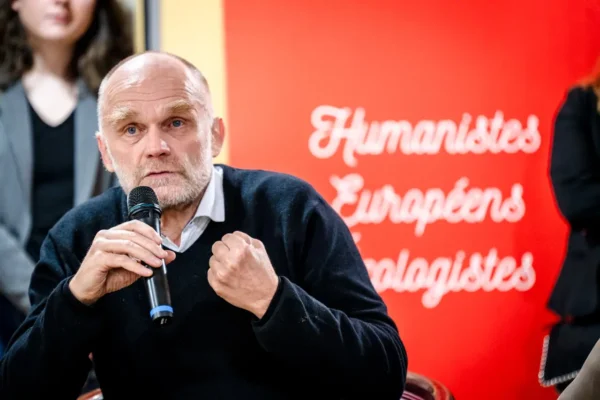
“The instrument of international sanctions is extremely useful, whether against the Russian Federation since the annexation of Crimea in 2014 or the full-scale invasion of 2022, against Belarus, or against any other state in the world. The Russian Federation, whatever it may say, is suffering enormously from these sanctions; disagreements and tensions are beginning to appear because of the drastic choices the government must now begin to make,” Petit said.
According to him, sanctions should not be viewed as a tool capable of producing instant results.
“The first characteristic is that this is a tool that does not provide an immediate response; its effects are extremely gradual. It would be childish to imagine that sanctions decided on a Monday could have an effect on any crisis by Friday,” he stated.
“They are a tool for framing long conflicts, a tool of gradual pressure, which normally allows patient or even chaotic negotiations to continue. Their concrete effects will never be immediate, and therefore it will always be easy in hybrid and information warfare to make people believe that ‘these sanctions serve no purpose,’” Petit said.
He also stressed that sanctions can be fully effective only when they rest on a strong international legal order.
“Sanctions, to be fully effective, require international law to be solid. That is the real question of the moment. There will always be techniques for circumventing sanctions, and there always have been. But what is new is that the foundation on which these sanctions could rely is now threatened or wavering,” he said.
Petit warned that the weakening of multilateral structures and the return of national egoisms make sanctions evasion easier and can even give it a quasi-official character.
“We can stop vessels of the shadow fleet, of course. But what should be done if the President of the United States decides unilaterally, without consultation, and in response to difficulties caused by his own individual actions, to ‘temporarily lift’ part of the sanctions? The return of national egoisms, the relativisation of international law patiently built over decades, the weakening of multilateral structures — all this not only makes sanctions evasion much easier, but even makes it almost official,” he said.
“What threatens our democracies is the return to permanent transactionalism, the abandonment of the ‘commons of humanity,’ the rise of national egoisms, and the entrenchment of grey-zone diplomacy. In my view, it is above all this context, which has been evolving dangerously in recent months, that weakens the effectiveness of sanctions applied to the Russian Federation,” Petit concluded.
Earlier German MEP Lukas Sieper told Guildhall that EU sanctions against Russia will remain weaker than intended if enforcement continues to be fragmented across Member States and violations do not systematically lead to investigation, prosecution and real punishment.
Только главные новости в нашем Telegram, Facebook и GoogleNews!
Tweet