
Moscow’s negotiation rhetoric, according to European politicians, is not backed by any real steps toward ending the war: Russia is seeking “peace” on its own terms and is trying to block Ukraine’s European future. At the same time, the European Parliament emphasizes that Ukraine’s accession process to the European Union has already begun and cannot be stopped. The key response to Russian aggression, it says, should be stronger military and financial support for Kyiv, tougher sanctions, and the use of frozen Russian assets.
Jean-Marc Germain, a Member of the European Parliament, said this in a major interview with the Guildhall news agency.
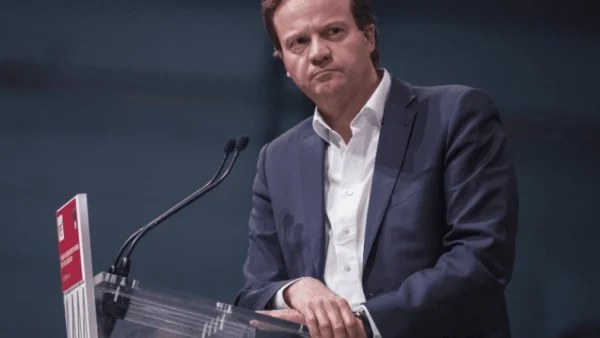
Mr Germain, good afternoon. Thank you for taking the time for this interview.
— Good afternoon. Likewise.
Against the backdrop of the anniversary of Russia’s full-scale war against Ukraine, a negotiation process initiated by the United States continues. The Russian Federation says it is ready to end the war. Based on your assessment of Russia’s actions, do you see any real readiness on Moscow’s part to stop its aggression?
— No, not at all. If Russia had genuinely agreed to stop the war, a peace agreement could already be reached now. Ukraine’s position has been absolutely clear: Ukraine is ready to fix the front line where it currently stands.
Europe and the United States are prepared to provide Ukraine with security guarantees, because the threat has not disappeared. In other words, if Russia wanted peace, it could achieve it.
But perhaps the key reason lies elsewhere: there is one thing that cannot be accepted — the attempt to stop Ukraine’s accession process to Europe. As Europeans, we may accept that the question of Ukraine’s membership in the North Atlantic Treaty Organization, NATO, can be postponed. But Ukraine’s accession process to the EU has already begun, it is moving forward, and no one can deny the Ukrainian people the right to be part of Europe. Perhaps this is one of the main “blockers”.
Do you believe Russia is using the negotiation process to achieve other goals?
— Yes. One of its goals is an attempt to restore the “former Soviet Union” in one form or another. That is why it is constantly emphasized that Ukraine is not the only target. If Ukraine lost this war, other European countries would find themselves in a zone of extremely high risk.
There is a well-known idea: Putin goes as far as he is allowed to go. Therefore, Europe’s task is to be as involved as possible, to help Ukraine resist and stabilize the front line — not only for the sake of Ukrainians’ right to live as free people, but also so that Europe remains a free continent.
Historical experience shows that an aggressor is usually forced to end a war either by military means, by economic means, or — most often — by a combination of both. The West supports Ukraine with military and economic resources, but Russia is not demonstrating any intention to stop the war. What additional tools does the West still have that have not yet been fully used to force Russia toward peace?
— It is important to understand: Russia is not Iran, and it is impossible to expect Russia to “lose” the war in some purely “peaceful” way. The main difference is not the size of the country, but the fact that Russia is a nuclear power. “Defeating Russia” as a state is not an option, but disrupting Russia’s attempt to seize Ukraine is the goal that must be achieved.
What can be done militarily? First of all, the financing of the Ukrainian army must be accelerated. This is already being done: two weeks ago, the European Parliament voted on a decision to provide a €90 billion loan to Ukraine for the next two years. Of this €90 billion, €60 billion should go directly to Ukraine’s defense budget so that Ukraine can produce the weapons and ammunition needed for the front.
These are enormous funds, and they are expected to change the situation — at the very least, to make it clear that Putin will never be able to “win the war in Ukraine”. If this support allows Ukraine to maintain an advantage, or at least resilience, along the front line, it will become an additional argument for Russia to stop the war — especially given how high the price of the war is for Russia, both in losses at the front and in defense spending.
The second block is sanctions. When a military victory by one side is not realistic, economic pressure becomes critically important. That is why the European Parliament supports tougher sanctions against Russia. In the Council of the European Union, the EU Council, this was not achieved last time because foreign policy decisions require unanimity, and Hungarian Prime Minister Viktor Orbán blocked the decision. Nevertheless, both in Parliament and, hopefully, in the EU Council, the line toward tougher sanctions will be advanced — not only against the state, but also against all individuals involved: freezing assets abroad and restricting the ability to travel outside Russia.
There is also another direction — working with third countries that buy Russian oil. In particular, this means diplomatic pressure on importing countries so that they reduce their purchases: if Russia has less oil revenue, it will be harder for it to finance the war.
Do you see prospects for a sharp and significant increase in military support for Ukraine from the EU? And what would be required to make that possible?
— On the part of the European Parliament, there is political will: 71% of MEPs voted in favor of the €90 billion loan. Support also remains in the EU Council: 24 out of 27 countries support Ukraine receiving the assistance it needs and not being defeated.
The main difficulty is finding practical support mechanisms despite the blockages. There is now talk of obstruction by Orbán and Bulgaria; it is also being said that Slovakia and Czechia are joining this. In other words, there are several countries trying to slow down support for Ukraine, and it is necessary to find a way around such obstruction.
For example, it was initially discussed that the €90 billion loan could be secured through an adjustment to the Multiannual Financial Framework, the MFF — the EU’s long-term seven-year budget — but this was blocked by Hungary. If that path is impossible, another option is being raised: the loan could be “European” in essence, but guaranteed by the member states themselves, outside procedures that require unanimity. In that case, the guarantors would be 24 countries, and the consent of Hungary, Slovakia or Czechia would not be needed.
The second issue is weapons. The new financial instruments include a condition: wherever possible, new weapons and ammunition should be purchased in Europe. But if American-made weapons are needed, it must remain possible to buy them with European funds.
A separate topic is authorization to use long-range capabilities. It is critically important for Ukraine to be able to strike not only targets on the line of contact, but also launch sites for strike systems — in order to prevent attacks before they are launched. In this context, the issue of German long-range Taurus missiles is mentioned, as well as the political decisions needed for their transfer and use, possibly with certain restrictions.
Another element is Ukraine’s European perspective. A clear benchmark for Ukraine’s accession to the EU, which has been discussed publicly, matters: if the prospect of membership is real, Putin will at some point understand that his “bad dream” of restoring the “old empire” has failed and has no future. Therefore, the accession process is not only a matter of justice, considering that much began with Maidan and Ukrainians’ aspiration toward Europe, but also a political signal: the goal for which Putin launched the war is unattainable.
In the context of pressure on Russia, it is often noted that a significant part of its state budget depends on hydrocarbon revenues. What additional tools does the EU have to increase pressure on the Russian oil and gas sector?
— The European Parliament has adopted decisions and regulatory measures, agreed with the EU Council, providing for a gradual reduction of imports, with target deadlines by the end of 2026.
At the same time, it is necessary to work with the largest importers of Russian oil — for example, India. These countries are becoming important trade partners for Europe, trade negotiations are underway, and the issue must be raised directly: if a country wants to be a strategic trade partner of the EU, it must reduce imports of Russian oil.
And, of course, there is the issue of individual EU member states that resist abandoning Russian energy resources. In particular, pressure is needed on Hungary, which continues to seek the preservation of supplies and uses energy as an argument in blocking decisions. In this context, the idea is being raised that if Hungary systematically blocks key decisions affecting Europe’s security, additional measures of influence should be considered — beyond the EU procedures already in place on rule-of-law issues.
This also includes the question of the veto right in decisions requiring unanimity: it should not be used to undermine the common European position. The view is being expressed that the veto mechanism should be limited until Hungary returns to a line of solidarity with Ukraine and with other European countries.
And the final question: has the European Union defined what exactly “victory” means in this war, and has such a benchmark been formally formulated or approved?
— The basic principle is no peace agreements without Ukraine. It is the Ukrainian people who must decide what they are ready to accept.
At the same time, for Europe, the approach appears clear: the front line is fixed, neutral zones are created along the line of contact, and mechanisms of international security control are considered — for example, a peacekeeping format involving European forces. In rhetoric, the expression “blue helmets” is often used, meaning peacekeepers, so that neither Ukrainian nor Russian troops return to these zones.
At the same time, Russia must accept that Ukraine’s future may be European. In the short term, Ukraine may not join NATO — this is viewed as a possible concession. But Ukraine’s accession process to the EU must continue if Ukrainians want it.
For its part, Europe is ready to participate in Ukraine’s security guarantees together with the United States. And it is important to emphasize: Ukraine’s very agreement to fix the front line is already a significant concession, because in the long term Ukraine’s sovereignty implies the restoration of its territorial integrity, including Crimea, Donbas and other occupied territories. Ukraine has taken a step — now Russia must accept the framework. But the principle remains unchanged: there can be no peace without the consent of the Ukrainian people, who have paid an extraordinarily high price while defending not only themselves, but also Europe’s security. Today there is an understanding that, in effect, Europe’s defensive border is being held on the front line.
Exclusively for Guildhall.
Только главные новости в нашем Telegram, Facebook и GoogleNews!
Tweet