
Europe still has the means to hit the Kremlin harder — but only if it is ready to break its remaining fossil-fuel dependence on Russia, curb the shadow fleet, intensify sanctions and prepare much faster for a larger security confrontation. Dutch Senator Saskia Kluit says these are the concrete steps Europe should take now if it wants to increase pressure on Moscow and stop treating Russian aggression as a crisis to be managed rather than defeated.
Kluit also speaks about the danger of the Middle East war diverting attention from Ukraine, the need to punish sanctions evasion, the strategic importance of energy prioritization in wartime, and Europe’s failure so far to formulate a sufficiently clear long-term objective toward Russia.
Saskia Kluit, a Dutch Senator from the GreenLeft-Labour Party, said this in an interview with Guildhall.
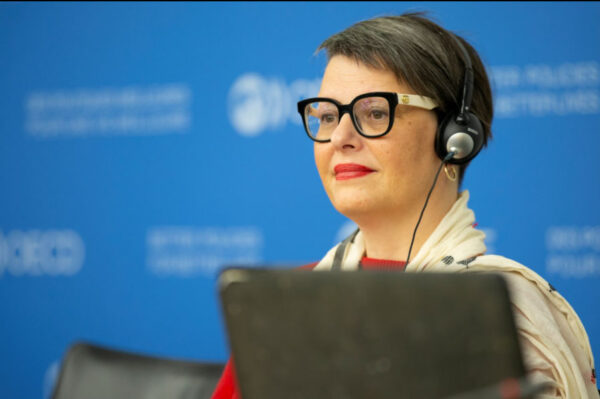
— There is deep concern over the war in the Middle East, especially from a European — and specifically Ukrainian — perspective. It has been reported that Russian intelligence services are trying to exploit this situation in order to divert European and Western attention away from Ukraine and Russia’s war against it. Do you see risks related to these Russian efforts?
— Yes, I think that analysis is essentially correct. The Middle East — or, as I would call it, West Asia — is closely tied to Europe’s economic model, which remains heavily dependent on fossil fuels. So when instability erupts in that region, Europe inevitably feels the consequences, and political attention shifts there very quickly.
— That is a serious concern, because after years of Russia’s aggression against Ukraine, a certain degree of media fatigue has set in. I do not agree with that tendency, but I do think it is a fact of life. And with Trump, every morning seems to bring another dramatic headline, which also affects the media agenda.
— Politicians, however, are not so easily distracted, because they have other channels of information. Governments continue to brief them, and in most European countries support for Ukraine remains strong. In my country, and within my party, there is a clear effort to keep Ukraine high on the agenda — not only politically, but financially as well.
— My biggest concern at the moment, however, is weapons. There have been concerns that weapons purchased by European countries in the United States for Ukraine may instead be redirected to the conflict around Iran. That would be a very grave and, in my view, unacceptable development.
— For me, human rights and international law are fundamental. They are a central pillar of the position against Russia, but also of opposition to a war against Iran. One may strongly disagree with the regime there — and I certainly do — but attacking another country can only be justified through the multilateral system of the United Nations, not through unilateral action. These are very serious concerns, and they deserve close attention.
— It is natural for people to grow tired of such a long war of attrition, which is why there is real appreciation for politicians who remain focused and active. That should not be taken for granted. Thank you personally for your position, and thanks to the Dutch people as well.
— May I add something? At the Council of Europe, some of my colleagues are working on reports about veterans, especially Ukrainian veterans, so there is a very clear awareness of the price Ukrainian people and Ukrainian families are paying in this war against Russia.
— So for me, gratitude does not need to be expressed in that direction. My own gratitude toward the Ukrainian people is also very great, because Ukraine is fighting a very hard war and paying a very high price. Solidarity is the only proper response. Among friends, there is no need for gratitude.
— We have all seen the recent exchange involving NATO Secretary General Mark Rutte and EU foreign policy chief Kaja Kallas. Without assessing that conversation specifically, it raises a broader question: what leverage does Europe still have that could be used against the Putin regime? Russia is clearly not going to agree to peace voluntarily; it can only be forced toward it. So what concrete instruments does Europe still have at its disposal?
— One obvious step is to end the remaining fossil-fuel relationship with Russia, because it still exists. A second is to move much more aggressively against the shadow fleet — and by that I do not mean military attacks, but simply stopping those vessels and ensuring that Russia cannot continue earning money that way.
— A third would be stronger sanctions against the Russian leadership. There are still many steps Europe can take, and these should be pursued multilaterally wherever possible. A great deal of trade has not actually stopped — it has simply been redirected. Goods that no longer move through Europe now enter through the eastern part of Russia. In every era of war, the economy has been central to stopping aggression, and for Europe this is one of the key paths to take.
— The second major area is defence. NATO countries should prepare better and faster for stronger European efforts on the eastern flank. Europe must be properly defended, and it can also do more to help Ukraine obtain the equipment it needs to fight Russia. So those are three areas I would point to: energy, sanctions, and defence preparedness.
— That point about sanctions is especially important. Despite what some claim, the economic data show that sanctions are working. They may not win the war on their own, but they are a substantial tool. Recently, OCCRP and several major Western media outlets published an investigation saying that Europe’s largest aluminium producer, the Aughinish smelter in Ireland, has become deeply embedded in the Russian military supply chain. In other words, production in Ireland is ending up linked to Russia’s defence industry. Experts say sanctions must be strengthened and that sanctions evasion should be criminalized. What is your view on criminalizing sanctions evasion?
— Evasion is a very serious matter, because sanctions are not introduced for no reason. If sanctions exist, there must also be punishment for those who deliberately evade them. For me, that is a natural part of sanctions policy.
— I also know that this is very difficult in practice. Legally and judicially, it can be hard to hold companies or individuals accountable. My country has some experience in trying to do exactly that, and it often takes a long time. So although I do think criminalization should be part of the package, I would not expect it to produce results tomorrow. That is simply the reality of the judicial system.
— To be honest, I think it would be faster to strengthen multilateral sanctions and to physically hinder the transport routes that are still functioning.
— That is true. It is a long road, but the earlier it begins, the sooner it can produce results. This is already the fourth year of the war. You have also touched on the energy issue. You said that Europe remains dependent on fossil fuels from the Middle East. There are really two dimensions here. One is economic. The other is defence and security, because modern defence is impossible without oil and gas. So how should the first problem be solved without undermining the second?
— There is another dimension as well, and interestingly Ukraine itself has shown leadership on it — namely the climate crisis and ecocide. Ukraine has recognized this issue in its legislation. Yet during wars people tend to forget that the climate crisis is approaching and that it will be enormous. It will threaten food security, homes and health — in many ways it already does.
— For me, my whole life has been dedicated to moving from a fossil-fuel economy to a clean-energy economy. Looking at what is happening now, any careless use of fossil fuels is deeply harmful. In the Middle East, oil infrastructure is being destroyed, and that has a massive impact. Of course, during war Ukraine is also forced to strike energy infrastructure, and for me personally that is difficult, because the climate consequences are so serious. But I understand why it happens.
— That said, fossil fuels should be prioritized for defence first. There is a hierarchy of essential uses. Defence is at the top. Healthcare is at the top. Heating homes in very cold regions is at the top. Europe must keep in mind that next winter it may not have the same amount of energy it had this winter, prices may rise, and measures will be needed.
— There is a great deal that can be done. As it happens, I am reconstructing my own house to make it climate-neutral and energy-neutral, using solar technologies and a heat pump so that I can move away from the fossil system. I am not certain I will become completely independent, but I will be much less dependent on fossil fuels.
— And on a broader level, people can change their behaviour. Public transport can be used more. Bicycles can replace short car trips. When people do drive, they can do so collectively. Homes can be heated a little less. In the Netherlands, many houses are heated to 21 degrees, but with proper clothing 18 can also be comfortable. Energy consumption in livestock production can be reduced. That would be better for the climate, for health, and for energy use.
— So for me, this is another wake-up call for Europe to become independent of fossil fuels. In the end, that would leave more energy — and cheaper energy — for the wars and crises Europe may have to confront.
— So this is really about changing culture and mentality — getting people ready to sacrifice some personal comfort for the sake of the common good. That is a strategic objective, and in Ukraine it is fully understood. But there is another side to this. Russia is concentrating military forces near the EU border, especially in Belarus and near the Baltic states. The head of German intelligence recently warned of a real threat in the coming years of hybrid or even conventional interference in the Baltics. And the war in the Middle East is only accelerating all of this. Unfortunately, for now, modern armies still need fossil fuels. So to make it absolutely clear: your position is that in conditions of scarcity, priority must go to key areas such as defence, correct?
— Yes, that has been my position for a long time. I do not think it would be sensible to do it any other way. One can use fuel to drive to the beach, the forest or a shopping area — or that fuel can be used for tanks, ambulances and other essential services. Conceptually, that is the choice.
— If energy becomes more expensive, everyone knows what the consequences will be. But there is also a great deal of room for improvement. Europe knows how to reorganize society when necessary. During the coronavirus crisis, there was a different trigger, but societies changed very quickly. Remote work expanded. Public transport can be improved. Bicycles can replace many short trips. In the Netherlands — and probably across much of Europe — most car journeys are only three or four kilometres long. That is a very short distance. If people cycle those distances, they become fitter and consume far less energy.
— In Ukraine, it is much the same.
— Exactly. It saves a great deal of energy.
— That is why there is a real need for sober and adequate policymaking, as well as politicians who are honest about threats, priorities and strategic goals. But there is another question. There are many contacts between the Ukrainian leadership and European leaders. Is this issue — efficient and prioritized energy use as part of broader resilience and security planning — actually being discussed enough at that level?
— From what I can see, not really — or at least not enough. And that surprises me, because I think it would be wise to put this issue on the strategic agenda in discussions between Ukraine and Europe.
— Europe is not living this war in the same way Ukraine is. For ordinary people in Western Europe, it is sometimes difficult to understand what concrete changes they themselves should make. So I do think it would help if this issue were raised more directly.
— Some politicians are already active on this agenda, including people close to Ukraine in PACE, but again, as I said, this is about changing culture and mindset. That takes time. Still, it is an important issue and it should be discussed more openly as a strategic question.
— That is exactly the point. It is not a one-, two- or three-year issue. It is about building the right culture and promoting the right priorities in the long term. If the war eventually comes closer to an end, Ukraine will also have to return to these strategic energy questions in a more systematic way.
— Yes, that is true, because it would also help reduce energy cuts and improve resilience. At the same time, Ukrainians are very resilient and flexible people. In conversations with my Ukrainian colleagues in PACE, there is always a very clear pattern: a problem is identified, analysed realistically, and then a solution is found.
— Ukraine should absolutely care about the environment, because it has a beautiful environment. But of course, right now there are more immediate priorities. For the rest of Europe, that is not the case. Europe has the room — politically and mentally — to invest in the energy transition, to invest in the social transition, to organize energy differently and to use it differently. So for me, this is very clear: Europe should use this moment.
— Some of my colleagues already understand that. Not all of them, I have to say.
— So there is still work to be done.
— There is work to be done. But it is good that these questions are being asked. And if there is one request I would make to Ukrainian politicians when they speak to Western European politicians, it is this: raise this issue too, as a strategic military and security question.
— Thank you very much for that. It really is one of the most important issues in security policy, and its importance becomes even more obvious as the war involving Iran escalates. Let me conclude with a broader strategic question. In your personal view, has Europe actually formulated a strategic objective toward Russia and Russia’s aggression against Europe?
— I would say not yet — or not clearly enough.
— Of course, nobody wants Russia in their backyard. That much is obvious. But that is far too vague to count as a real strategic objective. Strategically, people talk about what happens if Finland is attacked, what happens if the Baltic states are attacked, what happens if Poland, Romania or Moldova come under pressure. Those are real discussions.
— But for me, it is also very clear that the hybrid war is already under way. Every election in Europe has become, in part, a struggle against disinformation and against attempts to interfere through social media and other channels. So one strategic objective should be to protect European freedoms — freedom of speech, freedom of political organization and democratic choice — without leaving them open to foreign interference. That is a strategic problem Europe has to solve.
— On the military side, there has been progress in cooperation among European countries, but much more can still be achieved. There are still many inefficiencies. People often point out that Europe has far too many different weapons systems, where greater standardization would make far more sense. The same applies to drones. I am pleased that my government is taking steps to work with Ukraine in this field, but Europe is still only at the beginning compared to what Ukraine has already demonstrated.
— Modern military development should therefore be a strategic goal. Europe also needs a more serious discussion about how the transatlantic partnership functions in this new reality. That is a sensitive issue and not always easy to discuss in public, but the need to prepare better is obvious.
— Europe needs to better align its international policy, NATO’s objectives and Europe’s own defence system. At the moment, this is still something of a triangle. It needs to become more integrated, more coherent and stronger.
— And yet one should also remember this: if Europe truly stands up and acts together, then Russia is not some overwhelming, unstoppable force. Europe already spends very large sums on defence. The challenge is organization, readiness, replenishing ammunition stocks and scaling production.
— I also think there is an important human dimension here. One hears stories about Ukrainian women assembling drones at kitchen tables. I do not know how many are literally doing that, but it is a powerful image. In the Netherlands, there was recently a museum exhibition connected to war history, and visitors were invited to take part in assembling drones. That made me think: if Europe really needs to prepare better and scale up, why should it not also mobilize society more broadly in practical ways?
— Perhaps one day there should be an exhibition in Europe specifically about Ukrainian women involved in drone production. But that is a conversation for after the interview. Ms. Kluit, thank you very much for this interesting, insightful and substantive conversation. Ukraine is ready to contribute and to work together with Europe on preventing Russia from reaching Europe’s backyard — something Ukraine is already doing with Europe’s help. Thank you once again for your time.
— You are very welcome. All the best to your country. I hope your land remains Ukrainian. That is my position.
— Thank you, Ms. Kluit. Thank you very much.
Exclusively for Guildhall.
Только главные новости в нашем Telegram, Facebook и GoogleNews!
Tweet