
Europe must not only tighten sanctions against Russia, but also impose real penalties for sanctions circumvention, while at the same time reducing its own dependence on external energy suppliers that may use resources as a tool of blackmail.
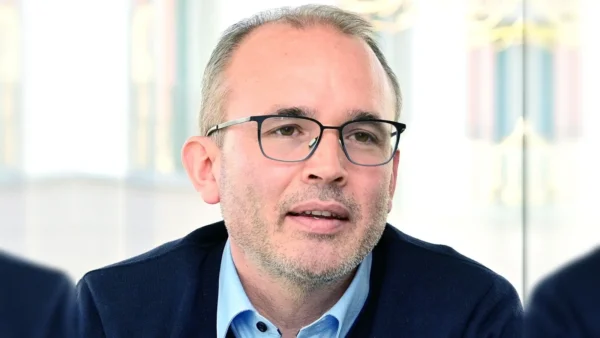
This was stated in an interview with Guildhall by Tobias Winkler, a member of the German Bundestag.
In the interview, he also stressed the need to cut off channels used to finance the war through the “shadow fleet,” expand the circle of reliable energy partners, and pursue a long-term transition to a more diversified supply system based, among other things, on renewable energy, hydrogen, and ammonia.
— To begin with, I would like to ask about the recent Irish case involving supplies to the Russian defence industry, and more broadly about sanctions circumvention and sanctions policy in general. What is your assessment?
— This example shows that sanctions circumvention is a real problem, and it has not gone away. That was already known. That is precisely why sanctions packages are adopted — to identify such schemes and tackle them. But of course, those doing evil are sometimes faster than those trying to stop them. That is why Europe is at times one step behind.
Nevertheless, these loopholes must be closed. And there are many more such channels — including the shadow fleet, which is of particular interest to me. We need to find ways not merely to put individual ships on sanctions lists, but to truly cut off this channel of war financing. Europe still has leverage here and can make a real difference.
In such cases, the role of the media and investigative journalists is especially important, because they help uncover these schemes. Those involved in sanctions circumvention are highly inventive, so everyone must do their part to counter this threat.
— Following the OCCRP and The Irish Times investigation, there were calls to criminalise sanctions circumvention, especially when it concerns supplies to the Russian defence industry. How do you view this as a politician?
— I fully support that. If rules exist, but no one is held accountable for breaking them, then it simply makes no sense.
Therefore, people, companies, and any structures involved in sanctions circumvention must be punished. This has to be part of sanctions policy. Especially in cases like this, where it is happening on European soil, it is easier to act than in situations where circumvention takes place via China, India, Kazakhstan, or Kyrgyzstan. In such cases, Europe should have every possibility for a tough response. I fully support that.
— Looking more broadly, do European politicians and governments today understand that energy independence is no longer just an economic issue, but also a matter of security and defence?
— Yes, I think that understanding exists. But in my view, the word “independence” is not entirely precise. What we really need is independence from countries that use energy as a tool of blackmail.
More broadly, Western countries need a strategy of diversification and cooperation. If one country faces problems with energy supplies, there must be others — allies — that can step in.
That is why Europe needs new partners and a new supply system, so that it is not dependent on the kinds of sources you mentioned. Most European countries have managed to reduce dependence on Russia quite significantly, although there are exceptions, such as Hungary. But Europe must also reduce dependence on other regimes, such as Iran or Venezuela. More precisely, not on the countries as such, but on corrupt and blackmailing regimes.
That is why Europe needs diversification and cooperation.
— So do you primarily link Europe’s energy security to expanding the circle of suppliers and partners?
— Yes, but not only that. In the long term, Europe needs more partners, and that will become easier if we move away from fossil energy. Renewable energy sources can be developed in most countries around the world: there is wind, there is solar energy.
Yes, this is not always a stable base for an industrial country like Germany. But if that energy is converted into ammonia or hydrogen, then suppliers can emerge all over the world. And then no one will be able to blackmail us anymore.
That is the strategic logic of the transition: to move away from fossil resources concentrated in a limited number of countries and toward other energy sources that can be produced almost anywhere.
— So you believe that Europe’s future energy security should be built not on a new dependence on individual oil and gas suppliers, but on a more flexible, diversified system?
— Exactly. Europe does not simply need formal “independence”; it needs a resilient system in which no external actor can use energy as leverage.
That means diversifying suppliers, strengthening cooperation among allies, and gradually moving toward energy supply models that reduce vulnerability to external blackmail. In this sense, energy policy and security policy are now inseparable.
Exclusively for Guildhall.
Только главные новости в нашем Telegram, Facebook и GoogleNews!
Tweet