
Czech Senator Pavel Fischer told Guildhall that Europe has already improved coordination on sanctions enforcement, but major legal gaps remain at both national and EU level. According to him, law enforcement agencies need stronger powers, suspicious assets linked to sanctions evasion should not be automatically unfrozen, and easing oil-related sanctions risks giving Moscow additional financial room instead of increasing pressure for its aggression.
Fischer is a Czech senator and Chairperson of the Committee on Foreign Affairs, Defence and Security of the Senate of the Czech Republic.
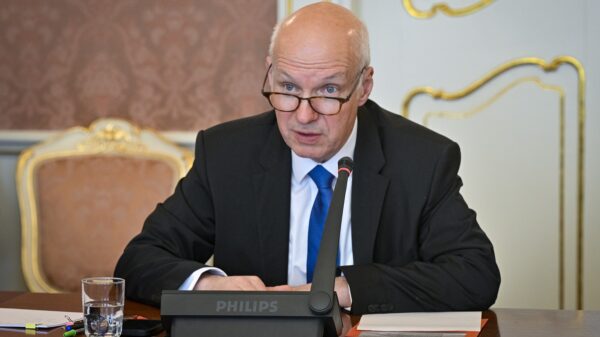
— From your perspective, what are the biggest remaining gaps in the enforcement of sanctions against Russia, both at the EU level and in national systems such as the Czech Republic?
— I think we do have a problem at the European level as a whole. This is also why new EU legislation was introduced to establish common rules across the Union and coordinate the work of law enforcement agencies.
This should not be underestimated. Since Russia’s full-scale aggression in 2022, we have seen a European response. But its effects will only become visible later. Before a real criminal investigation begins, there are often many preliminary inquiries that prepare the ground for it. So perhaps the more positive view is that there may be much more in the pipeline than the numbers currently suggest.
That does not mean we do not have a problem. Let me be very concrete. In Prague, we have a special analytical office known in Czech as FAU — essentially a central financial intelligence unit. It plays a key role in detecting and stopping sanctions circumvention. It screens the financial system and analyses reports of suspicious transactions from banks and other actors.
The problem arises when FAU identifies a suspicious money transfer and immediately freezes it. Since we are a rule-of-law state, the authorities must then ask the actors involved to provide the necessary explanation.
This is where a specific problem in the Czech system appears. If a Russian individual or legal entity does not respond, then after 12 months FAU has to unfreeze those assets. And cooperation with the Russian police today is practically non-existent.
Even if FAU has indications of criminal activity, organised crime or money laundering, after 12 months it still has to unfreeze the assets. By doing so, it sends a message that the assets have been unfrozen. The person then finds the money in the account, prints the document and shows it everywhere in the EU: look, I have an official paper proving that my money was unfrozen.
I think this is a very important breach in our legal system. We do not force people who are suspiciously rich to show where their wealth comes from. We should reverse the burden and oblige everyone who has huge amounts of money, transfers, luxury cars and so on to provide a tangible record of the activity from which this wealth was generated.
This legal instrument has already been prepared and exists in some Member States. But in recent years, the Czech Minister of Justice did not want to address this issue, even though the Senate, including the committee under my leadership, urged him to act. We now have a new government, and we hope it will address this.
European coordination exists, but we need more. When it comes to unfreezing assets linked to organised crime, terrorism or sanctions circumvention, we need to do much more. And we can do more. But we need the political leadership that was lacking in the Czech Republic in recent years.
— Should such liability extend across the full chain of individuals and companies involved in sanctions violations? Sometimes there is a European entity, but we also know who is involved on the Russian side — banks, traders, insurers and others — who are not actually prosecuted. Should liability extend to the full chain of actors involved?
— I think so.
But we also have some good news. For instance, there was a case involving an attempted export of luxury cars to Russia in 2022, where a Russian citizen was accused of trying to export three luxury cars. In January 2024, prosecutors brought the first known Czech court case concerning alleged sanctions circumvention in this matter.
The second case was in September 2025 and concerned the export of mining machines to Russia. The National Centre Against Organised Crime charged six individuals and one company over the export of seven mining machines to Russia through intermediaries in other countries. These machines were also on the EU sanctions list.
The third example is TOS Varnsdorf, a company producing industrial machine tools classified as restricted goods under sanctions. The evidence suggests that these products reached Russia through third countries, including Kyrgyzstan or Turkey. The company denies exporting anything to Russia and says there are no direct links to intermediary companies.
But we now have a new Czech law, within the EU system, which strengthens prosecution for negligent sanctions violations. So we are already seeing the first cases being brought before courts.
But law enforcement needs much more. The example of FAU shows this clearly: they see suspicious assets moving through bank transfers, they act, but 12 months later they have to unfreeze them. That is where we probably need to do more.
We cannot exclude that there are people trying to enrich themselves by boosting imports through third countries. It has always been like this. But we can do more, even based on what we already see now. We need more authority for law enforcement. This is something we have to work on, and at the European level I think we can and should coordinate this much more.
— Perhaps there should be a European Parliament working body established to oversee sanctions enforcement?
— If sanctions are imposed under the UN, there are very clear procedures. Unfortunately, the UN is not in the best shape today, because Member States have done a lot to undermine its authority.
But we must do more under our international legal obligations. And if this does not work at the UN level, then we have to do more at the EU level. Definitely.
— There is the European Public Prosecutor’s Office, but its capacity and powers in this specific field are quite limited. Perhaps they could be expanded, or at least this direction should be considered?
— I do not know. We should study its current authority and the framework in which it can act. As far as I understand, one of its powers concerns the illegal use of European subsidies. But I am not an expert in this field.
We can also do more at the national level. But we need a stricter legal framework. The example of the financial unit here in Prague shows that they could do more, but they simply cannot, because the law does not exist for the time being.
— One last question. We see that the American president has extended sanctions relief related to Russian oil for another month. But we are speaking here about increasing pressure on Russia, not lifting it. Does the EU have additional leverage to increase pressure on Russia? Sanctions are one tool, but perhaps there are others as well.
— The paradox of the current situation, speaking at the strategic level, is that we have three different combat zones, but the very same battle. These three are the Indo-Pacific, the Middle East and Ukraine. For European countries, perhaps the order should be reversed: Ukraine first, then the Middle East, and only then the Indo-Pacific.
But in each of them, there is a fight against Western dominance. Every day of this conflict can bring satisfaction to China, Russia, Iran or North Korea, which are working as a coalition against Western values, the rule of law and a rules-based order.
The unhappy situation we now have to deal with is that, because of global economic challenges, the United States — which has always been a power on the side of freedom — started to unfreeze sanctions against Iran after 40 years. I know this is a caricatured way of putting it, but by doing this, they effectively admitted that Tehran can find fresh money for the fight against US interests, US soldiers, US bases and US allies in the region.
And we observe the same with the lifting of sanctions on Russian oil. This is very unfortunate, because we have to do much more to punish Russia for its aggression.
By providing fresh money to Moscow because sanctions need to be eased due to global financial and economic struggles, we create a short-term and very dangerous situation that we should avoid in the long term.
I am very puzzled by the fact that the United States prolonged this sanctions relief.
Exclusively for Guildhall.
Только главные новости в нашем Telegram, Facebook и GoogleNews!
Tweet