
The central weakness of the European Union’s sanctions policy against Russia lies not only in inconsistent enforcement, but in the absence of sufficiently broad political will to impose real costs on the Kremlin and on those who help sustain its war effort. In Per Clausen’s view, meaningful progress will require tougher accountability for companies and intermediaries involved in sanctions circumvention, stronger financial penalties, and a readiness to look beyond narrow national interests that continue to weaken the EU’s common position.
This was stated in a comment to Guildhall by Per Clausen, a Danish Member of the European Parliament from The Left group and a member of the group’s Bureau.
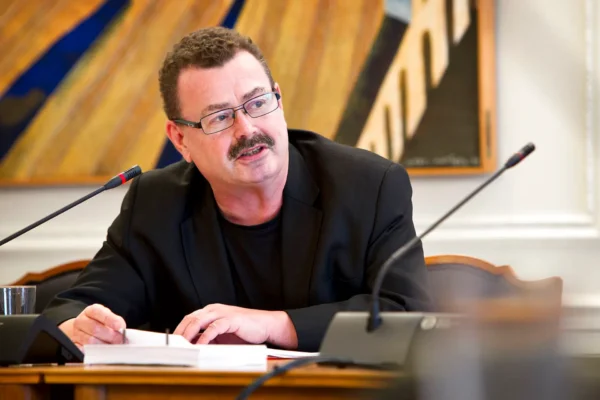
— Do you agree with this assessment of the main weakness in the EU’s sanctions enforcement?
— Yes, indeed. EU sanctions against the Russian regime remain far too weak and inefficient. Sadly, from the very beginning, it has taken the EU far too long to deploy strong and meaningful sanctions.
To see this clearly, one need only look at the continued activity of the shadow fleet, or at how long it took the EU to target Russian exports of non-essential goods such as caviar, vodka, and diamonds. This underlines that one of the main weaknesses has been, and remains, a lack of genuine and broad political will to hit the Russian regime — perhaps more than anything else.
— In your view, what should be changed to ensure that every established case of sanctions violation leads to criminal proceedings and real punishment for those responsible?
— Again, I think the political will has to be there — including the will to sidestep narrow national interests, such as those tied to the diamond business.
Then we need to make sure that companies exporting electronics or other goods that end up in Russian missiles and other military equipment are held accountable. That also means ensuring they are punished financially in a way that strips them of all related profits, in addition to imposing heavy penalties. As long as this remains financially attractive, some unscrupulous companies will continue exporting, even if they know or suspect that their products ultimately end up in the hands of the Russian military.
The boring answer is that as long as countries do not actually prioritise sanctions enforcement, it will remain a serious problem. And in order to prioritise it, political will is needed — including the willingness to look one step further every single time.
— Should such liability extend across the full chain of individuals and companies involved, including banks, traders, insurers, logistics operators, intermediaries, and entities from third countries that knew or should have known the nature of the operation?
— It is certainly something that should be looked at very seriously.
In that sense, it is disappointing to see that the EU’s due diligence rules were dismantled to such an extent, because they helped establish that companies bear responsibility for more than just their own immediate actions. That is exactly the kind of responsibility that now needs to be examined more closely.
It should not be possible for companies to wash their hands of the matter by claiming they do not know why all their sales are suddenly going to newly established shell companies in, say, former Soviet republics, which then resell those goods to Russia.
— Could expanding the powers of the European Public Prosecutor’s Office in investigating sanctions violations form part of the solution?
— Since the European Public Prosecutor’s Office is primarily tasked with investigating, prosecuting, and bringing to judgment crimes affecting the financial interests of the EU, I am not sure whether it is the institution best suited for this role, or whether such a solution would end up taking too much time in each case because of the need for cooperation with the respective national authorities.
But it is absolutely clear that something must be done.
Exclusively for Guildhall.
Только главные новости в нашем Telegram, Facebook и GoogleNews!
Tweet