
The central weakness of the European Union’s sanctions policy against Russia lies not in the absence of restrictions, but in the failure to turn documented violations into real criminal consequences. In Karolis Neimantas’s view, closing that gap will require not only stricter enforcement, but also harmonised liability standards across the EU, stronger investigative capacity, and clearer responsibility along the full chain of intermediaries involved in sanctions circumvention.
This was stated in a comment to Guildhall by Karolis Neimantas, a member of the Seimas of Lithuania.
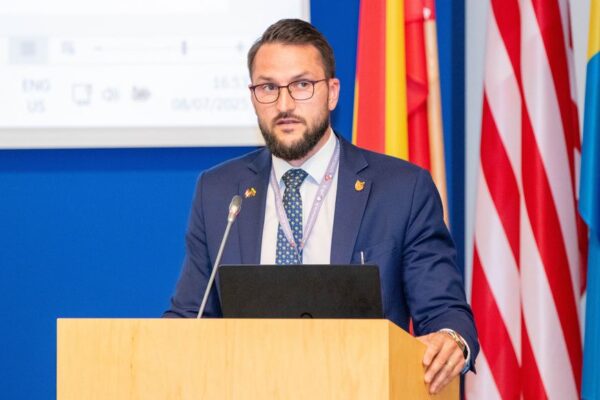
— Do you agree with the assessment that the main weakness in the EU’s sanctions enforcement lies in the fact that too many identified violations do not lead to real criminal proceedings or meaningful punishment?
— Yes, I largely agree with this assessment.
The data presented show a clear imbalance between the scale of identified sanctions violations and the actual legal consequences. When only a small fraction of nearly 1,500 investigations results in convictions or meaningful penalties, this points not to a lack of violations, but to an insufficient conversion of cases into effective criminal prosecution.
The core issue appears to lie not in the regulatory framework itself, but in its enforcement: inconsistent application of sanctions across EU member states, limited capacity of national authorities, especially in investigating financial crimes, complex evidentiary chains in cases involving international networks and intermediaries, and insufficient coordination between jurisdictions.
As a result, many identified violations stall at the investigation stage or are resolved through administrative rather than criminal measures. This undermines the deterrent effect of sanctions and creates conditions for their systematic circumvention.
Therefore, the main weakness indeed appears to lie in the enforcement chain — from the identification of violations to the imposition of final accountability.
— In your view, what should be changed to ensure that every established case of sanctions violation leads to criminal proceedings and real punishment for those responsible?
— Several changes are needed.
First, the legal framework should be further harmonised at the EU level. Sanctions violations should be qualified as criminal offences under comparable standards across all member states, with minimum requirements for criminal liability, including sentencing thresholds and corporate liability.
Second, specialised investigative capacities must be strengthened. This means expanding financial crime units with expertise in sanctions evasion schemes and improving analytical capabilities, including data analysis, financial flow tracking, and the identification of beneficial ownership.
Third, the EU should move toward a principle under which a significant and established sanctions violation automatically triggers criminal proceedings rather than being handled only through administrative measures.
Fourth, interinstitutional and cross-border coordination must be improved. Real-time information-sharing between customs, financial regulators, law enforcement authorities, and prosecutors is essential, as is the wider use of joint investigation teams and other EU-level instruments.
Fifth, liability should extend beyond direct violators to the broader chain of intermediaries, including financial institutions, consultants, and logistics operators. Corporate liability must be clear and backed by meaningful financial and operational sanctions.
Sixth, deterrence must be strengthened through proportionate but sufficiently strict penalties, including imprisonment where appropriate, and through public communication of significant convictions in order to reinforce risk awareness.
Finally, sanctions enforcement must be treated as a high-priority security policy issue rather than merely a technical regulatory function.
In short, the key shift should be from fragmented, often administrative responses to a consistent, coordinated, and unavoidable application of criminal liability across the European Union.
At the same time, it is important to note that these proposals are largely theoretical in nature and would require substantial financial and human resources to be implemented effectively. The European Union currently faces serious shortages in both areas.
— Should such liability extend across the full chain of individuals and companies involved, including banks, traders, insurers, logistics operators, intermediaries, and entities from third countries that knew or should
—Yes, liability should extend across the entire chain of related individuals and companies, but with clearly defined thresholds of culpability.
An effective sanctions regime is not possible if liability is limited only to direct violators. In practice, sanctions circumvention usually takes place through multi-layered structures involving intermediaries, financial instruments, and third-country jurisdictions.
At the same time, the principles of proportionality and legal certainty must be preserved. Liability should be linked to either intentional participation or breaches of due diligence obligations. Entities that have complied with all reasonable verification procedures should not be automatically criminalised. There is also a need for clear guidance on what exactly constitutes the standard of “knew or should have known,” in order to avoid legal uncertainty.
So yes, extending the chain of liability is necessary, but it must be grounded in clear criteria of culpability, knowledge, and breach of obligations. Otherwise, there is a risk of both overregulation and selective enforcement.
— Could expanding the powers of the European Public Prosecutor’s Office in investigating sanctions violations form part of the solution?
— Yes, expanding the powers of the European Public Prosecutor’s Office could be an important part of the solution.
At present, the investigation and criminal prosecution of sanctions violations are often fragmented across member states, which creates inefficiency and inconsistent practice. A stronger EU-level role could help ensure that identified violations do not remain stuck within national investigations and that liability is applied more consistently across the full chain of involved parties.
The key challenge, however, is to ensure that the European Public Prosecutor’s Office has sufficient financial and human resources to carry out such investigations effectively.
Exclusively for Guildhall.
Только главные новости в нашем Telegram, Facebook и GoogleNews!
Tweet