
The main weakness of the EU’s sanctions regime against Russia lies not only in the small number of criminal cases and convictions, but in the way enforcement itself is structured across the bloc. Fragmented jurisdictions, uneven national customs practices, weak coordination between member states, and political and economic incentives to look away from certain violations all create space for sanctions circumvention through intermediaries and third countries.
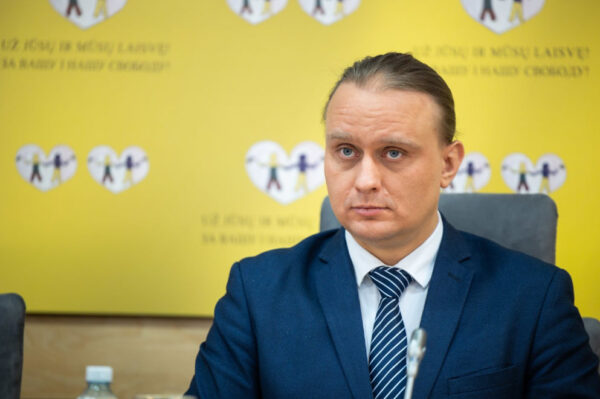
Laurynas Šedvydis, a Lithuanian MP and Chair of the Seimas Committee on Human Rights, made that point in an interview with Guildhall.
1. Do you agree with this assessment of the main weakness in the EU’s sanctions enforcement?
The enforcement of sanctions is hampered by the very fact that the European Union is barely a fully functioning economic union. The pressures of polycrisis create warped incentives for certain states to push back against the inclusion of new objects to be sanctioned, while economics — weak growth, high levels of public debt, and the cost-of-living crisis — shapes the decisions of policymakers.
If we do not look only at sanctions imposed on Russia, but also at other fronts, we can see that countries with friendly relations with the People’s Republic of China, such as Spain and Portugal, and those included in the supply chains of outside actors, experience higher growth, which helps politicians in power survive. By contrast, anaemic growth creates political instability. So the political incentives are there to reduce sanctions or to look the other way when they are being circumvented.
One of the main questions concerns the essence of sanctions themselves. A broad discourse was created around sanctions as a lever to hasten regime change. At this point, that seems naive, as it can only work in societies with democratic institutions or democratic impulses. Therefore, sanctions can and should be used to change the behaviour of potential adversaries and to hamper them before they become full-fledged enemies. Other uses barely work and may even be counterproductive by pushing states on the verge toward China or Russia.
There is another dangerous trend. As the sanctioned sphere expands, those under sanctions begin to cooperate, and more and more of the world becomes illegible to the West.
Barely anyone knows who should enforce sanctions, with the exception of the financial sector — banks and similar institutions. Individual countries sometimes do not have the full information needed to prevent sanctions busting if the sanctioned items or persons are outside their direct sphere of interest. For example, Lithuania produces a great deal of fertiliser, so sanctions related to that sector have an interest group that makes them more enforceable. But in unfamiliar sectors there are opportunities for sanctions busting via intermediaries — Kazakhstan, Central Asia in general, Georgia, Armenia.
The sanctioned sphere is constantly expanding, and even companies that try to follow the law are not always familiar with what they can and cannot do. In Lithuania there is some aversion to products related to Russia, but barely anyone checks whether the nails are produced in Russia, or whether the supply chains or ownership chains are sanctioned.
So enforcement is a problem, but it is a problem created by a conflict of jurisdictions. As long as customs offices remain national, there will be different practices throughout the EU. No one is seriously considering integrating these systems, because there is very little appetite for further EU integration and for expanding its competences. Personally, I would like to see the EU doing more, but I am a realist here.
2. In your view, what should be changed to ensure that every established case of sanctions violation leads to criminal proceedings and real punishment for those responsible?
The EU could create an instrument to better enforce sanctions and make the sanctions lists more binding.
There is another, more radical way that could help: creating the principle of universal jurisdiction for sanctions busting. In human rights cases, certain countries, such as Spain, accept cases in their courts from worldwide jurisdictions. There have been successful cases from South America.
This would not be popular among member states because of jurisdictional issues, but it would be very effective, as legal activism could be used to pressure other countries that provide lax enforcement of sanctions.
3. Should such liability extend across the full chain of individuals and companies involved, including banks, traders, insurers, logistics operators, intermediaries, and entities from third countries that knew or should have known the nature of the operation?
Liability should touch everyone who knowingly participates.
Logistics operators, for example — a major industry in Lithuania — mostly assume that every good they carry is legal. So if they know what they are doing, they should at least be examined.
4. Could expanding the powers of the European Public Prosecutor’s Office in investigating sanctions violations form part of the solution?
The European Public Prosecutor’s Office is a small institution at this point in time. For example, the branch in Lithuania has around five people working in it.
Unless there is agreement to create an agency with a central location, it will not work, and there will be pushback against expanding it from countries that do not get to host that central location.
But it could be discussed, and it could be used as a starting point.
Только главные новости в нашем Telegram, Facebook и GoogleNews!
Tweet