
Established cases of sanctions circumvention must trigger a mandatory criminal procedural response; however, even more important is to prevent such supplies in advance by refusing export licenses in suspicious cases.
This was stated in a comment to Guildhall by German Member of the European Parliament Michael Gahler.
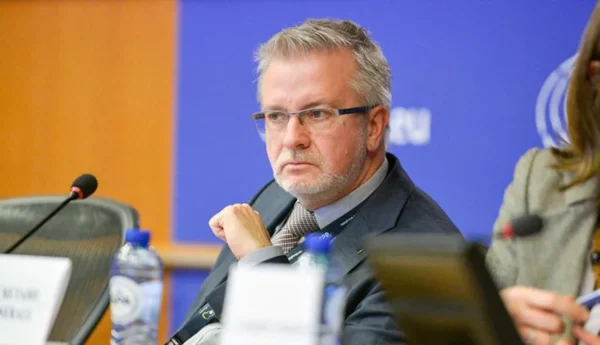
According to the German MEP, today the EU sees “a huge redistribution of transport routes. I mean, especially through Turkey or, how should I put it, the Central Asian republics, where we are observing this.” At the same time, he noted, “our authorities are simply overloaded,” and “to prove that an entrepreneur who exports something really had, so to speak, criminal intent to circumvent sanctions — that is difficult.” That is precisely why, he added, “if this is established — yes,” such cases “must trigger a mandatory response in the form of criminal proceedings.”
At the same time, the MEP stressed that the priority should be to prevent such supplies. “My point is to prevent it, not to let it happen and then punish. Because if you allow it to happen and then punish the person, it means it has already happened,” he said. According to him, “the best thing is not to allow the export, not to grant an export license to a third country.”
He described a change in the approach to proof as the key solution. “My proposal is to reverse, so to speak, the burden of proof. Not to assume that what is exported to Uzbekistan stays there, but to assume that someone who suddenly exports to Uzbekistan, although they have never done so before, should be considered to be violating the rules and should have to prove the opposite,” the MEP said. He added: “As things stand now, I would reverse it and say: I assume that such activity is intended to result in the goods ending up in Russia. And therefore I do not issue an export authorization unless the other side proves that the goods will remain there. The balance of the burden of proof — it needs to be reversed. That is what the practice should be.”
Developing this idea, he noted: “Then it is no longer for me, the state, to prove that this person had malicious intent, but to shift this onto the exporter, who must prove that the goods are not intended to be sent to Russia. And that is something he usually cannot prove. So he will not receive authorization for export. And that is the preventive measure. That is the way.” As an example, he cited a situation in which a company had previously supplied Russia and then suddenly began exporting to Kazakhstan: “And for me, that is grounds to assume that, all right, you will not receive this authorization, because we know where this ultimately ends up, unless you actively prove that everything is different.”
Earlier it was reported that the U.S. Department of the Treasury removed three Russian vessels from the sanctions lists — the tanker Primorye, the dry cargo ship Viktor Tarasov, and the auxiliary vessel Arctic Orion. At the same time, Washington stated that the overall strategy of pressure on Russian exports remains unchanged and that new restrictions are being imposed in parallel against entities and vessels involved in sanctions circumvention.
Только главные новости в нашем Telegram, Facebook и GoogleNews!
Tweet