
Russia’s full-scale invasion of Ukraine did not fundamentally change the nature of the Kremlin’s hybrid warfare against the West, but it dramatically intensified its scale, sophistication, and reach. Moscow is increasingly relying on proxy operatives, criminal networks, digital payments, infrastructure sabotage, and political penetration as part of a sustained campaign against Western societies.
Russia is conducting a broad-spectrum attack designed to divide countries from one another and deepen internal fractures within democratic societies, while much of the real scale of these operations remains underestimated.
British journalist and security expert Edward Lucas said this in an interview with Guildhall.
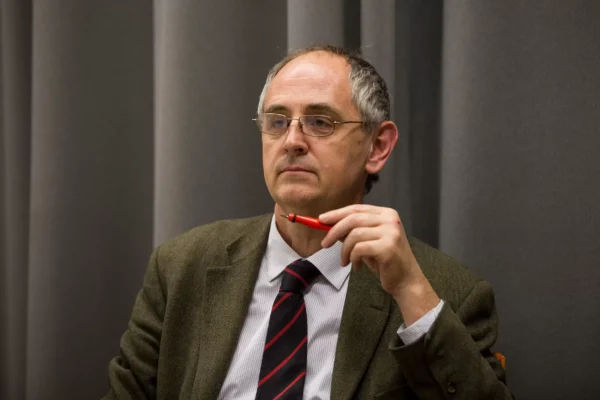
— Mr. Lucas, thank you very much for taking the time to speak with Guildhall today.
— Thank you for inviting me. It’s a pleasure to speak with you.
— Mr. Lucas, if we compare the period before 2022 and after, has the full-scale war changed the very nature of Russia’s hybrid warfare against the West, or has it only accelerated and scaled up what the Kremlin was already doing?
— It is definitely the latter. This so-called “hybrid warfare” is not a term I especially like. I prefer the old Russian term: active measures. These methods have very deep roots, going back to the Soviet era. Active measures were also visible in the 1990s. At that time, however, they were not primarily directed against Western Europe, so Western Europe chose to ignore them. But they were clearly visible in Ukraine, in the Baltic states, and elsewhere.
So the key change is not that these methods are fundamentally new. What has changed is the geographical focus, which has shifted westward, as well as the scale, sophistication, and intensity of these techniques.
— According to the Center for Strategic and International Studies, the number of Russian attacks in Europe nearly tripled between 2023 and 2024, after quadrupling between 2022 and 2023. By what means has Russia managed to scale up its efforts so dramatically?
— First of all, I think those figures underestimate the true scale of the problem. A great many incidents either go unreported, are covered up, or are not interpreted correctly. They are dismissed as random acts of hooliganism or ordinary criminality, when in fact they may be part of something much larger. So the real scope is bigger than what appears in public statistics.
What has changed most is Russia’s use of proxies — people who are paid in cash or digital currency and often have little or no understanding of the significance of what they are doing. They are simply told: go and burn this down, blow that up, buy a drone, carry out a delivery. They do not really care. They get paid, and from their point of view the worst that can happen is a fine or a prison sentence — and some of them are not especially deterred by that anyway.
The use of these disposable cut-outs is one of the key newer features. Another is the targeting of vulnerable transport and infrastructure systems: drone attacks on airports, attacks on undersea cables, GPS jamming. This is particularly alarming because it exposes how fragile the systems are that keep Western societies functioning.
— So after 2022, Russia has increasingly supplemented high-profile intelligence operations with lower-threshold, mass-scale active measures executed by proxies. At the same time, has Moscow preserved the capacity for highly complex, political, and expensive operations?
— Yes, I think there is certainly some of that as well. In particular, high-level engagement with political parties involves sophisticated use of access agents, money, and influence channels.
It is important to remember two things. First, this is a full-spectrum approach. It ranges from trying to bug the prime minister’s office or recruit someone close to power, all the way down to conducting a simple act of physical sabotage — and everything in between.
Second, what is visible is not the whole picture. Information operations receive a lot of attention because they are visible. If Russian propaganda is circulating on TikTok or Telegram, it can be seen, written about, and measured. But there should be just as much concern about the things that remain unseen. There is often a tendency to focus on one part of the problem, but the central point is much broader: Russia is conducting a sustained, broad-spectrum attack on Western societies with the aim of dividing countries from each other and dividing societies internally.
— It is increasingly reported that criminal actors have become not just occasional instruments, but a systematic part of Russia’s hybrid warfare. Much is often said about the criminalization of Russia’s armed forces — but should more attention also be paid to the criminalization of Russia’s active measures?
— Yes, absolutely. There has always been a kind of symbiosis between organized crime and the Russian state. Even in the Soviet period, shadow intermediaries and criminal figures helped keep the dysfunctional planned economy operating by identifying shortages and moving goods and services through unofficial channels.
Later, in post-Soviet Russia, that relationship became even more significant. It is well known that Putin had close connections with criminal circles in St. Petersburg during his time in the mayor’s office. In many ways, the real story of post-1991 Russia is that elements of the old KGB merged with organized crime and effectively took over the state.
Against that background, it should not be surprising that organized crime also serves as a vector of influence abroad. This was already visible in the 1990s. The criminalization of the armed forces is another manifestation of the same pattern. Wagner, for example, was essentially a kind of mafia militia, though it is far from the only example. There is every reason to expect that this trend will continue.
— How has the role of dormant or semi-dormant networks changed after 2022? Is Russia activating structures laid down years ago, or is it mainly building improvised new connections for specific tasks?
— From what is known about Russia’s illegal networks, an enormous amount has been invested in them, often with rather limited returns. The old-style illegals program — the sort associated with figures like Anna Chapman and others in North America — makes for excellent television dramas and spy thrillers, but in practice it may not have been as effective as popular imagination suggests. Some of those operatives were technically competent in certain respects, but not necessarily outstanding spies.
That is no reason for complacency, because even one useful agent can cause a great deal of damage. Still, the greater concern now is not the old illegals model, but the newer one: people operating under their own names, on contract, and able to do significant damage in a short period of time.
Russian tradecraft has changed. It has become easier to task people through cut-outs and to manage operations at a distance. There is no longer always a need to send a trained operative physically into the target country for a secret mission. If someone can be paid in one place through digital channels, and that person can then mobilize another intermediary somewhere else to sabotage a warehouse or carry out another act, that increases efficiency considerably — including for the bad guys.
— Speaking more specifically about the United Kingdom, what goals do Russia’s hybrid operations appear to be pursuing there now?
— Russia’s goal, always and everywhere, is to divide and rule. The more fragmented the outside world becomes, the easier it is for a large country like Russia to get what it wants. That is true across the board, but the United Kingdom is a particularly prominent target at the moment.
Britain speaks a great deal about supporting Ukraine and does provide meaningful support. But at the same time it is already more isolated from Europe than before, and increasingly less aligned with the United States. It also lacks some of the resilience structures seen elsewhere. It does not have the kind of comprehensive defense model that Finland has, nor the vigilance of the Baltic states. There are also technical vulnerabilities: limited air defense, insufficient protection for subsea infrastructure, and a general lack of civil resilience.
It is entirely plausible that Russia could use a combination of seabed attacks, cyberattacks, and drone attacks in ways that would be highly damaging to the country. Attribution would be difficult, certainty would be elusive, and the response options would be limited. The real weakness is not only technical but political: there is insufficient political will to do what should be done, namely to support Ukraine decisively and impose real costs on Russia. Public opinion is not fully prepared for that, and neither, in many cases, are politicians.
— One of the traditional goals of Soviet intelligence was to weaken the transatlantic link and drive the United States out of Europe. How would that process be assessed today?
— The transatlantic relationship has always been somewhat uneasy. Even going back to Eisenhower, there were periods of friction between Europeans and Americans. So it is not as though there was ever some perfectly harmonious golden age.
That said, trust has taken a severe beating. In previous decades, the relationship rested on a combination of shared values, practical cooperation, and self-interest. The trust has weakened, the shared values have come under strain, and what remains most clearly is self-interest. It is still in America’s interest to have European allies that can buy, coordinate, and act. But Europeans increasingly no longer view the relationship in the same way. Many feel bruised and want greater autonomy.
The problem is that Europe still needs the United States — its high-end capabilities, software, hardware, intelligence, and military enablers. So there is a gap between political sentiment and strategic reality. Over time, Europe may well get its act together, especially the Nordic, Baltic, Polish, and northeastern part of the continent, where the Russian threat is understood very clearly and where there is both money and willingness to act.
It may not be as effective as the transatlantic defense architecture that existed in its stronger form, but it could eventually become adequate. Still, from Russia’s point of view, anything that weakens or fractures the Atlantic alliance is a strategic gain.
— If the West does not change its approach to the Russian hybrid threat, what is the most likely scenario over the next few years?
— The most likely outcome is continued division and disunity across the West. The transatlantic gap will widen. Divisions within Europe will grow. Internal polarization within European countries will deepen further. Germany’s political scene is already increasingly fragmented, and other countries may also see stronger radical forces emerge.
That should not be overstated, however. Western societies have an enormous capacity for reaction and self-correction. When bad things happen, there is often first fear and anger, and then eventually a response. So although the coming years may be very difficult, that does not mean the outcome is predetermined in Russia’s favor.
In the end, Russia is fundamentally a weak country that gets many of the results it wants because of a lack of political will on the Western side. This is not the same kind of challenge as China, where the balance of resources is very different. So yes, there will be a difficult period ahead, but the long-term disaster is more likely to be Russia’s than the West’s.
— Mr. Lucas, thank you very much for your time and for this interview.
Exclusive for Guildhall by Taras Mokliak.
Только главные новости в нашем Telegram, Facebook и GoogleNews!
Tweet