
Russia is waging a hybrid war against Europe: provocative flights by UAVs and aircraft, probing borders, intimidation. The response must be firmness without panic, unity among allies, and increased aid to Ukraine as the main front. Peace is only possible through the failure of aggression and a determined policy of deterrence – “peace at any price” means slow-motion surrender.
Pressure must become systematic: strict enforcement of sanctions, blocking the “shadow fleet,” refusing Russian energy resources, targeted use of frozen assets for Ukraine, and reducing dependence on Rosatom. The rights of people under occupation require an international presence – a UN/OSCE mission to record crimes and protect civilians. The outcome of the war has global resonance: the defense of Ukraine and the containment of China are part of the same task of protecting the free world. European unity is growing stronger, with the US being a factor of uncertainty; Ukraine’s victory remains a key signal to aggressors from Kyiv to Taipei.
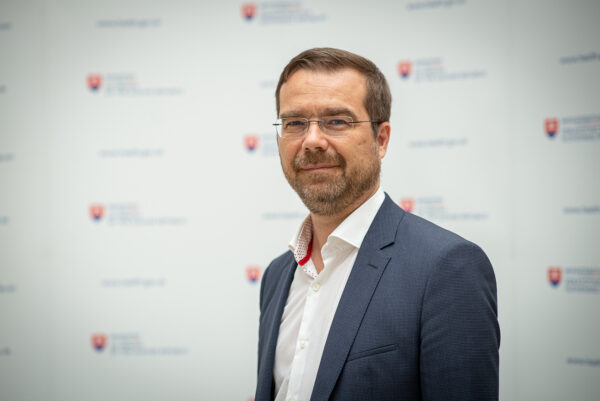
This was stated in a lengthy interview with the Guildhall news agency by Marek Krajči, a member of the Slovak Parliament.
– Recently Russian war drones “Shahed” have attacked Poland’s airspace. Russian war planes have attacked Estonian`s airspace. Every day we see some drones above european countries. NATO says that Russia bears full responsibility for escalatory airspace violations. Can you consider these cases as an act of military aggression?
– These are not accidents or navigational mistakes – they are deliberate provocations, part of Russia’s ongoing hybrid warfare against Europe. Let’ s be honest: Moscow has returned back to Soviet era and they are leading a full-scale hybrid cold war against us – but we in Europe are still not realising it fully. Moscow is testing the limits of our political resolve and unity. At the same time, it seeks to spread fear among European citizens. We must show we are not afraid, respond to these provocations firmly but calmly, and with unity. They remind us why NATO’s deterrence posture must remain strong.
– If so, do you support a significant increase in military aid to Ukraine as a response to all those acts?
– Absolutely. The only effective response to aggression is strength and solidarity. We need to be very clear: Supporting Ukraine militarily is not escalation. It is Ukraine’s undeniable right to defend its existence. And it is our moral duty to help Ukrainians in every possible manner. This aid must not only increase, but it must be more sustainable and predictable. Europe cannot afford let Ukraine fall – that would seriously threaten Europe’s security as a whole, and my country, Slovakia, in particular, being a direct neighbour. A stronger Ukraine means a safer Europe and safer Slovakia.
– Observing the developments in Ukraine (in particular the continued missile strikes on civilian infrastructure and the preparations for a new offensive in Eastern Ukraine), do you see any indication that Russia demonstrates a willingness for a peaceful settlement?
– Unfortunately, there are no credible signs that Russia wants peace. The continued missile strikes on Ukrainian cities and civilian infrastructure prove that Moscow’s goal remains destruction and domination, not negotiation. Russia’s behaviour proves that genuine peace will come only when it’s military aggression fails and Russia’s leadership realizes it cannot win this war. Until then, any Putin’s talk of negotiation and peace is just camouflage for conquest.
– Do you share the strategy of “peace through strength” regarding Russia, and that Russia must be compelled into such peace?
– Peace through strength is the only realistic approach. History has given us painful lessons. In 1938, the world witnessed the betrayal of Czechoslovakia in Munich — appeasement that led not to peace, but to war. Weakness invites aggression. Strength ensures peace. Eventually, we have just seen it in the Middle East, where only firm and decisive Israel’s action forced Hamas to finally release hostages and start negotiate. We also need to see the bigger picture: There are countries who are watching closely the developments around Ukraine and evaluate the costs of possible aggression – one example is China wanting to take over Taiwan. For a real, lasting peace in the future, it is absolutely vital that Russia, and eventually every country, understand that aggression does not pay off. This is also my answer to all those calling for peace at any costs – that is not peace, but capitulation in slow motion, as I‘ve said already in the past. Only just peace can be lasting peace.
– What additional levers of pressure to compel Russia towards peace are still available to the West and have not yet been employed?
– There still seem to be many options how to put compel Russia to peace. Some of them can be even more effective than military weapons. Western nations should:
- Enforce sanctions rigorously – such as close the loopholes that allow Russia to sell oil to finance this war. The most recent decision of the EU leaders, combined with the US sanctions on Russian oil companies, are bold steps in right direction.
- We should also put more pressure on countries that provide support to Russia, helping to prolong this war.
- Freeze and effectively repurpose Russian assets for Ukraine’s aid and reconstruction.
- Effectively influence Russian elites, to divide them and separate from Putin’s regime.
– According to Reuters, despite sanctions, Russia is expanding its shadow fleet, which continues to generate vast revenues for the Russian war budget. What further measures should be taken to counter Russia’s shadow fleet? Can it be completely blocked in the Baltic?
– It can, if we take enforcement seriously. This comes back again to the question of sanctions – the “shadow fleet” thrives on their weak implementation and many loopholes. There are many ways how EU and NATO allies can enforce such measures against Russia’s shadow fleet – but I would leave that for experts. What I want to say here is to respond to all those who say sanctions don’t work: Sanctions do work, just not overnight – but they can be very effective in draining Putin’s war machine and actually stop the war. It is just a pity that they come so late and so slow. Experts say that if bold sanctions were imposed early enough, the war might have ended by now. The real question is not whether they work, but whether we have the courage to implement them.
– The EU remains the largest importer of Russian gas – 51% of Russia’s LNG exports go to the EU, and in July alone Russia received €1 billion from the EU. What is your assessment of this situation?
– This is one of the most painful contradictions in Europe’s policy. It’s morally wrong and strategically foolish. Buying Russian gas, and oil, undermines our own efforts to stop the war and to the contrary, helps finance the war. Diversification is possible and alternative sources are available – including for Slovakia who is one of the last remaining recipients of Russian oil and gas. Europe has the means to diversify — we’ve seen countries like Poland and the Baltics already do it. Slovakia can too, especially through joint EU efforts. Even if it leads to temporary increase in energy prices – this is but a small price compared to potential costs of prolonging Russian aggression – and it is the least we can do in solidarity with Ukrainian people who suffer each winter without heating or electricity.
– The Russian corporation “Rosatom,” which produces both nuclear and conventional weapons for the aggressor state, is still not under systemic sanctions in Europe and continues its projects and cooperation. What steps can and should be taken with regard to “Rosatom”?
– It’s absurd that «Rosatom», a company building both nuclear plants and nuclear weapons for an aggressor, still operates freely in Europe. We must phase out this dependency, diversify nuclear partnerships — with European, U.S., and Asian partners. It is completely feasible, we just need to start working on it as soon as possible. In the end of the day, even in peace times, it is always better to diversify and have alternative options for energy supplies, be it oil, gas or nuclear energy.
– The issue of the rights of millions of Ukrainians living under Russian occupation remains largely absent from the international discourse. Recently, PACE characterised Russia’s actions in the occupied territories of Ukraine as “ethnic cleansing” amounting to genocide. Do you support the implementation of such a resolution at the national level in your country?
– I personally support such recognition. We must name crimes for what they are. I don’t doubt there is overwhelming evidence: the systematic attacks against civilians in Ukraine, deportations, torture, and Russification in occupied territories constitute ethnic cleansing and genocide. At the same time, I realize that such recognition should follow proper legal process and it should be firmly established beyond any doubt according to international law. The ongoing efforts to document each crime is so crucial here – but also to uphold the memory of the victims.
– Should there be a demand for the introduction of a UN mission to monitor human rights in the occupied territories of Ukraine?
– First of all, I wish that all of Ukraine would be free again. But as long as these territories are occupied, international presence is essential, to document crimes and protect the remaining civilian population. A UN or OSCE mission, coordinated with Kyiv and backed by EU and NATO states, could save lives and preserve evidence for future justice.
– Does the West remain united around the need for Ukraine’s victory in the war?
– Unity remains our biggest challenge – and our most powerful weapon. Too often, we keep hearing calls for immediate peace at any cost – these come from complete lack of understanding of history and how lasting peace works. But I also see hope: Europe today is more united and resolute than two years ago. We also see the unpredictable and changing position of the US administration – we see development there too – president Trump gradually coming to realisation that Putin is not reliable partner for peace. Slovakia, my own country, is experiencing this struggle firsthand. Our government’s stance, and in particular that of the Prime Minister, towards Russia and Ukraine, are a disgrace and in direct contradiction of our national interests. I want to make it very clear: they do not represent the opinion of Slovak citizens. I’m very proud of Slovak citizens who, in stark contradiction to the government, have shown time and again that they stand on the right side of history — by opening their homes to Ukrainian refugees, providing humanitarian and military aid, and even by taking to the streets against those who try to undermine our freedom. The people, not the politicians, represent our true values. As opposition in Slovakia, we send a clear message: we stand with Ukrainian people, your right to defend your nation. Ukraine’s victory and prosperity is our vital interest.
– RUSI has posted a research that Russia encourages China to seize Taiwan. What is your stand on this matter?
– If true, this is indeed alarming, but not surprising. As I already said, there are no doubts that countries like China are watching closely Ukraine and assessing their stakes in other fronts. If the West will accept the Russian occupation of Ukraine as a price for “peace” and Russia will get away with its aggression, it will embolden China to try the same with Taiwan. Europe must realize: defending Ukraine and deterring China are parts of the same struggle — defending the free world. Russia and China share an anti-democratic agenda aimed at weakening the international order based on rules and Western values of democracy and human rights. Europe should recognize that Taiwan’s security is directly linked to our own — the defense of freedom must be global, not selective.
– Last week at the Warsaw Security Conference, Taiwan’s Deputy Chief of Staff for Intelligence, Se Ji-sheng, stated that Ukraine’s defeat would signal to China that it could take more aggressive action against Taiwan. Do you share this point of view?
– Yes, as I already said, I fully agree with this assessment. Ukraine’s defeat would send a message not only to Beijing, but also to Iran and others, that aggression is acceptable way of pursuing their interests. Conversely, if Ukraine stands firm, it sends the opposite message — that democracies can and will resist tyranny.
– It is obvious that the West should react accordingly to prevent this scenario. What should be done to do that?
– To prevent that, we must act with clarity and resolve. The West needs to:
- Build a global coalition of democracies — NATO, the EU, Japan, South Korea, Australia, and others — united not only by interests, but by shared values.
- Deter aggression before it starts — through credible defense, technological superiority, and the political will to use both.
- Reduce dependence on authoritarian regimes — in energy, technology, and critical supply chains.
- But MOST IMPORTANTLY: Ensure Ukraine’s victory — politically, militarily, and economically. That’s the clearest message to any aggressor that freedom defends itself.
That’s why Ukraine is so important today — it is the frontline of the free world. If we stand firm there, we not only defend Europe — we defend the very idea of freedom, from Kyiv to Taipei. The way how we end the war in Ukraine will define the future of the next world order.
Guildhall, exclusively.
Только главные новости в нашем Telegram, Facebook и GoogleNews!
Tweet