
It is necessary to sharply ramp up military aid to Ukraine and send tough signals to Russia: this is a fight for all of us. The starting framework is international law and respect for borders; hybrid attacks must be met promptly and proportionately, while avoiding premature escalation.
It is necessary to adress the “shadow fleet,” strengthen financial and personal sanctions, confiscate assets via the Register of Damage and the claims procedure, introduce full restrictions on cooperation with Rosatom, while in parallel accelerating the transition to decentralized clean energy. At the UN it is necessary to take into account the risk of a Russian/Chinese veto and resort to General Assembly formats and peacekeeping only with a clear mandate; within the EU — to speed up decisions where the veto right slows assistance.
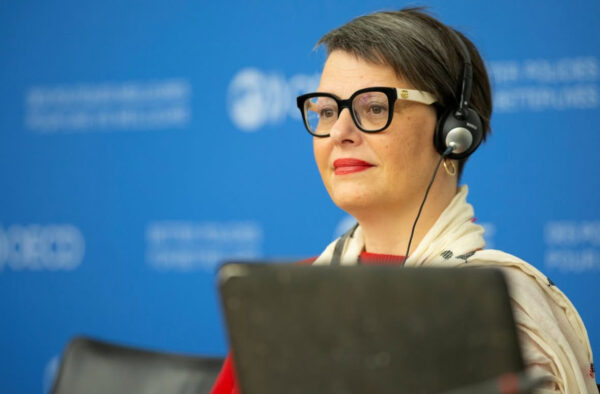
This was stated in an exclusive extended interview for the Guildhall news agency by Saskia Kluit, a member of the Senate of the Netherlands (GreenLeft) and a member of the Parliamentary Assembly of the Council of Europe.
— There are many concerns that China may attack Taiwan. The RUSI study says that Russia is sending equipment to China that can be used for an attack, and that Putin and his government believe the war in Ukraine may push China to start this war. In this context the West — Europe, the United States — should react accordingly. What is your overall view of what should be done?
— I am no specialist on the dynamics of that region. But in general, it’s quite simple. For me and my party the most important thing is to respect international law and the rule of law. And you can now see that, against the backdrop of shifting geopolitical balances, some countries feel they can do whatever they want whenever they want. I do not agree with this. We have established an international legal order to protect innocent people, the civilian population, from the “law of the strong.” It does not matter whether you are talking about China, Russia or Israel — for me it’s all the same. International borders must be respected. The will of people to decide for themselves and how they see their future must be respected. So their future cannot be imposed by any military means. If a state decides to respond militarily against another nation, we have many instruments we can use to exert international pressure and make it step back from that devestating path it has chosen.
— Various drones have been spotted over European airspace — over Denmark, Norway, Germany and other countries. Can these cases be considered acts of military aggression by Russia — all these episodes with planes, drones and the rest?
— You need to know the history — and of course you know it well. Russia rarely starts with full-scale military aggression. Long before that it begins a hybrid war. And now, on Europe’s border, you can see Russia “prodding.” It can be drones. It can be rockets. It can be attacks on critical infrastructure. It can be digital interference in elections. In other words, it’s a wide set of actions that Russia is trying to undertake. But, to be honest, not only Russia — other countries try it as well. And therefor, it seems to me, we should be both vigilant and ready to respond. We shouldn’t wait until military action begins. You need to respond at the moment we are attacked in a hybrid way — in a similar manner. At the same time, you always have to make sure you don’t start full-scale military operations too early. War is an extremely destructive means, and it is very painful for citizens. So in my opinion, a certain self-restraint also serves the common good. On in all the signals are extremely alarming, and I think we must be very attentive. I, of course, work in the Council of Europe — we have 46 states. Whenever we meet, representatives of the Baltic and Balkan countries, as well as countries from the Caucasus, are very clearly aware of the risks of what is happening. That is good and we in the West should learn from their experiences.
— We in Ukraine believe that Russia understands only tough and military signals. Do you support a significant increase in military aid to Ukraine as a response to these cases?
— Yes, that’s a very good question. We have supported Ukraine and its military provision from the very beginning. And my party has also done so from day one. Because we see how the people of your country have for long fought for their democracy. And that is a positive development. Your population has gone out into the streets again and again for a more democratic future and a belonging to Europe. In this you have our full support. And I also want to say thank you: in the Council of Europe, in my committee, we are preparing a report about the military people who are hurt on the military borders — about veterans. They do incredibly important work for the whole of Europe. I really want to thank everyone who do this important job of protecting Ukraine, and all the families that support the Armed Forces of Ukraine. So the short answer is — yes, we must help you. We must arm you as much as needed. And we must also prepare ourselves for a good, strong response to Russia’s aggression. So this is not only about Ukraine: for me, this is a fight for all of us.
— Do you support that Russia needs to be forced into peace?
— Yes. I truly believe we must use every possible means we have to make Russia choose a different future for itself. I do not believe that what is happening now is the future the people of Russia see for themselves. Naturally, when you are bombarded with propaganda day in and day out, it is very hard for ordinary Russians to realize this now. But in my view it is not in any nation’s interest to be in a state of war. That applies to Russia as well. And as Europe we can still take many steps to increase this pressure — through measures against the “shadow fleet,” and by disconnecting, for example, from LNG deliveries in tankers and from LNG terminals. We really have worked a lot — not only because of the war in Ukraine, but also for the sake of combating climate change and preventing it — to move our fossil interests out of Russia and shift them to other energy sources. I also believe that this is the future for Ukraine — to be less dependent on all these fossil fuels, because we now see how easily they can be abused in geopolitics. The only future is a clean future with a decentralized energy system. We should use this; we should use financial sanctions and personal sanctions. I think we must deploy every instrument we have, because we know: if we give clear signals now, we will save lives up ahead. Therefore we are obliged to do it.
— You mentioned the “shadow fleet” and LNG. Do you consider it possible to completely shut down the “shadow fleet” on the approaches to Europe? Is a full blockade in the Baltic realistic? After all, despite the sanctions, it is expanding and feeding Russia’s military budget.
— Yes, a blockade for the shadowfleet of the Baltics is possible and this is something we really need to try to achieve. Economically, it is evident that Russia is suffering, and it will be better if we make the price high and effective in the short term, instead of proceeding step by step, dragging it out for a very long time and thereby making it worse for everyone. Returning to the “shadow fleet”: I think there are many things we can still do — tighter control, strengthened monitoring, measures against companies that are trying to cooperate with Russian economic structures. But we also need to be realistic. Even if we close the Baltic 100%, new routes will be found. In my view this is a continuous “game of hide-and-seek,” because they will find new routes — to China, India or somewhere else. But we know what we can do, and there are steps that can still be taken. You described it very precisely: we adopt some measures, and then we see how everything shifts into a different channel. For example, if the reports I’ve received are true, in one of my ports we essentially accept fish that is in fact from Russia — the catch of Russian fishing vessels. It is transshipped somewhere in a Norwegian fjord onto another vessel, and then it enters a Dutch harbor. This is unacceptable. All of this is not what we want. And as soon as we discover it, we must take measures and hit such companies with economic means.
— And on LNG: how do you think, is it possible to completely stop imports of Russian LNG into Europe, into the EU?
— I’ll speak for my own country, because there are big differences between different countries. If you live in an Eastern European country and have minus twenty in winter, that may be a different story. I am sure my country can do much more to reduce our dependence on LNG. In the first year of the war both households and companies took measures. Energy prices shot through the roof — there was an economic incentive, and we showed we can do this. Of course, the price was high. People with low incomes suffered greatly, because they stopped heating their homes entirely. And although we don’t have minus twenty, that is still very uncomfortable. I understand. But if you look at this from the perspective that we as a continent are also a partner in this fight against Russia on many levels — and if the Russians came here, we would make sure these steps would also made possible — then I see two paths. The first is to repeat what we have already shown in cutting energy consumption: do it again and try to help people and companies stop using LNG or any other fossil-based fuel. The second is to build a decentralized energy system: for many reasons it is more flexible, more stable, more resourceful and resilient under attack. There are many positive aspects anyway.
— Another important topic is Russian assets in Europe. Confiscation could be a serious factor prompting Moscow to seek peace and a peace process. What is your view of transferring them to Ukraine as reparations, or confiscating them?
— I support this. I think that is the way to proceed. We gave them enough time to choose a different path. They didn’t. And it is absurd that the country which has been attacked is now suffering economically and financially. We see that we have, especially in Western Europe, a lot of legislation protecting property — post-war in origin — and it is not yet ready for this kind of situation. That is why we struggle: how to adapt legislation, which sometimes takes years, and at the same time how to act. But from my point of view we must discuss it and act. And here it’s fairly clear: you can start at the top and transfer. At the council of Europe of course, we have the Claims Commission and the Register of Damage, where Ukrainians can enter information about their losses. We are now launching the claims procedure — it will probably be organized in the Netherlands. And once that exists, you have a very clear link between the damage and the money you seize.
— There is another company that is not under comprehensive sanctions — Rosatom. What steps should be taken to restrict it?
— As a party (we are green social democrats, or social-democratic “greens,” we are merging two parties) we have already proposed full sanctions on cooperation with Rosatom. We are extremely critical of any interaction, especially in the field of nuclear energy. The medical area is more difficult. Essentially, there are two areas where cooperation continues. It may be easier to end interaction in nuclear energy than to “cut everything off with one stroke” everywhere. From a personal standpoint: I also chair the Health Committee in PACE, and I always believe that when it comes to treatment of seriously ill people, nationality should not matter — we must help them. That is a humanistic approach. So I can quite accept that cooperation continues in the medical sphere. But in nuclear — no.
— The Parliamentary Assembly of the Council of Europe adopted a resolution calling Russia’s actions in Ukraine “ethnic cleansing amounting to genocide.” Would you support a similar resolution at home, in the Netherlands — in the national parliament?
— I think so. Because it’s absolutely clear that the attacks are massive. We have a network on issues of Ukrainian children; there you very quickly understand that they strike at the position of children — and that is one very clear indicator that the goal is the destruction of parts or an entire people. They attack universities, attack the language, attack historic buildings. So apart from the huge number of victims and strikes on civilians, it is entirely clear that especially in the occupied territories there is ethnic cleansing and an attempt to replace Ukrainians with Russians. For me this fully corresponds to what we see. Although in my country there is an official policy to recognize such things only after a judicial body’s decision. I am not sure what year this specific report was adopted: we actually adopt two or three reports on Ukraine at each session — there is a lot of work. But I think the discussion has already taken place, and for us it is not a major subject of dispute — “is it genocide or not.”
— Perhaps we should think not so much about a resolution as about a call for a UN mission to monitor human rights in the occupied territories, to prevent all these crimes?
— Yes, the idea is of course very interesting. But you need to take into account: if you want to act within the UN, you always have to go through the Security Council. And I am not sure that, with Russia there, it will pass. And China — yes, that is an other problem. Naturally, there are other routes, as was explained around the situation with Israel and Gaza: the General Assembly can also bring forward such proposals. Peacekeeping forces are an option. But you always need to understand what their mandate will be, what they will do, what they will achieve. In the Netherlands we have a very painful experience with Srebrenica, where we were the peacekeeping force and did not receive support at the moment when it was needed. Therefore we will evaluate very strictly whether the conditions for such a peacekeeping mission — if you take it through the General Assembly — are such that you can actually do the work on the ground. Otherwise, it should not be done — it will create a lot of problems for the military of any country.
— Is the West now united around Ukraine’s victory and countering Russian aggression?
— You see, the heart of democracy is that you are never “fully united,” because there are different opinions within a country. And that is actualy a great feature of democracy. In Europe it’s the same. It is perfectly obvious that some countries are, so to speak, very, very hesitant in supporting Ukraine. But I do not share their views at all. I consider Ukraine a very inspiring example of a country that fights for democratic values and for human rights. Any country and any people that does this should receive support. So you are entitled to count on our support at any time. In that sense I would say that the West — in the context of democracy — is indeed united. But our system at the EU level is arranged so that we still have the veto right, which can in the meantime block very logica land important steps. And we see that this may need to change: the geopolitical situation requires speed and flexibility in the EU, and too much effort and time is now being wasted debating. It cannot be that one or two countries, because of their domestic situation, say “let’s not do it” when twenty-five others say “we must do it.” This is perhaps a call for the European Union to begin moving to the next level of European cooperation.
— That’s all. On behalf of our entire team I thank you for your work, your position and your kind words. We greatly value your position and your help.
— Thank you. See you soon. Thanks again.
Guildhall, exclusive.
Только главные новости в нашем Telegram, Facebook и GoogleNews!
Tweet