
France increasingly sees Russia as a direct threat to the nation and to Europe. The public debate still features voices that dress up appeasement as “being for peace,” yet when positions must be formalized, red lines hold. The response is to get stronger rather than theatrical. Air defense for Ukraine and initiatives like Sky Shield France reflect that shift from rhetoric to capability.
Hybrid incidents across Europe are read less as linear escalation and more as systematic testing of NATO, European institutions, and citizens’ resilience. Cable cuts, drones near airports, and propaganda flurries probe reactions and search for seams. The answer is unity and deterrence, not recycled “peace plans” that freeze lines without justice. The hybrid campaign against the Baltics is already under way, while Russia’s conventional readiness is limited by chronic mismanagement. Security rests on sustained support to Ukraine, firmer European capabilities, and a clear refusal to be intimidated. Long term, regime engineering is neither desirable nor necessary; pressure, resilience, and Ukraine’s success will make the imperial model untenable.
This was stated in a lengthy interview with the Guildhall News Agency by Frédéric Petit, member of the French National Assembly.
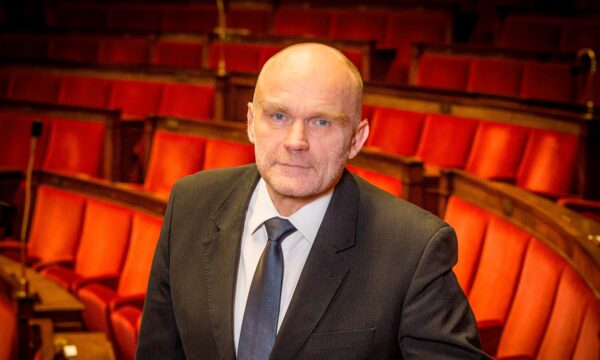
– In your estimate, do people in France see the Russian Federation as a danger to them and to the country?
– Yes, clearly. What may look troubling from the outside is not a political crisis but an institutional one. We also have a surface-level public debate where some voices say “Russia wants peace,” or claim “I am for peace,” and then use that to criticize Ukraine or to twist history. But when politicians must write such claims down and formally commit to them, they become very careful. They do not cross red lines, because they know society will not accept it. I travel a lot to small towns to give talks. Earlier this week, in a village of just a few thousand residents, about a hundred people came. They were already convinced on the essentials. Not that they say easy things or stupid things — they ask good questions, trying to understand a region they do not know well. We spoke for two hours. The understanding was clear: Russia acts as an empire. I often explain it is not only about territory, it is about models. Ukraine belongs to the model in which different peoples accept differences — language, history — and still work together. Think of the Cossack and Ukrainian past, deep history, the history of Odesa, and the Polish-Lithuanian Commonwealth. On the other side is a model that says: because you speak Russian, I am the boss. In France, this is increasingly understood.
– Across Europe we see hostile activity after the full-scale invasion — drones, damaged seabed infrastructure, cyber incidents. Do we see an escalation in Europe and in France?
– I would not use the word escalation. Escalation implies a competition in aggression, which is not the case. We are getting stronger in defense. The idea of protecting the sky over Ukraine is advancing. I launched Sky Shield France, and in November we held a public meeting for anyone who wanted to discuss it. It was not a concert; it was not meant to be fun. About one thousand people came. This is not about hating Russia; it is about being stronger if we want to remain democratic, and about showing that strength.
– Then how do you read actions like drone flyovers or cutting cables in the Baltic or Black Sea? What is the goal?
– Testing. They test NATO and Europe, and they also test citizens’ readiness. Cutting a cable or flying drones near a major airport is not about provoking a nuclear response. It is about observing the public debate that follows. If people say “it is nothing,” they push further. If the reaction is “this is dangerous,” they recalibrate. They are testing future resilience. It is testing more than pure military probing.
– NATO is a prime Russian target after Ukraine. Do you see operations aimed specifically at dividing the Alliance, and how should NATO answer?
– There are attempts to divide us, for example through recurring “peace plans” and buzz about negotiations — 28 points, 22 points, 19 points. You often see a point about “restoring the economy between Russia and America,” or now the G7 or G8. For me it is clear what that means: it is an adaptation to the reality that the United States still leads NATO. I am not in Congress, but I do speak with members of Congress. Recently, with colleagues from a European-Mediterranean parliamentary network created four years ago by Koubiliou, we went to the United States twice to meet Republicans face to face — in March and in June — to explain our position. It was not easy and not very clear then. But last week you saw Republicans publicly opposing the current course of American diplomacy; some were strong figures, including two we had met. I do not judge American politics, but there is a problem to watch closely. As for Europe, we are not as strong as NATO, yet our direction is right. I would rather take the risk of losing with trusted friends than count on people I do not trust.
– About the so-called 28-point “Trump plan,” which you view as a Kremlin plan. What should Europe and NATO do instead to reach peace?
– Four viewpoints matter. First, Ukraine. For eleven years Ukrainians have said: we are the ones under attack, we defend ourselves, and we want peace. We want economic growth for our children; we want dignity. That was true two weeks ago before the “28 points,” and it is true today. President Zelensky’s key line last week was: I already gave my answer four years ago. Second, Europe. The reaction was immediate and united — we cannot accept those points. We will go to Geneva and acknowledge that an action was taken, but we do not agree with the 28 points. Third, the United States. Too often the debate shows little knowledge of the region, and the leak of that conversation only added confusion. They said stupid things about Gaza. Gaza is not a desert. Gaza is one of the oldest and most symbolic cities, as significant a big city as Jerusalem. It is not a desert. The Trump team shows they do not understand what states are and what is happening there. Fourth, Russia and China. Moscow’s advance is real but slow and very expensive. Remember the panic around Avdiivka; now ask the distance to Pokrovsk. Careful people say one hundred kilometers; I say closer to fifty — that is three years. There may also be a U.S.–China trade-off over Taiwan. We do not know what was said, but perhaps Trump seeks something in exchange for paying less attention there. I look at the evolution of China–Russia relations over four years. I think China opposed the invasion at first, then joined later to take advantage, as China often does. Perhaps they profited, but now their support may be more in question. If you are a Russian leader and you imagine China might leave you alone tomorrow, you begin to say: maybe I have to do something. In short, nothing truly new in the 28 points. Perhaps something will appear on the nineteenth around this “front line” idea. A frozen line does not recognize borders internationally — we see that elsewhere. It could be presented as a ceasefire and used in the tricky relationship between the Kremlin and the Russian public to claim: we achieved something. That might offer the Kremlin a way out, but it does not make it just or durable.
– Conventional risk: do you see a military danger for Europe today?
– You can have “little green men” in Estonia. There is also the Suwałki Corridor. But I see two things. First, the hybrid war against the Baltics has already begun. Let me give a recent example. Six to eight months ago, a dean at Moscow University published a new “scientific” book titled History of Lithuania — with a foreword by Pavlov. In it you “learn” the Lithuanian language does not exist, that the best period for Lithuanians was under the Russian Empire, and that Lithuania collaborated with the Nazis, and so on. Exactly the same ideological pattern as with Ukraine. It mirrors Putin’s August 2021 speech about Ukrainian “brotherhood” and history. The hybrid war will last. It divides society and manufactures incompetence among the enemy. The Kremlin benefits when extremist parties advance — AfD in Germany, Rassemblement National and La France Insoumise in France — and when Roman-area candidates gain. You cannot hand them the keys to the bus; some cannot even ride a bike, yet Russia backs them. I would call this “incompetence among the enemy.” Second, on the conventional side, I doubt Russia’s readiness. Beyond producing more tanks or shells, management and competence matter. Soviet-era industry became ill not because of science but because of management. I am convinced Chernobyl’s cause lay in stupid management — perhaps helped by alcohol. In the 1990s, when I worked with an energy company in Lithuania, I saw directors drunk at noon. For me that is worse than being drunk on a motorway — not only for them but for the people depending on them. Did you see Baikonur yesterday? It was not a brave failed attempt; it was incompetence. They lost their launch tower — unrelated to mission learning — simple mismanagement. Even if they produce more, they are not ready. Systems where every paper must be signed by the biggest boss do not fight well. Ukraine’s strength comes from delegation and initiative.
– In Ukraine many believe there are two tracks to lasting security — Ukraine wins on the ground, and Russia’s regime changes. Do you agree on the second?
– As a democrat, I cannot advocate changing another country’s regime by force. We have to think in the long term. I am too old to be pessimistic, but I will try not to be too optimistic. The end of the Soviet system was preceded by a quick hardening of the regime. Andropov — the first KGB chief to become General Secretary — brought harsher control, but his rise also signaled fragility. The KGB’s strength had been to remain in the government’s shadow. With Putin, the security apparatus returned to power, yet the imperial model looks less and less sustainable. Consider the reversal on the Chinese border. Twenty years ago Russia there felt like a leader; now it is the opposite. The Chinese are the strong side, with yuan power; the ruble is weak; they are the big brother. Add Baikonur’s failure and even basic state-capacity crises like the Moscow fires years ago. If the long arc holds, Russia will one day need us. The hard part will be doing what France and Germany did after World War II, or what we expect in the Balkans — turn enemies into partners. That is the most difficult thing for human beings.
– Thank you for your time and support for Ukraine. I hope we will see you soon. Have a good day.
– Thank you. Let us stay in contact. Bye-bye.
Exclusively, Guildhall.
Только главные новости в нашем Telegram, Facebook и GoogleNews!
Tweet