
Slovakia’s view of Russia is built on mixed memories. Soviet occupation sits alongside a long-taught storyline that once cast Moscow as a partner, which helps explain today’s split public mood. The current government recycles pro-Kremlin narratives that blame Ukraine, while polling puts the opposition slightly ahead on domestic grievances like prices, taxes, infrastructure and corruption rather than foreign policy.
Hybrid pressure is rising across Europe and in Slovakia it fuses with homegrown conspiracy politics. Moscow’s goal is to weaken EU and NATO cohesion, using Bratislava as a lever when possible. The toolkit ranges from migrant push-ins via Belarus and drone incidents to embassy-stoked pseudo-scandals and attempted recruitment, all amplified by social-media algorithms. The near-term risk resembles a 1948-style dismantling of democratic competition more than a 1968-style invasion. The antidote is unity, turnout and institutional vigilance, backed by the basic truth Ukraine has already proved: determined allies can stop the Kremlin’s project.
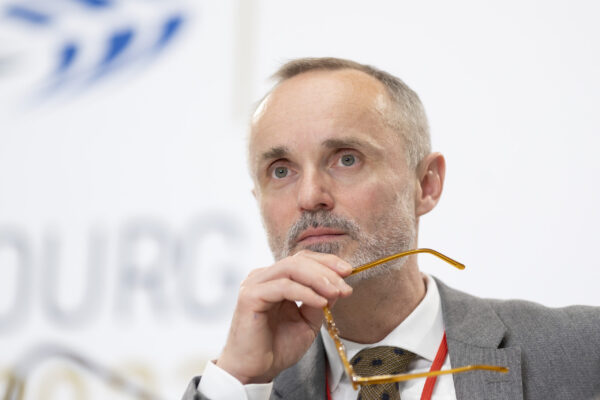
This was stated in a lengthy interview with the Guildhall News Agency by Tomáš Valášek, Member of the Slovak Parliament from the Progressive Slovakia party.
– Do Slovaks perceive Russia as a danger to them and to the country, and how do they view the situation in Ukraine?
– Slovakia is not Poland or Estonia; we don’t share the same historical animosity toward Russia. That’s not entirely true — we did have Soviet occupation from 1968 to 1991 — but for much of our history there has been a strong current that saw Russia as a partner in Slovak emancipation from the Austro-Hungarian Empire, mainly the Hungarian part. That theme is still taught in schools, so our mindset differs from, say, Poland or Estonia. That said, Slovakia can view Russia through a national-security lens. The Dzurinda government (1998–2006) clearly made the case that Russia is a potential threat and that we must join NATO, and public support rose dramatically. People are open to the message when it comes from the top. The current government, however, says the opposite — portraying Ukraine as responsible for the war and Russia as a misunderstood victim of a Western conspiracy.
– And what do Slovaks think of the current government? Polls show the opposition slightly ahead. How divided is the country?
– The country is fairly evenly divided, but consistently in recent months the opposition has pulled ahead and the government has fallen behind in public-opinion polls. For most of the last nine months, if you trust the polls, the government would be unable to form another majority. This isn’t mainly about Ukraine or foreign policy. Polls show security and foreign policy aren’t top-five issues for most voters. It’s quality of life: inflation, electricity prices, higher taxes, dilapidated infrastructure, train crashes, and justified suspicion of high-level corruption. Those factors are dragging the government’s ratings down more than its foreign-policy stance.
– On hybrid warfare: after the full-scale invasion, Russia didn’t stop its hybrid operations in Europe. Do you see escalation now?
– It’s hard to tell in Slovakia because our own government and many leading politicians — including the far-right, openly pro-Russian Republika party, currently third in polls — are so deeply mired in conspiracy thinking that it’s hard to see where Russian disinformation ends and their own politics begin. Here, they’re closely intertwined. We don’t even need a busy Russian embassy; our prime minister and his political allies can do plenty of damage to solidarity and national unity on their own.
– Why is there notable support for the right wing in Slovakia?
– Two observations. First, a response to EU integration: after joining the EU, countries often go through a sobering and a search for identity distinct from a European identity. You saw a conservative turn in Ireland after accession. Nation-states look for a national definition and resist becoming purely European. Second, in many Eastern countries there is generationally driven nostalgia. Those who grew up under communism tend to be anti-communist and skeptical of modern Russia. Younger people have no memory of communism; many pensioners remember guaranteed minimum social standards. You get a coalition of some young people rebelling against the mainstream and many pensioners believing they were better off under a socialist system.
– What are Russia’s goals in leveraging a pro-Russian government in Slovakia — disrupting NATO and the EU?
– I don’t think Russia created this government; it uses and assists it. Slovakia is a means to an end, not the end itself. The end is weakening the EU and NATO. Putin’s worldview favors big states dominating while small and medium states don’t get a vote. Two obstacles stand in his way: NATO and the EU. The EU equalizes big and small states by giving smaller ones like Slovakia a real seat at the table. NATO guarantees protection for small and medium states against the kind of pressure and attack Russia treats as normal. He wants both weakened or gone. He has been gifted two governments — Orbán’s in Hungary and Fico’s in Slovakia — to act as a battering ram against EU/NATO unity, to slow and water down sanctions, and to portray the EU as weak. When voters see small countries blocking common defense steps, they lose confidence in the EU — exactly what Putin wants. Slovakia matters to him only insofar as it helps break EU and NATO unity.
– And the goal of the Slovak government itself?
– Survival and reelection, like most governments. Their calculation is that nostalgia among pensioners and rebellion among some youth can propel them to another term. It’s cynical populism, not ideology.
– Methods: beyond Soviet-style infiltration and influence, have you seen new Russian tactics?
– Not new so much as higher intensity. A well-publicized case two years ago: a Russian operative was recorded offering a bribe to someone with a security clearance to leak secrets. Traditional recruitment continues. In Slovakia the challenge is smaller because many politicians willingly collaborate; there’s no need to recruit or cultivate them — they repeat the lines on Telegram because they think it helps reelection. The embassy also “opens cases,” turning benign events into scandals. A local mayor repaired a neglected cemetery; the embassy framed it as “defacing a Russian cemetery,” filmed it, and it went viral. Government figures amplified the narrative. We haven’t seen sabotage like in Poland or the Czech Republic — there’s no point when pro-Russian politicians are already in power. Sabotage elsewhere serves to discredit pro-Western governments and project Russian omnipresence.
– Russia finances far-left and far-right groups and exploits tensions like migration. Do you fear radicalization in Europe and in Slovakia?
– Yes, but I blame social networks even more. Algorithms reward extremism over accuracy, truth, balance, or wisdom. Russia feeds those algorithms with nonsense, and it works. Since X (formerly Twitter) began publishing location data, we’ve seen leading disinformation accounts in Slovakia based in Russia. But if you removed either Russian disinformation or social networks, removing social networks would be more stabilizing. Russian propaganda would have far less impact without corrosive algorithms.
– Conventional military danger: is Russia a real military threat now to Europe and to Slovakia?
– We’ve all heard warnings from French, German, and British services. Applied to Slovakia, I worry more about “1948” than “1968.” In 1968, Warsaw Pact armies invaded Czechoslovakia. In 1948, there was a communist coup that abolished democracy. I think Russia aims for a 1948-style outcome in Slovakia — engineering a coup by marginalizing or banning pro-EU/NATO parties and changing the system so no other party can take power. They feed anti-EU, anti-NATO disinformation and encourage changes to electoral laws. Their aggression against Ukraine also helps their narrative: portray Russia as too strong to resist, so people demand accommodation. In reality, Russia isn’t ten feet tall. Its economy is about a tenth of the EU’s. NATO could prevail easily if we were determined.
– How can this be made impossible?
– Ukraine is already showing the way: national will, unity, and proof that Russia can be stopped on the battlefield. If Ukraine — much smaller than Russia — can do it, NATO certainly can. For Slovakia the answer is vigilance and turnout. We faced rule-bending before in the 1990s; civil society and voters pushed back and voted the offenders out. It takes vigilance and the courage to vote.
– That was all for us. I’m very glad to have a like-minded partner in Slovakia.
– The pleasure was mine. Many thanks for your excellent questions and for the work you’re doing in Ukraine and beyond. Let’s keep in touch.
Exclusively, Guildhall.
Только главные новости в нашем Telegram, Facebook и GoogleNews!
Tweet