
Hybrid pressure on Lithuania is constant: engineered migrant flows at the borders, ongoing propaganda and cyberattacks, and new drone overflights across Europe used for intimidation. Vilnius fortified the Belarus border and improved cybersecurity, but drone detection and clear response protocols still need work. Smuggling has shifted to balloons; not every case is state directed, yet Belarusian services likely tolerate it, so Lithuania must also disrupt the domestic market that receives the cargo.
Moscow’s aim is to keep the EU and especially NATO unready, and the outcome turns on Ukraine. Russia is constrained by the war, and trade or energy ties never moderated its revisionism. In the Baltic Sea the shadow fleet brings military, economic, and ecological risk; traffic can be controlled and should be blocked. The answer is two tracks: support Ukraine and build resilience at home through cyber defenses, intelligence sharing, and steady readiness for disruptions. If Ukraine falls, Europe faces catastrophic consequences.
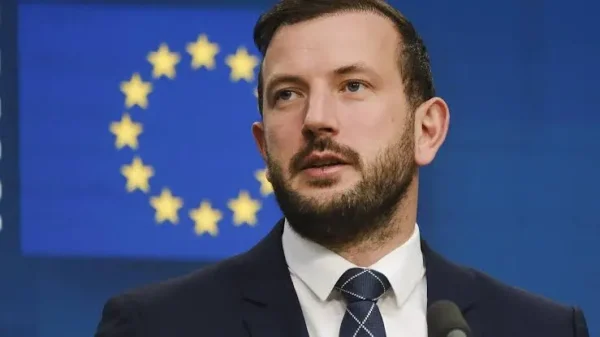
This was stated in a lengthy interview with the Guildhall News Agency by Virginijus Sinkevičius, Member of the European Parliament from Lithuania.
– What hybrid threats from Russia do you see for Lithuania today?
– Hybrid threats are not new. The most visible example was the migrant pressure when people were pushed to the Lithuanian, Latvian, and Polish borders. But there are constant propaganda campaigns and constant cyberattacks. Lately, not only in Lithuania but across Europe, including Belgium, we’ve seen drones flying overhead — acts of intimidation. People often think “hybrid war” means something like Crimea, but that isn’t entirely accurate. Hybrid warfare is ongoing and has many angles. The current wave is an opportunistic push aimed at intimidation.
– How do you assess Lithuania’s current strategy for countering these attacks and provocations? What works well, and what needs improvement?
– On the migrant front, Lithuania acted decisively. Most importantly, we strengthened our border with Belarus. This is about more than migrants — it’s also about smuggling and contraband. The response was sound, and the outcome was a more secure border. We’re improving in cybersecurity. We’ve seen a few drone incursions, and here detection and response need to be strengthened. The government is working on better drone detection and on clear reaction protocols. Our airspace isn’t closed, so you can’t just start shooting; you need a precise algorithm for response. Generally, we should react with measures that reduce the likelihood of future incidents.
– We’ve also heard of some balloons coming from Belarus into Lithuania. What can you say about that?
– Balloons began appearing after we sealed the border with a wall. Smugglers shifted from overland routes to drones, and when drones became easier to detect, they started using balloons carrying 40–50 kilograms. We also need to address the domestic illegal market for cigarettes. Balloons arrive because someone in Lithuania receives them and distributes the product across Europe. I would avoid escalating this and first address it domestically. These networks are well connected in Belarus and are not friendly to our country. I wouldn’t automatically label every balloon as a hybrid attack — balloons are hard to maneuver and drift with the wind. I wouldn’t pin each case directly on the regime. Of course, Belarusian services likely know who’s flying them and could stop it, but they don’t. So our first task is to solve the domestic part of the problem.
– Russia also tries to act from within. Are there Russian proxies in Lithuania spreading propaganda and fueling hybrid operations?
– It’s hard to know who is a direct proxy and who is a “useful idiot,” who simply hates any government in Lithuania and seizes opportunities. We saw this in Ukraine as well: some took Russian money, others just wanted power at any price. We certainly have many of the latter. They present themselves elegantly, but they try to stir conflicts with Ukrainians who fled the war, and they inject disinformation about support for Ukraine. With everyone able to publish from a phone, algorithms often amplify negativity over facts. Even so, I’m pleased with Lithuanians’ resilience to propaganda. Our support for Ukraine doesn’t swing the way it does elsewhere; that matters. It shows people understand. After almost four years of war some become desensitized, but the majority have not — and that is crucial.
– Looking ahead, what are Russia’s goals? Is it trying to divide NATO and the EU by interfering in member states and weakening support for Ukraine?
– It’s difficult to predict specifics, but Russia’s goal is clearly to keep the EU — and especially NATO — as weak and as unready as possible. Tactical choices will depend on how the war in Ukraine ends. Our future is being decided in Ukraine. Had Russia taken Kyiv in three days as planned, Europe would be in a very different place now. Russia is bleeding and getting weaker, its economy isn’t resilient, and it’s stuck in Ukraine. That limits other tactical moves for the moment. This period has also forced others to see Russia as it is. Trade and energy ties didn’t moderate its policy — Russia’s foreign policy remains aggressively revisionist despite neighbors’ internationally recognized borders.
– The Baltic Sea is another concern. The Russian “shadow fleet” is expanding. It poses military, economic, and ecological risks. Is a complete block on such vessels in the Baltic realistic?
– It should be. The Baltic Sea has narrow access points, so traffic can be controlled. We could prevent shadow-fleet operations in the Baltic, but some member states lack the political courage. Blocking them is the only way: these ships circumvent sanctions, threaten the environment, and can serve as tools of hybrid warfare. We saw what happened with undersea cables. It’s essential that such vessels do not operate in the Baltic.
– One last question: what should NATO and the EU do to counter this hybrid warfare? More military aid to Ukraine?
– We should support Ukraine as much as possible, and then more. That alone won’t end hybrid attacks — hybrid warfare is relatively cheap and about disruption. You rarely know where or when it will strike, so prevention can’t be total. We need to do two things in parallel: support Ukraine, and strengthen our own capacity to react. Be prepared, don’t panic, but be ready for disruptions. Invest in cyber resilience and cybersecurity. Improve intelligence sharing to preempt attacks where possible. Above all, we must support Ukraine. The suffering is real, and the consequences if Ukraine falls would be catastrophic. We have to act accordingly.
– Thank you for your work and your position.
– Thank you very much. I hope we’ll speak again soon.
Exclusively, Guildhall.
Только главные новости в нашем Telegram, Facebook и GoogleNews!
Tweet