
Hybrid warfare targets the quiet core of democracy: social trust. It hides in ambiguity, so success is hard to judge in real time. Drone sightings that shut airports in Brussels and Gothenburg, GPS jamming in the Baltic, and similar incidents disrupt daily life while injecting doubt about facts and about one another. The danger is cumulative, not a single episode but the slow corrosion of a shared reality.
Effective defense begins with clarity and resilience. Expose pretexts, state verified facts, and refuse to go soft on support for Ukraine. While Russia is not judged a direct military threat to Sweden today, its strategy seeks to soften societies, use proxies that mimic ordinary citizens, and exploit the Baltic theater, from undersea cable damage to a growing shadow fleet. Europe should reinforce both military and civil defense, protect critical infrastructure, coordinate within the EU and NATO, and preserve social capital so essential services and trust endure under pressure. Sustained support for Ukraine and a united West deny the very outcome hybrid tactics aim to produce.
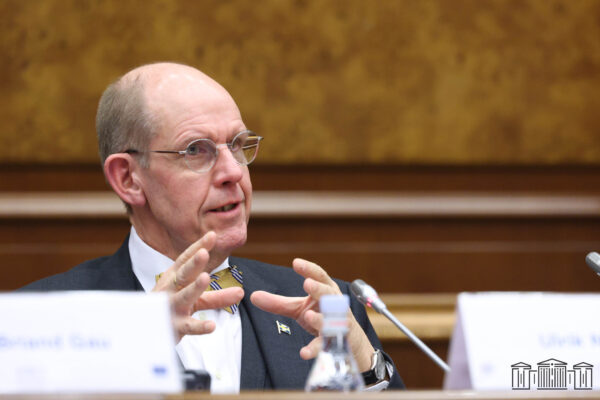
This was stated in a lengthy interview with the Guildhall News Agency by Ulrik Nilsson, Member of the Swedish Riksdag.
– What hybrid pressure from Russia do you see today for Sweden?
– I’d start from another angle. The problem with hybrid warfare is that you often don’t recognize it until after it happens. If actions were flagged as acts of war – as the rules of war and the Geneva Conventions prescribe – the method would be useless. It’s like being asked, “Have you ever been fooled on the internet?” Sometimes I recognize attempts and can handle them; other times, if I was fooled, I wouldn’t know. That’s the point. It’s always hard to judge success in real time. What truly worries me is how this undermines social trust. When I don’t know whether an attack is happening, I’m tempted not to trust others. If I receive an invitation written in Cyrillic, I may wonder whether it’s someone tied to the Putin administration or an ordinary Ukrainian journalist seeking an interview. That erosion of trust hits the core value of democracy – the ability to trust your counterpart so we can discuss and understand. In that sense, it’s similar to terrorism: the real damage isn’t only the attack; it’s that we change our behavior to avoid it – then the tactic has succeeded. There were drones over an airport in Brussels; one was identified over Gothenburg, and the airport shut for hours. Was it a real threat? I don’t know. But trust wasn’t there, and many people had their day disrupted. The danger is less the immediate effects of single incidents than the cumulative effect on society: we change how we look at fellow citizens; trust is undermined.
– We’ve heard about GPS jamming in the Baltic from ships, drone incursions, and airports closed in Stockholm and elsewhere. What do you think the goal is in these cases?
– The goal is precisely that erosion of trust – the “gold” of democracy. In a healthy democracy, people share a common factual baseline and then draw different opinions from it. Hybrid tactics try to inject “alternative truths” – for example, “Ukrainians provoked this; it’s their fault.” Once that narrative enters the system, trust erodes. That’s why there’s a political responsibility to stand firm and say clearly: this is not the case; here are the facts.
– How do you assess Sweden’s current strategy for countering these hybrid threats? Russia has been identified as the main national-security threat.
– On military countermeasures, even as a member of parliament I shouldn’t know – or, if I do know, I shouldn’t say. That’s strategy. I hope most Western European countries have a strong vaccination against fake news and half-truths. Whether that will be sufficient in the long run is part of what this war is about. Since Russia cannot conquer a country like Ukraine, I don’t see it as a direct military threat to the rest of Europe right now. But if Russia can influence political will in our countries, we may go soft, leave Ukrainians to fight alone, and risk their defeat. Their strategy is to soften societies like Sweden’s. We are therefore very clear about standing with Ukraine. I do see that this approach has had more success in places like Hungary or after the recent Slovak elections – it pays off more in the war against Ukraine than in direct conflict with Europe. My position – and most Swedes share it – is that brave Ukrainians are fighting for all of Western Europe. We must stand firm and dismiss, not endlessly debate, disinformation from Russian sources. Again, the hardest part isn’t the narratives we can identify – it’s the ones we don’t catch, that slip under the skin.
– Hybrid warfare mixes economic, political, and information tools and can strike from inside. Are there Russian proxies in Sweden that Moscow could use from within?
– Most likely. But they will follow the patterns of ordinary Swedes. Despite those images of men in rough suits and special hats, they won’t show up like that. They will look and behave like normal Swedes. Sometimes I can spot them and argue with them. I receive many emails from ostensibly ordinary people; based on some of the views they push, I suspect proxies of the Kremlin or troll factories in St. Petersburg.
– The Baltic Sea seems central to Russia’s activities and threatens the Baltic states and Sweden. What about the expanding shadow fleet that funds the war budget? Can it be blocked or restrained?
– My military background is in the Swedish Coast Guard reserves. Years ago I spent almost two years studying Soviet naval installations and operations in the Baltic. I’m used to thinking about threats from the east – even if today only a small part of the Gulf of Finland is Russian in the Baltic theater. We now have friends in Estonia, Latvia, Lithuania, and Poland – plus the Kaliningrad enclave. Consider the undersea cables. If I went to Red Square and said Russian naval captains are so poorly trained they forget to weigh anchor before sailing, I probably wouldn’t survive the day – that would insult Russian professional training. Yet we are asked to believe damaged Baltic seabed cables are from ships dragging anchors. That defies logic. Yes, Russia has strategic interests in the Baltic. Yes, there is a shadow fleet. Yes, the revenues help finance the war. But the real danger is us going soft in support for Ukraine, because the war is there. I wish more people would stand in a square in Stockholm and say, in effect: no, your captains didn’t just forget the anchor. Making such pretexts ridiculous punctures the intimidation effect and helps us stand for our values. If we don’t take the threat seriously, in 10–20 years it could become a military war – especially for our Baltic friends, perhaps not Sweden in a first strike, but we must be prepared. Right now it’s more important to remember Russians are ordinary human beings. If we make the bluster ridiculous instead of treating it like an omnipotent menace, we can sustain support for Ukraine. I have no doubt Ukraine will win. It’s impossible for roughly 140 million Russians to control a nation of 50 million Ukrainians; you would need an enormous occupying force just to control the population. As long as Ukraine stands strong, it cannot be conquered, and we must stand strong in support.
– Cables, drones, GPS jamming – do you expect more intensification of Russian hybrid warfare in the Baltics, Europe, and Sweden? What might Russia do next, and how should the EU and Europe prepare?
– We must prepare in both military and civil defense. If something bad happens but we preserve trust among people, society can keep functioning. Even if my bank account were frozen, my local grocer who knows me might still let me buy food – that’s social capital. The core objective of hybrid warfare is to undermine those democratic fundamentals. Politically, some parties may see short-term gains in exploiting distrust; that makes this primarily an information war for now. We need shared systems with like-minded partners. Sweden has long been in the EU and is now, more recently, in NATO. It’s been a long road from cherished neutrality to clearly saying who our friends are and teaming up with them. One challenge is that not every country in the EU or NATO is a fully robust democracy – shared values matter. Also remember: Russia isn’t monolithic. There’s a huge difference between middle classes in St. Petersburg or Moscow and rural regions – in values, opportunities, everything. As sanctions bite, internal strains will grow. When this is over – when Ukraine secures its freedom – we must also remember that Russia has been part of Europe for centuries. There are great Russian artists and composers. We should invite Russians back into the European family – when they know how to behave: respect human rights, democracy, and the rule of law. I observed a Duma election, I think in 2012, and saw massive cheating. Nobody seemed to care. Even in a decent election United Russia would likely have won, but not with those figures, and the opposition would have done better. That’s the core problem. There are good people in Russia, and we should find ways to give them courage – the big change will come from within the Russian state.
– Thank you for your thoughts and your work. We are very glad Sweden is such a friend. Ukraine and Sweden have much in common – from the Cossack era and Mazepa to Poltava. I believe we’ll have a good future because we share interests and face a common adversary.
– And we share blue and yellow colors – both countries and the European Union.
– Absolutely.
– Thank you very much. Bye-bye. Have a nice day.
Guildhall, exclusively.
Только главные новости в нашем Telegram, Facebook и GoogleNews!
Tweet