
France now treats Russia as a direct threat to the country and to Europe. After President Macron’s March 2025 warning, public awareness rose and the official line hardened. The deputy cites a sharp intensification of Russian hybrid activity since 2024: AI-driven disinformation networks, vandalism and intimidation, suspicious drone overflights, attempts to sabotage cables at sea, and campaigns aimed at polarizing debate, weakening support for Ukraine, testing resilience, and influencing elections.
The message for policy is firm and practical. Strengthen conventional and nuclear deterrence, modernize forces, tighten NATO–EU coordination, cut strategic dependencies, build societal resilience, and keep long-term support flowing to Ukraine. The aim is not regime change in Moscow but an end to the war on terms acceptable to Kyiv and the international community. Europe must act with unity and prudence: transparency over propaganda, preparedness over denial, peace through strength.
This was stated in a lengthy interview with Guildhall News Agency by Laurent Mazaury, a member of the French Parliament from the Union of Democrats and Independents party.
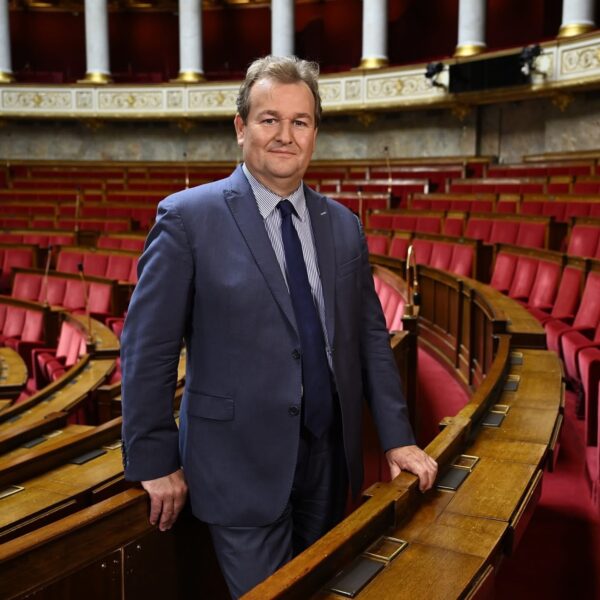
– A political leader must explain the challenges facing the state, yet also account for electoral sensitivities. In your view, does French society see the Russian Federation as a threat?
– Based on my meetings in the constituency – yes. A majority in France now sees Russia as a direct threat to France and Europe. In March 2025, President Emmanuel Macron publicly called Russia “a threat to France and Europe,” sharpening the official line and raising public awareness. Broadcast to 15 million viewers, this statement sparked a national debate about strengthening defence and resilience. France’s military leadership and the 2025 National Strategic Review both identify Russia as “the most shaping threat” – militarily and through hybrid actions (cyber, disinformation, sabotage). That said, perceptions are not uniform: parts of the left, especially the far left, warn against “war hysteria” and insist the ecological and social transitions must not be sacrificed for rearmament. I do not share that view. We must be mentally prepared and continue to deter Russia from any action against France and Europe. Our armed forces, nuclear deterrent and diplomacy must work tirelessly. And I do not confuse the Russian people with their current rulers.
– RUSI says that alongside its war on Ukraine, Russia has intensified hybrid operations against the West. Do you see such an escalation?
– Yes. Based on well-documented evidence, since 2024 Russia has stepped up hybrid operations against France and Europe. According to CSIS and the EU, the number of Russian hybrid attacks in Europe nearly tripled from 2023 to 2024 and continues to rise in 2025. This includes cyberattacks, disinformation campaigns, sabotage of critical infrastructure, and repeated election interference among our European allies – potentially here in France tomorrow. France has been specifically targeted: in 2025 our services recorded large waves of disinformation (via networks such as Storm-1516 and Portal Kombat), physical attacks (Molotov cocktails against SMEs, suspicious drone overflights, coffins and pig heads left at mosques, provocative and antisemitic graffiti), and attempts to manipulate public opinion on immigration, support for Ukraine and national cohesion. The EU and NATO have repeatedly condemned these activities as “destabilizing,” noting their intensification since the war began.
– What are Russia’s objectives in hybrid operations against France?
- Weaken national cohesion: polarise debate, discredit institutions, erode trust in the media and elites.
- Undermine support for Ukraine: targeted disinformation about the “ineffectiveness” of French military and humanitarian aid.
- Test France’s and Europe’s resilience: through provocations, sabotage and cyberattacks — finding weak spots and discouraging responses.
- Influence democratic processes: the 2024 European elections were a prime target via social media and fake news sites — and, unfortunately, this is not over.
In France in 2024–2025, a series of incidents underscored hostile activity: in June 2024, five coffins draped in the French flag were left by the Eiffel Tower inscribed “French soldiers of Ukraine”; large-scale disinformation drives spread via AI-generated articles and videos, deepfakes, and pro-Russian influence networks; and cyberattacks on companies and critical infrastructure were attributed to Russia’s military intelligence (GRU).
– It is no secret that Russian services rely on the KGB’s subversion toolkit. Have you or your authorities identified new hybrid methods?
– Yes – clearly identified and attributed to Russia: heavy use of AI to generate disinformation (articles, videos, deepfakes) and to automate its distribution; recruiting local “saboteurs” via Telegram to carry out vandalism and intimidation; plus targeting energy and digital infrastructure with drone attacks and GPS disruption. At the same time, the “old” methods persist: KGB-style active measures (planting false narratives, using pliant media and agents of influence), classic espionage and sleeper infiltration in political (including within parties), economic and media circles, and the exploitation of social divides (migration, inequality) to weaken cohesion.
– Which actions specifically against NATO do you observe?
– I see repeated violations of member states’ airspace and waters (Poland, Romania, the Baltics), joint drills with Belarus (e.g., Zapad-2025) simulating conflict with the Alliance, and suspected sabotage of undersea cables in the Baltic Sea attributed to Russian vessels or proxies, alongside disinformation aimed at discrediting NATO and sowing discord among allies, notably regarding enlargement.
– Reports of violence within such hybrid operations (attacks on politicians, assaults on migrants) are multiplying. Given the known ties between Russian services and extremist/far-right groups in the West, do you fear radicalization?
– Yes – the risk is real and documented, and I share it as a member of Parliament. Russian services maintain links with extremist and far-right groups, instrumentalizing them to destabilize democracies; they act as amplifiers of Russian propaganda. In France, cases of disinformation on the extremes — aligned directly or indirectly with Kremlin interests — have been identified, with sporadic acts of violence by individuals holding anti-Western and anti-NATO views. The EU and NATO warn of escalation risks up to attacks targeting politicians, migrants and state symbols.
– How do you assess Russia’s conventional military threat to Europe?
– Serious and growing. German and French intelligence services assess that Russia could be able to launch a conventional attack on a NATO country by 2029–2030 — depending on the war’s course and Europe’s preparedness. Russia has rebuilt stocks and modernized forces, ramped up output (tanks, artillery, drones), and spent 7.1% of GDP on defence in 2024 — rising further this year. Feared scenarios include a limited attack on a Baltic state or Poland to test NATO’s response, and greater pressure on the Alliance’s eastern borders.
– How to make such a threat impossible?
– We cannot make aggression impossible, but we can reduce the odds that a threat turns into action. Priorities are clear: strengthen conventional and nuclear deterrence by raising defence spending, modernizing forces, and improving NATO/EU coordination; cut strategic dependencies in energy and critical technologies while building societal resilience; and sustain support for Ukraine, since a Ukrainian defeat would signal weakness and embolden Moscow.
– Do you agree that neutralizing the Russian threat requires both a Ukrainian military victory and regime change in Russia?
– I support self-determination and democracy — not French or European interventionism in sovereign states. The Russian people must choose their path; if they decide to reform, they must also accept the costs of that choice. That said, I — like France and the EU — consider a Ukrainian victory essential for European security and deterrence. The official goal is not regime change in Moscow, but ending the war on terms acceptable to Kyiv and the international community. Strategically, opinions differ: some argue for a durable weakening of Russia (sanctions, diplomatic isolation, internal pressure); others warn of the risks of uncontrolled destabilization, notably regarding nuclear proliferation. The latter point calls for prudence: we should not play “apprentice sorcerers” by interfering in Russia’s internal affairs. At this stage, I share NATO’s and the EU’s line: long-term military, economic and political support for Ukraine, combined with managing Russia’s expansionist aims and a conditional dialogue with Moscow.
– In sum: Russia is the aggressor; its leadership has already committed war crimes (numerous atrocities against civilians) and crimes against humanity (deportation of children). On the French side, we have taken the measure of the threat – but we must avoid both denial and panic. Our response must be firm, united and proportionate. Russia uses every lever to divide us; our best defence is transparency, resilience and European cooperation. We must prepare our armed forces for all scenarios, while prioritising de-escalation (Si vis pacem, para bellum – “If you want peace, prepare for war”). Peace in Europe rests on international law and solidarity with Ukraine. Ukraine’s victory is not optional; it is a condition for our collective security. We do not seek war with Russia – we seek a just and lasting peace.
Exclusively, Guildhall.
Только главные новости в нашем Telegram, Facebook и GoogleNews!
Tweet