
Peace is only possible with reliable guarantees backed by force – a weak agreement opens the door to new aggression. We need air defence and a ‘sky shield’, stable funding for defence production and energy security, and the return of children and prisoners. The lesson of Budapest for Kyiv is simple – paper without force does not work.
The EU must act as a defence-industrial power – joint procurement under EDIP, local content, integration with the Ukrainian industry, less procrastination and more unity. Transatlantic ties are important, but Europe must be independent alongside the UK, Norway and Ukraine – to stop the war and lay the foundations for a just and lasting peace.
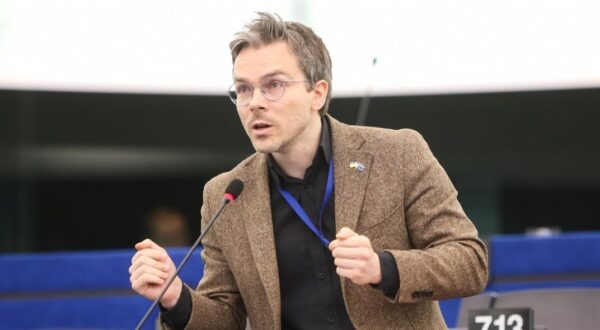
This was stated in an interview with the Guildhall news agency by French Member of the European Parliament Thomas Pellerin-Carlin (Group of the Progressive Alliance of Socialists and Democrats).
– Even during the peace negotiations, we see that Russia is not going to step back from their expansionist demands. Just a week ago, Putin declared officially that all the goals of the so-called special military operation have to be fulfilled. Taking into account this, experts, at least in Ukraine, are agreed that the real security guarantees which will make new aggression impossible is a key question within the framework of this peace process. What do you think about that? Do you agree that that’s the key issue right now?
– I think that’s one of the key issues, but there are many, many key issues. One of them, obviously, is the release of the Ukrainian children that were kidnapped by Russia. Also, the release of the prisoners of war and the return of the bodies of the fallen. And obviously, territory is a key issue there. We cannot accept to be in a situation where aggression is being rewarded. You know better than I do the problems that Ukraine is facing, that the world is facing. And let’s say, to put it mildly, the unpredictability of the U.S. president is clearly not being helpful. Then the question there is, what can we do as people in the European Union, as policymakers at the EU level? We can do several things. The first one, obviously, is to increase the material, the moral and the financial support we provide to Ukraine. We are continuing to work together with Ukraine, especially in the area of energy, which is the area where I am prominently active, to make sure that Ukraine can get the material that it needs in order to have an electricity system that is as resilient as possible to the attacks that are happening. That goes from units to produce electricity, solar panels, wind power, etc., as well as elements to the grids. This has been a constant cooperation between Ukraine and the EU for the last years and something that we need to intensify. And on top of that, I’m one of the many members of the parliament that are supporting the so-called Sky Shield initiative. And as a Frenchman myself, I would be in favor of the French president to decide, possibly with other allies, to propose to Ukraine that the French Air Force could try to protect the sky of a part of Ukraine, possibly around Lviv, if we want to start in an area that could be more acceptable for European public opinion. Simply because if we have the capacity to intercept Russian drones and Russian missiles and doing that in a way that protects both Ukraine and Poland, because we’ve seen some of them going to Poland, is a step that I think France should be able to take now. But obviously, I see the capacity of Europeans to procrastinate, and you know that better than I do. We’ve been doing the right thing, but too little; too late, we must unify that a bit more and more quickly.
– Do you see any threats to the EU if there is an agreement without proper security guarantees?
– We need to zoom out. Some people in the West have the impression that this started in 2022. You know better than I do that from a military perspective, it started in 2014. And if you look at the Russian capacity to destabilize Ukraine politically and not only in internal politics, then I don’t know when it started, but way before 2014, to say the least. So, the final objective we want to reach is a just and long-lasting peace. That is the final objective that we all want. And so, therefore, when looking at any discussion of so-called peace or ceasefire, we need to ask ourselves what was done in the past and failed. I think we are about to celebrate the more than 30 years anniversary of the Budapest Memorandum, which, to say the least, was not respected by Russia, but also not by the U.S. nor by the UK. And so, discussions about security guarantees are important, but they need to be backed with hard power. Otherwise, they’re just ink on paper. And we know that ink on paper does not protect civilians from tyrants.
– There is also an expert’s opinion that the only one positive experience — an analog of such a conflict solving — is the model based on the South Korea experience, when it was a two-side mutual defense agreement; in this case, a two-side mutual defense agreement between the U.S. and Ukraine, signed by the U.S. Senate, when others, including European partners who are willing to do that, can join. So, experts in Ukraine say that such an agreement should have a juridical obligation for the sides, when the attack on Ukraine will be perceived as a threat to the United States and, of course, mutual defense as an agreement. So, what’s your assessment of such a proposal?
– It’s always interesting to look at what happened in the past. In the case of Korea, it works, but it also works because North Korea doesn’t have the economic power to do anything. And North Korea is much smaller in terms of population. Just look at the map of North and South Korea at night from a satellite view. You see South Korea with a lot of light and North Korea with little. And so, a structural reason why North Korea has not aggressed South Korea again is simply because they’re extremely weak and they know that they’re weak. And so, the comparison there is already a big difference between the situation between North Korea and South Korea and Russia and Ukraine. On top of that, most of the Korean War, especially the last years, was fought by non-Koreans. You had a lot of U.S. troops, but also French troops fighting together with South Korea. This is not the case in Ukraine, as you know. And on the North Korean side, it was mostly Chinese soldiers in the end that were doing the fighting, which is currently not the case for Russia, even if they had in the end some critical North Korean support. Whenever I think about an analogy, and maybe because I’m French, I’m thinking about the First World War, which has been very traumatic for France still today. Still today, the French day where we honor the veterans is November 11th, the end of the First World War. In the First World War, in 1918 there was a very difficult moment for France. At the beginning of 1918, Russia collapsed — because the Russian Empire did collapse several times already. Russia collapses in late 1917, and in early 1918 a big part of the Russian Empire is occupied by Germany. But Germany had now many, many soldiers that they could send west. And the German army is pushing and pushing and pushing and pushing. They’re gaining ground, they’re gaining tens of kilometers per day, which was a lot, to the point that they come very close to Paris. And finally, the French beat them during the Second Battle of the Marne. And that was the moment where we achieved victory. And there were the counter-offensives later in 1918 — we’re talking mostly here August, September, October. And that is the moment where we knew we would win. And when the war was won by France, together obviously with its allies — the UK, the U.S. — there was not a single centimeter of German territory occupied by France; and a big part of France was still occupied by Germany at the time they surrendered. It’s simply because the German army collapsed on itself, and the German economy collapsed on itself. The point is: structural strength, endurance and hard power decide outcomes more than paperwork.
– Do you see that United States political elites realize that these security guarantees and relevant proper settlement of Russia’s aggression is a key moment for the United States as well?
– There are definitely some people in the U.S., including the U.S. Republican Party, that think that. But the guy making the decision at the end is Donald J. Trump. It’s not only that neither you nor me can predict what he’s going to do — he himself cannot predict what he’s going to do in the next days. And he is someone that is reaching old age. And, you know, it’s just downhill from there. Some people say that the version of Trump that we see today is the best version of Trump that we’re ever going to see, because as time progresses, he will not become more rational, more calm. So to me, again, the question is really: what can we do? My role as a Member of the European Parliament is to ask myself what can the European Union do. And to give you one precise example: I was delivering a speech last week in Strasbourg, and it was an important — I mean, the speech was not important, but the vote that we had after was important. It’s something called EDIP so that’s the European Defence Industry Programme. And that’s the first time in European history where we put EU money, not only national money, to procure military equipment together while having a local-content requirement — that’s the word we use in Brussels to say that we need to make sure that a big part of the military component is actually made in the EU — and therefore to free us from U.S. dependence. We know that we will remain dependent on the U.S. on some military capabilities for some years, but we need to make sure that at the end of the day, we can rely on ourselves — and “ourselves,” when it comes to European defence, is the EU together with the UK, together with Norway, together with Ukraine too. And in this programme, there is a specific window for cooperation with Ukraine, not only because it’s in our interest as Europeans to support Ukraine, but also because we need to make sure that we are up to speed with the best military equipment — and clearly Ukrainians in many areas, especially drones, know better than Western Europeans. And so we need to learn — not only to be able to support Ukraine in a more efficient manner, in a more effective manner — but also to make sure that we can deter Putin from doing to Narva or to Lapland — places in Estonia and in Finland — what he has been doing in Donbas already for so many years.
– Thank you very much for this fundamental and interesting conversation. Thank you for your also personal efforts, which are quite significant on the field of resisting Russian aggression. And we are very much looking forward to seeing you again.
– I don’t know to what extent this is known in Ukraine, but the courage of the Ukrainian nation — the society, the soldiers, the doctors, the people fixing the electricity grid — this is something that gives us in Western Europe a lot of courage too. And so we are inspired by what you are doing. And this hopefully will lead us to do a better and more effective job in the EU to support you until victory. And I hope to still be a Member of the European Parliament when Ukraine will join the European Union. And I would be happy to see people elected by Ukrainian EU citizens in that future Europe that we all strive to build together.
– By our joint efforts, I believe that’s the future of Ukraine and the future of the European Union — sitting together and fighting for democracy together. Thank you very much. It’s always a pleasure to listen to your opinion and to get insights from yours. Thank you very much, sir.
– Thank you.
Guildhall, exclusively.
Только главные новости в нашем Telegram, Facebook и GoogleNews!
Tweet