
Russian provocations in the European sky drone flights over Poland and incidents involving aircraft near Estonia are increasingly regarded as a test of NATO’s resolve. There is an urgent need for a forceful response: deploying air defense (AD) systems with a range that covers western Ukraine and prevents new violations of airspace.
At the same time, Europe is actively discussing the acceleration of arms supplies, the removal of bureaucratic obstacles for volunteers of the International Legion of the Armed Forces of Ukraine, as well as the tightening of sanctions pressure. This includes the confiscation of Russian assets, the introduction of restrictions against «Rosatom» and the «shadow fleet,» and a complete rejection of Russian gas imports.
This was stated in an interview to the Guildhall news agency by Katrijn van Riet a Belgian Flemish nationalist politician.
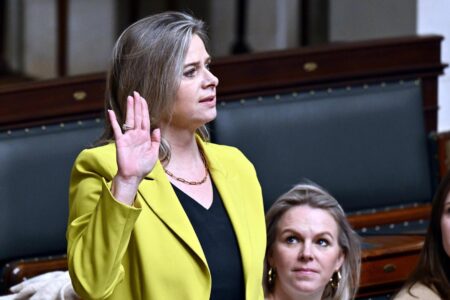
– So I want to start, unfortunately, with bad news. We heard about Russian war drones all over the Europe, above Poland, above Denmark, above and other countries. We’ll also hear about Russian warplanes in Estonia’s airspace. In Estonia and in Poland. So can we consider all those cases as an act of military aggression of Russia?
– Yeah. But first of all, I don’t think that in all states and all the drones have been identified as Russian. So it’s not always the case we can suspect it’s Russian or other people who play with Russians or with Russian Federation. But not all items have been identified as such. And of course the planes in Estonia, was it on purpose? Was it by accident? Was it by not knowing? We have to be, I think that certainly the NATO partners are very aware and they are very on guard as well, more and more, but they won’t identify it immediately as a state of aggression.
– I understand it. NATO and Mark Rutte say that Russia bears full responsibility for these airspace violations. And how do you think NATO should react in the future for such cases?
– I heard NATO will react and but will also be very, very careful of shooting down planes or because then it’s immediately an act of aggression of NATO and we are in war. And it would be very destructive for the naval boats who are in the seas, in the Black Sea and in the White Sea, observing all Russian movements. Because if these boats have to go, it would be a very big problem for Ukraine.
– In Ukraine we believe that the only signal Russia understands is uh military aid and the military pressure on it. So do you support a significant increase in military aid to Ukraine after those cases with drones and planes?
– Yeah, we must. There are several things to do. We must support Ukraine by supporting militarily. But also we have to cut Russian resources and facilitators of Russian finances and reinforce Ukraine’s defense. That’s something that we have to do to force Moscow to negotiate.
– We are thankful for you for that. And maybe what are additional levers of pressure to Russia that haven’t been used yet in the West, in the EU, in NATO?
– I can think of many things like secondary tariffs and to target Russian finances that fuel the war economy. Yeah, we must put Russia on an economic dry spell. That’s only way to make them that they surrender. And we need to close all the loopholes by targeting first the direct exporting channels, banks and intermediaries. We have also to target the re-export channels through third countries. We have to tackle their indirect trade and sanction who facilitate the Russian trade. For us then, we have to make for the indirect trade, we have to make sure that we find alternatives for energy supply, like the LNG, the gas that’s rather crucial. So we need to strengthen our energy capabilities and make them resilient. But another path leads us to diplomatic isolation to silence Russians’ claim of legitimacy. We have to make sure that we are still open for peace discussions, but on fair terms, not on the Russian terms, on fair terms that are supported by the Ukrainian people. It’s so true, yes.
– And you mentioned LNG, Russian gas, to Europe. What do you think? Can Europe fully set up its import from Russia?
– In fact, the current situation, the situation that we that we have now with lots of Russian gas is a result of policies that that were facilitated by people who were either naive in the past, or they did it by the good grace of the Russian leadership. Yeah. And we will investigate the motives. Now we have to deal with the consequences, but it was sure that the Russian Federation wanted us to be dependent on them so they could use it as a diplomatic blackmail to say. And we will not buy into that again, but now we are confronted in this situation and we already cut off a lot of oil supply. This is already good thing. So the oil has been cut off for most cases, but then the gas. Yeah, we have to find an alternative for our strategic autonomy of gas and we are looking to do so. The current deadline, I believe is 2027. But we might progress faster if those, it’s not all the countries. It’s those who are so dependent on Russian energy are offered viable alternatives. Of course, they can buy lots of gas, but at a very high economic price and we can’t push them like that neither. But we are very aware that that by cutting off this this gas supply that that’s evil.
– And in this context, it’s also important to talk about Russian shadow fleet, which is expanding, is fueling its war budget. And what more should be done to stop it to curb it? Is a full blockade in the Baltic realistic to shadow fleet?
– That’s very difficult. By international maritime law, a complete blockage would be very difficult. Because there is no formal state of war. Not with us. So it’s with Ukraine and the Russian Federation. But we can’t state there is a peace of war, a state of peace neither. It’s not the case. So yeah, we are not naive. Moscow is prepared to defend the shadow fleet. And we must know that NATO is a defensive alliance and we are prepared to step up. So we can deny ports and services in European Union and sanction intermediaries and create blacklists, but it requires a sound cooperation of all our member states, of all the member states. And we can try to bargain with other countries in the world to stop accepting the shadow fleet practices and we’ll offer them trade incentives. Companies and persons that facilitate the shadow fleet will be prosecuted. It’s an interesting path. And also Russia has a lot of assets in Europe. They are frozen now but its confiscation could be a massive factor for Russia to start real peace protests, to find negotiations.
– What do you think about confiscation and transferring it to Ukraine, maybe as reparations for us?
Yeah, I know this has been several times, it has been popped up, but it’s not the Russian Federation. It’s the capital or the money is there is not from the Russian Federation. It’s from Russian belongings. So it’s not a state and it’s a it’s a very difficult precedent to to cut off. I know that our prime minister said we don’t have to slaughter the chicken with golden eggs. We first have to eat a golden egg. So we used the interest to support Ukraine. But we’d like to keep the capital for negotiations or leverage later on when the war is over. But in this case, I think it’s very difficult to proclaim or to say what to do. This is really for a governmental level.
– I want to talk also about humanitarian sphere. It’s very important for Ukraine. We now have millions of Ukrainians who live under Russian occupation. It is a difficult life. And parliament, possibly on the Council of Europe, called Russia’s actions as ethnic cleansing, amounting to genocide. And would you back a similar resolution at home?
– In fact, we have had the same question about Palestine and about the Gaza. In fact, we are very aware of the policy what the Russian Federation is doing and all the atrocities they do on Ukrainian people and the policy of displacement and brainwashing and even the children they want to raise in the Russian way. It’s horrible. But the term Genocide is a very strict legal term and cannot be declared by politicians. It has to be declared by an international court or international tribunals. But we fully support themongoing uh investigations that you are making. And nevertheless, we would support also resolutions in the parliament that’s condemned these horrible policies that the Russian Federation is making. We also in we had a resolution that has been voted to support the atrocities in Gaza for the Palestinian people. But we can’t declare as a politician, it’s a genocide. There are politicians who do so, but we don’t. It’s a legal term. So we have to stick to our business. This resolution, it is called amounting to genocide. So it is called ethnic cleansing. So not genocide, amounting to genocide.
– And maybe if not resolution, should there be a call for a United Nations mission to monitor human rights in the occupied territories to prevent all those crimes there?
– Yes. For this I can say yes. The human rights situation is certainly in the Russian occupied territories is very bad. We acknowledge that. And these days the focus tends to lead on the Middle East. But the international community cannot and should never turn a blind eye towards what’s happening here in the east of Europe. So we have to defend human rights and the rule of law is non-negotiable. And we support the idea of the UN mission as a moral imperative and as a matter of European security and justice. And those who are responsible will be held accusable. I hope so.
– And the last for today, and maybe the most important, is the West united now behind Ukrainians victory and countering Russia? Is it united at all?
– Yeah, but then you have to define what for you is the West, because China and stuff is not the West. But yes, we agree that Ukraine is within its rights and we believe in the sovereignty of Ukraine. While some argue against the Western set of international laws, it’s a system that has been proven that it fosters peace. So the alternatives that have been offered by uh very authoritarian systems that you have in North Korea or Russian Federation have been tried. They have been tried in the past and they all lead to misery, corruption and high attribution rates and overall instability. European security and rules-based international order, they have their flaws, but they are worth defending and viable. So we will defend these values. And if Ukraine wants to join, that’s up to the people. But they have seen how the Russian alternative looks like. So I think we are in that in on that path. We are all standing together. And as you mentioned, Russia, Iran, North Korea, they are trying to break this international law system, the rule-based order. And what I still want to, would like to add, Alexander, if you allow to do me so, I’d like to refer. I’m not sure if you heard the speech of our prime minister at a UN conference in New York last week, but in fact, he was uh quoting Tuky Didis, who sided between war between Athens and Sparta long way back. Athens and Sparta two titans and Milos was a mini state, mini island who was squeezed between these two titans and who had to choose which camp they would belong to. And in fact, Tukidida said the strong do what they can and the weak suffer what they must. You hear? The strong do what they can and the weak suffer what they must. So, our Belgian Prime Minister said we don’t believe in a world where this is the case. That’s why we have these larger organizations like the European Union, like NATO, like the UN who invest collectively in defense. It’s not up to the titans to decide and the small ones to suffer or to undergo. It is very interesting, interesting quote.
– I thank you for your position, for your help, for this conversation. It is very insightful.
Guildhall News Agency, exclusive.
Только главные новости в нашем Telegram, Facebook и GoogleNews!
Tweet