
A ‘territorial exchange’ is unacceptable for Ukraine, as the war would have already ended if Russia had withdrawn. To speed up this process, it is necessary to strike at the Kremlin’s main source of income – oil: tighten control over the ‘shadow fleet’ through insurance, flags and registries. At the same time, we should move away from gas and oil.
However, the EU remains a union of 27 separate countries with insufficient defence capabilities. The London meeting of leaders pushed for rapprochement on the issue of Ukraine, but disagreements on other issues and dependence on the US keep Europe in limbo.
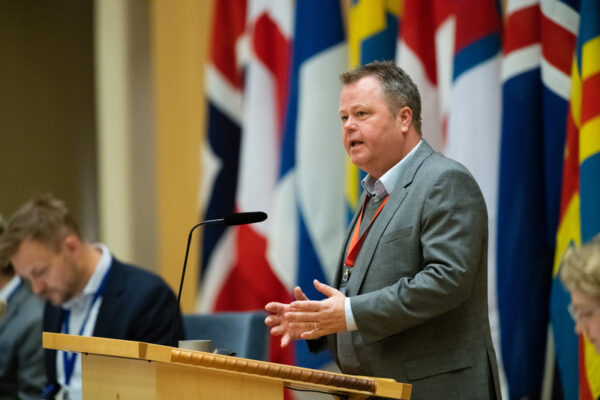
This was stated in a lengthy interview with the Guildhall news agency by Henrik Møller, a Social Democratic member of the Folketing and former chair of the Baltic Parliamentary Conference, which deals with security issues in the Baltic Sea.
– Before the full-scale invasion of Ukraine, it was often said that Ukraine was not a subject but an object of world politics. If we analyse the behaviour of the United States and the European Union, don’t you think that the EU itself is now shifting from being a subject to an object against the backdrop of rivalry between the United States and China?
— I think we would like to be a subject, not an object — that is, to be able to make our own decisions. In the European context, especially in Denmark, we say without hesitation: Ukraine’s future is for Ukraine to decide. In this sense, we are talking specifically about subjectivity. But looking at recent events, it seems to me that the US views Ukraine more as an object: a bargaining chip, after which it can appear as a ‘hero’ or present itself as the creator of a certain ‘solution.’ I don’t think Europe feels the same way. When it comes to any solutions to the conflict… The war could end tomorrow if Russia withdrew and left Ukraine to the Ukrainians. But any other options in the Danish context are impossible without Ukraine’s consent. And the EU is still 27 independent countries. It is not a single state, but 27 different countries — that is, 27 different subjects. Of course, when we negotiate with the US, we may find ourselves in the role of an object.
— On 12 May, there was an attempt to strengthen European subjectivity — a meeting of leaders in London. Are you satisfied with the result? Was it possible to create another centre of attraction besides the US?
— The situation in Ukraine has brought European countries closer together; they are quite united in their support for Ukraine. But on other issues, such as Gaza, the EU is not monolithic: the positions of different countries vary. Recognition of the Palestinian state — Germany and Denmark will not support it, but France and some others will. There are issues where the EU acts as a single entity, but there is not yet sufficient convergence — there are vulnerabilities. What happened in England is, in my opinion, positive. And in many ways, it was the US that ‘pushed’ Europeans towards each other.
— Speaking of Ukraine, some Western politicians are raising the issue of a so-called ‘exchange of territories’ between Ukraine and Russia. But Ukraine did not take any territory from Russia and is not an aggressor. How do you assess such proposals?
— As I said, the war could be stopped tomorrow if Russia returned what it had seized. There is essentially nothing to negotiate here. But, as in the conflict in Gaza, the US is part of the key to the solutions, and right now it’s hard to call them unconditional friends: they often have their own agenda. I’m not sure that the EU is strong enough — I hope it is — but we are lagging far behind in terms of security and defence spending. It will take years before we reach a level where we can contain Russia militarily. For now, it’s a state of limbo. I don’t think the EU has any idea that Ukraine should give up any land. But look: they say Putin and Trump are going to meet — but where is Europe? Where is Ukraine? What will they say? With President Trump, the situation is very uncertain: today he is pro-Ukrainian, tomorrow he is pro-Russian.
– Are there any other levers of pressure on Russia that have not yet been used — energy, financial, legal, diplomatic?
– We currently hold the EU presidency, and our priorities are security, defence and Ukraine. Denmark has been at the forefront of support and will try to ensure European leadership and maintain hope for Ukraine in the next six months.
— What levers would have the greatest effect?
— Russian oil is still the key; it is their main source of income. If we hit them where it hurts, it will have a serious effect. But they have many ways around it. We are talking about the ‘shadow fleet’ in the Baltic Sea — here we can and must act more aggressively, making oil exports as difficult as possible. The US is now taking measures against India because of its imports of Russian oil — but against the backdrop of their meetings with Putin, this is difficult to understand. In any case, we need to hit harder on oil.
— Regarding the ‘shadow fleet’: experts suggest closing Danish trade and transit to it. What do you think?
— In principle, everyone has the right to freedom of navigation, but there are tools for dealing with the ‘shadow fleet’: insurance, flag, registration, etc. These measures need to be strengthened. It is difficult to say ‘stop all ships’. I am from Helsingør: there used to be Kronborg Castle with cannons there, and every ship had to stop and pay a toll (Sound Dues). It is unlikely that we can ‘resurrect’ such a regime, but control needs to be increased.
— And about Russian gas: it is still coming to Europe. How can this be stopped completely — is it possible?
— The simplest solution is to ensure sufficient renewable energy. Denmark is a leader in wind energy. However, renewable energy sources alone are not sufficient; several countries also utilise nuclear energy. The main objective is to eliminate dependence on oil and gas altogether. This is what we are doing in Denmark, but it will not happen overnight. Poland, for example, is heavily dependent on fossil fuels — it will take years. It is also important to certify the origin of energy. And remember the price: energy in Europe is about three times more expensive than in the United States. This hits households and industry hard. If prices double, support for Ukraine may wane — people will say: ‘We need lower tariffs.’ It is a complex issue, but it is crucial to use all our strength to free ourselves from Russian oil and gas.
— On a difficult topic: Russia’s crimes in the occupied territories. PACE recently adopted a resolution recognising the actions of the Russian Federation as ‘ethnic cleansing, tantamount to genocide’. Should national parliaments implement this at their level?
— I think this will be a pan-European topic for discussion during our presidency. The problem is that the US, by meeting with Putin, gives him a certain ‘legitimacy’, while most European countries have issued arrest warrants for him for war crimes. Nothing may happen to him now, but after the war there should be a tribunal — at least, I hope so.
— The last question is about transatlantic unity. How strong is it today in supporting Ukraine’s victory?
— The United Kingdom and Canada are strong allies within NATO. The weak link is the United States, even though it is the most important partner. The United States’ actions weaken both itself and Europe: at times, it seems that we are not on the same side. Statements by J. D. Vance and Trump, among others, show that Europe is not their ‘favourite’. The agenda is different, and, alas, this weakens transatlantic cooperation. The paradox is that it is precisely because of the US that the other transatlantic partners have grown closer to each other.
Guildhall News Agency, exclusive.
Только главные новости в нашем Telegram, Facebook и GoogleNews!
Tweet