
Russian provocations in the skies over Europe – drone flights over Poland and aircraft near Estonia – have become part of Moscow’s strategy to test NATO’s readiness borders. The Kremlin is step by step escalating in order to understand the Alliance’s reaction and to prepare for possible attacks on its countries by the end of the decade.
Against the backdrop of no signs from Russia of readiness for peace, the priorities now are increasing military aid to Ukraine, using frozen Russian assets to finance it, tightening sanctions against the “shadow fleet,” and the complete cessation of imports of Russian energy resources into the EU.
This was stated in a larger interview for Guildhall by Member of the European Parliament from Germany, member of the S&D faction, of the Committees on Foreign Affairs and on Security and Defence, Tobias Cremer.
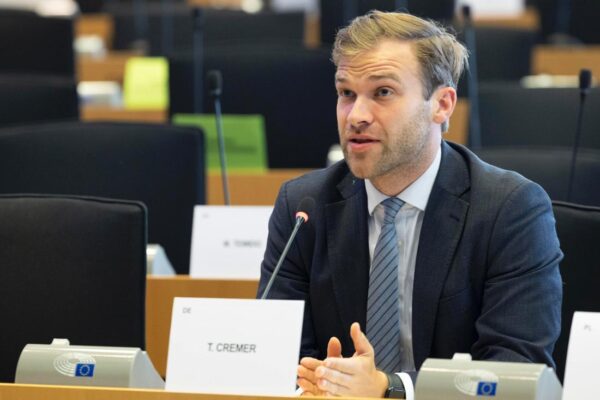
— We have heard about Russian drones in Poland, about Russian aircraft in Estonia, about all these cases. Can this be considered military aggression by Russia against these countries, against NATO, against the EU?
— I think this is preparation for it, we see how Russia is trying to test how far it can go. They collect intelligence in two ways. First, they test NATO’s resolve: are we ready to respond, do we set clear boundaries. Second, they record how quickly we can react — which planes take off, who does what and when. All this is obviously extremely useful for future operations. We need to clearly understand this. In a sense, there is nothing new here: even before I became a Member of the European Parliament, I worked as a German diplomat, oversaw the Baltic countries, and we recorded almost daily incursions of Russian aircraft into the airspace of these countries. Something similar is observed by Finland — practically without pause for almost 80 years, including the times of the Cold War. But what we see now and what causes concern is the slow escalation by Russia to test our reaction to various steps. And unfortunately, this is part of the general pattern. All our intelligence services warn: Russia is preparing to gain the ability to attack a NATO country, to really test the Alliance by the end of this decade, by 2029. Our task is to deter them, to ensure that Russia’s capability does not correspond to Russian willingness to attack. And this willingness directly depends on our reaction. Therefore, I am glad that NATO demonstrated the ability to shoot down these drones, that we strictly followed protocols. We showed: we see Russia’s actions. But it is no less important politically to demonstrate strength and to clearly make Putin understand: what he is doing is a bad idea. We are ready to defend ourselves.
— Do you support a substantial increase in military aid to Ukraine after these incidents, in order to show Russia a certain position?
— Yes, absolutely. In a sense, we can even be “grateful” to Trump’s attempts at diplomacy in August. I say this because he finally refuted the “zombie theory” that had long haunted Western discussions: as if, if you are softer with Putin, if you make concessions to him, he will be ready for peace. Trump really tried. He rolled out the red carpet, tried to push Ukraine to concessions, himself made concessions to Putin. And what did we get? Nothing. We got more attacks, more violence. In an outright mockery of the very idea of diplomacy, Putin even bombed the EU Embassy in Kyiv, aiming at diplomats who devoted their lives to finding peaceful solutions. So now everything is perfectly clear: the only language Putin understands is strength. That is why it is absolutely right to strengthen Ukraine right now. We know that the Ukrainian army today is the best guarantee of security not only for Ukraine, but for all of Europe. Therefore, I welcome that Europe has declared its readiness to compensate for a possible reduction of American support and to take on the main share of the costs. I am pleased that European Commission President Ursula von der Leyen is finally pushing the issue of frozen assets. This is what we have long been calling for. A week before her speech, together with our coordinator on Ukraine, we sent yet another letter promoting the use of these assets. And it seems that finally there is movement. If we can use the frozen assets in a legal way — and such ways exist — for example, as an advance payment on loans under reparations, on obligations that legally Russia owes Ukraine, — we will clearly show Putin: Ukraine will continue to be able to defend itself. This is hundreds of billions of euros available to Kyiv. And this will be the most effective: instead of endless spending on weapons supplies, we will invest in the Ukrainian defense industry. I am glad that the Danish and Dutch models are already moving in this direction. Ukraine still has significant unrealized potential, and we must help to unlock it. I look at this optimistically and think that we are moving forward to finally take steps that really will send a signal to Russia: this will not end. Putin still hopes that tomorrow the West will abandon support for Ukraine. But if we introduce “reparation loans” and say: “Now Ukraine annually receives 50 billion euros as an advance on Russian obligations,” — this will be an incentive for Putin to think: maybe it is worth stopping, if he does not want to lose his money.
— As for the assets: you support that Ukraine annually receives part of the Russian frozen assets in Europe, right? So they need to be confiscated?
— This is not confiscation. Here there is a subtle legal distinction. With direct confiscation, legal problems arise. We are looking for another way: to transfer the assets to another custodian and use them to secure “reparation loans.” We all agree: from the point of view of international law, the UN has clearly stated in a resolution — Russia owes Ukraine reparations. We would use the assets to borrow money under them and already start paying part of the reparations for Ukraine. In essence, Russia will already begin to pay for the damage: if they do not pay reparations, they simply do not get their money back. If they do pay — they keep them.
— What do you think, what additional levers of pressure are really not being used by the West against Russia now?
— The biggest lever is frozen assets. This can become a turning point, because it is about long-term financing of Ukraine. Another point is the recent 19th sanctions package. There are important elements there, especially concerning the “shadow fleet.” We need to be much tougher. Russian vessels formally have the right of passage, but many “shadow fleet” vessels do not meet the requirements. We can apply strict inspections and stop them. Therefore, I think this regime will really have an effect. I am also glad that we are approaching the date of a full refusal of Russian gas and energy. It is always important that sanctions hit Russia harder than us. Exceptions like Hungary and Slovakia, which continue imports, are unacceptable. It is pleasant that even Trump criticizes this. But we know that through bypass routes still too much oil and gas gets into Europe. Therefore, it is good that the date of refusal has been moved six months earlier — to the beginning of 2027. With all sanctions, we need to look: what hits Russia harder than us. Hence the question of secondary sanctions. I am not sure that introducing secondary sanctions against India will hurt Russia more than us. On the contrary, India needs to be brought to our side. It is more beneficial for it to work with Europe and Ukraine than with Russia. India has an interest in an international order based on rules. And I hope President Zelensky will state this at the UN General Assembly: this is not a small regional war over a patch of land. This is about the future of the international system. Every country that has experienced colonialism, every country that has an aggressive neighbor, understands: the transition from an order of rules to the law of the jungle is dangerous. Russia is engaging in neo-imperialism, and this is exactly what we must stop. This is about dictators — Russia, Iran and others.
— And there is one more question. “Rosatom.” What should be done about it in the future?
— “Rosatom” is a complicated case. Some countries have already imposed targeted sanctions. But here too we need to work: to reduce dependencies in the nuclear sphere, and then move on to more effective measures.
Guildhall news agency, exclusive.
Только главные новости в нашем Telegram, Facebook и GoogleNews!
Tweet