
Russia is waging a hybrid campaign against Europe — drone and fighter incursions, cyberattacks, weaponised migration, a “shadow fleet.” The response must be firm: call things by their name, strengthen deterrence, and above all ramp up military support for Ukraine — from air defence to stable financing of domestic arms production. There are no credible signs the Kremlin seeks peace; it must be compelled to it.
Pressure has to be comprehensive: close loopholes and secondary routes, expand personal sanctions to elites and affiliates, tighten inspections and stop the shadow fleet, use Russian assets in Ukraine’s interests, and cut dependence on Russian energy and nuclear supplies. In the occupied territories, deploy human-rights monitoring missions — an effort Latvia is already lobbying. In parallel, Ukraine’s victory is the clearest signal to China and other autocracies that aggression does not pay.
This was stated in a lengthy interview with the Guildhall news agency by Antoņina Ņenaševa, a member of the Latvian Saeima from the Progressives.
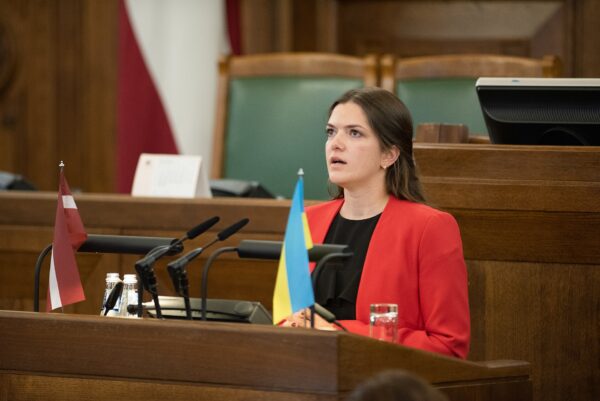
— We’ve seen Russian drones over Poland, Denmark and other countries, and Russian warplanes in Estonian and Finnish airspace. NATO says Russia bears full responsibility for that. Can these incidents be considered acts of military aggression against Europe?
— Yes and no at the same time. I’d still call them provocations rather than outright aggression. Of course, what constitutes “aggression” is open to interpretation. But we face hybrid warfare every day – and this is part of it. For instance, Latvia has endured more cyberattacks this year than ever, and the tempo keeps increasing. The same goes for jets, drones, even instrumentalised migration via the Belarus border – all of it is both provocation and hybrid warfare. In that perspective, it can also qualify as aggression – but through hybrid tactics.
— How should NATO and EU respond to that?
— We should have a clear and united response, signaling that such attacks are unacceptable. Right now, our response isn’t strong enough. I do understand the blurred line: calling it “military aggression” implies corresponding action. But we must protect ourselves better. Hybrid threats pose another problem – cyberattacks rarely receive an open response. It’s the “green men” story: not there, but there. We lack a common playbook for ever-changing cases – hence we get stuck. And I’m sure this wasn’t the last incident: there will be more drones, more planes, and perhaps other tools.
— You are right that there will be more aggressive actions by Russia in Europe. In Ukraine we believe Russia understands only force – military signals. Do you support a significant increase in military aid to Ukraine after that?
— Definitely. We’ve always supported it. We all know Ukraine is also fighting for us and for Europe as such. I was glad to hear your president confirm the Patriot arrival. Across Europe, with different national approaches, we try to persuade partners to step up military aid. We should increase support and donations – and deploy other tactics against Russia: for example, constraining investments feeding its war economy.
— Do you see any signs of Russia’s readiness for peace?
— No – no credible indications.
— Do you support an approach that Russia must be pressured into peace by force – since it isn’t ready otherwise?
— Personally – yes, and that aligns with our broader foreign-policy stance. I fully agree: Russia understands only strength. There’s no partner for meaningful talks. Their behavior is clear: targeted strikes on civilian infrastructure – especially ahead of winter – and a full wartime economy. They benefit from this. So while you fight, we must help you win. Without Russia’s defeat there will be no lasting peace.
— Beyond military tools, which additional non-military levers remain underused by Europe?
— Rigorous sanctions enforcement. The 19th EU package helps – broader, more targeted – but the machinery still isn’t effective enough. We don’t hit the elites and their networks hard enough to make them feel it. We lack consequences for evasion via third countries. We must be surgical: if European-made goods keep reaching Russia, we’re underperforming. I’m also concerned about visas – where Russians can still travel within Schengen, normalising life and diluting pressure. And sales of gas and other commodities – unacceptable. We should be much tougher. Sometimes Europe should be “a bit like Trump” here: if you trade with Russia, you face sanctions. Yes, that’s hard inside the EU – but the logic stands.
— On Russia’s shadow fleet: it’s expanding, fuels the war budget and poses ecological risks for Latvia – those ships are like “eco-bombs”. What more should be done? Is a full Baltic blockade realistic?
— I’d be more than happy if we found a way to fully block the shadow fleet. During last week’s visit by Denmark’s King and Queen, I even asked at lunch about the strait between Denmark and Sweden. Historically they taxed every passing ship – perhaps we could thoroughly inspect every vessel now. It sounds like a joke – but not entirely: we must check each ship. We need stronger control and interdiction – better radars, tracking systems, UAVs and subsea drones to protect infrastructure. The risks are dual: we’re enabling Russia’s fuel sales and we’re endangering the Baltic Sea’s ecology every day. I call what Russia does in the Baltic close to ecocide – it’s a daily risk. We’re getting better at catching and prosecuting the shadow fleet, but we should go further – restrict passage as much as possible.
— Russian assets in Europe: confiscation could strongly push Moscow toward peace. Do you support seizing and transferring these funds to Ukraine – as aid or reparations?
— We’re moving in that direction. Any lawful tool that helps Ukraine win is legitimate. It’s encouraging that Europe is taking first steps toward a legal solution. Politically and legally it’s hard – we’re searching for lawful ways while Russia destroys what was rebuilt the day before, and taxpayer money keeps flowing. Their funds “sit there” while we’re told seizure is “illegal”. Was the invasion legal? It’s a tough issue, but we must uphold the rule of law – otherwise someone may mirror such measures against us elsewhere. I’m positive about mechanisms like loan structures backed by these assets. I spoke with Belgium’s ambassador last week – they’re open to new procedures but want burden-sharing and collective risk. We don’t hold such volumes ourselves, so Belgium and others are key – together. Overall, Ukraine has a right to these funds. Waiting for formal reparations after Russia’s defeat is an option, but Moscow won’t admit anything – so mechanisms are needed now.
— Rosatom – Russia’s largest nuclear company serving both civilian and military sectors – remains outside comprehensive EU sanctions, partly due to some countries’ dependencies, like Hungary’s. What steps are needed to change this?
— I’m not a technical expert to go deep on specifics. Politically, my view is consistent: Europe must be independent of Russia in oil, gas and nuclear – for our own security. Latvia isn’t the “problem case” here, but within the EU we should keep pressing members who block decisions – as already happened with Hungary on other files. We must systematically sanction all fuel types. I do understand the difficulty – dependency, household costs, cold winters and so on. But often a rapid break accelerates economic re-tooling – it can even help. And we shouldn’t abandon the Green Deal despite political pushback. It’s about climate – and strategic independence from authoritarian suppliers.
— Humanitarian sphere: millions of Ukrainians live under occupation. PACE called Russia’s actions “ethnic cleansing” amounting to genocide – due to killings, forced Russification and other crimes. Would you back a similar resolution at home – in Latvia?
— To my knowledge, we already made statements along those lines – maybe not with PACE’s exact wording. First, we must document what is happening on the ground. Rights are systematically violated. A major focus is abducted Ukrainian children. We’re pushing for maximum documentation and exposure to international bodies. Forced deportations and Russification – recognising these abuses is vital, it’s the basis for accountability. But with children we can’t wait for the war to end – they must be brought back now. We hosted the Crimea Platform in Riga; this is a key topic. The legal path is complex; we work diplomatically through third countries to facilitate returns. If a strong statement by Latvia helps Ukraine on the occupied territories, we’re open to it.
— Should there be a UN mission to monitor human rights and protect civilians in the occupied areas?
— Perhaps. I’m not a procedural expert. From January Latvia is a non-permanent member of the UN Security Council. We’ll advocate there for a fair and lawful settlement. Latvia has already called on Russia to ensure safe, unhindered access for human-rights monitoring mechanisms to all temporarily occupied territories of Ukraine – that’s in our statements. UN peacekeeping missions serve monitoring purposes. The best outcome is to end the war – meaning Ukraine’s victory.
— RUSI reported that Russia encourages China to seize Taiwan, providing enabling technology; Ukraine’s defeat could embolden Beijing. Are these conflicts connected? Would Ukraine’s defeat signal to China that invasion brings no meaningful countermeasures.
— To some extent all of this is connected. I don’t even want to entertain the idea of Ukraine’s defeat – we can win. If partners do everything they can to support Ukraine, we won’t see that scenario. Europe must act so that authoritarian regimes don’t feel impunity. We’re not heading toward a world where borders can be changed by force and, “one day,” anyone can attack their neighbours — especially weaker ones — and simply overturn the international rule-based order. It is already happening. Unfortunately, we saw that when the response isn’t strong enough — 2014, Crimea, the “green men,” then Donbas — the outcome is predictable. If an aggressor is allowed to do whatever it wants, it will. Any attempt to annex Taiwan would violate international law. It would send a very dangerous signal for global stability, which is already under threat. Russia will use everything to provoke other wars and say, “Look, we’re not the worst — China is doing things too,” trying to rewrite the rules of the international order.
– China–Taiwan is a top priority for the U.S. How can Europe and NATO show Washington these wars are connected and that defeating Russia in Ukraine is essential to countering China in the Indo-Pacific?
– I hope Mr. Trump’s closest circle is providing him with full information on what Russia is doing — and that he will take an informed decision. In fact, Russia’s “help” to China could be an argument to Mr. Trump: everything is connected, and it’s in his interest not to let Russia win. We do see gradual change — not at a single moment, but in the overall trajectory. Mr. Putin’s broken promises and manoeuvres help demonstrate to Mr. Trump that Putin has no will to find solutions. His aim is to win — or at least to destroy the order, to maximise chaos. In chaos, he feels more comfortable, because fewer people notice who created it.
– That’s all for today. It was a pleasure. Thank you for your stance and your work — it’s very important for us. Let’s keep in touch and speak again soon.
– Thank you. Good luck and goodbye.
Guildhall, exclusively.
Только главные новости в нашем Telegram, Facebook и GoogleNews!
Tweet