
In the context of Russia’s ongoing aggression, security and support for Ukraine are becoming top priorities for the European Union. Europe must increase military aid to Ukraine, continue pressuring Russia through sanctions, and provide support. It is important for the EU to continue increasing the supply of weapons, providing Ukraine with the necessary equipment and financial assistance.
It is also necessary to seriously tackle Russia’s «shadow fleet» and expand sanctions against Russia, including the confiscation of frozen assets. The refusal to import Russian energy resources and the development of alternatives for countries dependent on Russian gas are becoming an important step for Europe.
This was discussed in more detail in an interview with Guildhall by Eddy Hartog, a member of the Senate of the Netherlands.
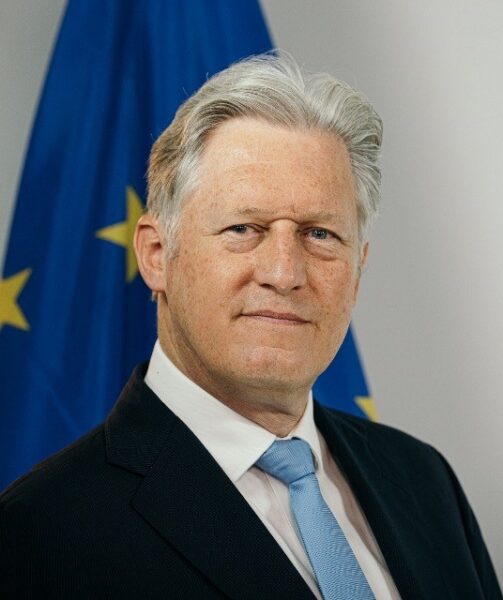
— Unfortunately, we begin with bad news. Russian combat drones Shahed attacked the airspace of Poland. Russian military planes attacked the airspace of Estonia. Recently, there have also been some drones over Denmark and Norway. NATO says that Russia bears full responsibility for this. Can we consider these cases as acts of military aggression?
— Yes, let me briefly say that as the Senate, we do not have a very direct operational role in policy matters in the Netherlands. It is just a limited role with the approval of legislation. The second point is that I am a member of the pan-European political party Volt. We are also in Ukraine, by the way. So, we are pan-European. Therefore, for us, the war emotionally began with the invasion of Ukraine. So, we really see it as a war that we are facing on our borders as part of the European family. Now, the recent events, of course, as you know, are still being investigated. We do not know what the cause was, what happened. And, as the NATO Secretary General also said, we are very cautious. I think the good news is that we are not silent about it, we know what we are doing, and we are also well-prepared. I read an article today saying that NATO is very well prepared for such incursions and especially also for the testing that the Russians are doing, and you all know this — how they started capturing Crimea, it wasn’t a war, but it was an invasion, and there were people without uniforms, etc., etc. So, we are very well aware of what is happening, and I think we are also very well prepared as NATO to deal with it in a way that does not lead to the escalation of any conflict.
— We believe the only signal that Russia will understand is military aid to Ukraine. Do you support a significant increase in military aid to Ukraine?
— First of all, let me say that we have great respect for how the Ukrainian people are conducting this war, as well as how the Ukrainian armed forces are conducting this war. And I am amazed by the technological development we have seen in Ukraine, from which the rest of the European Union can really benefit. So let me start with that. Yes, support for Ukraine, as I see it, has been 100% unconditional from the very beginning because, as the Volt party, we see this as an invasion of European values, into European territory. This is a real violation of what we thought would never happen again after World War II. So there has been full support. I expressed this in the Senate, actually because these matters come to the Senate, and I had the opportunity to express this on behalf of all European countries, as we are a pan-European party, and we fully support the assistance provided to Ukraine — moral, military, and from the standpoint of equipment, as well as from the standpoint of hosting and taking in Ukrainians who did not feel comfortable where they were before and were forced to leave their country. So, this is really important.
— Do you support the approach that Russia must be forced to peace?
— Yes. I mean, it’s not just peace, but peace on the right terms. Because, you know, there are, so to speak, certain political figures who want peace at any cost. I think that it is the Ukrainian people who should determine what peace means for them, what the conditions will be, and we will fully support whatever Ukraine decides to do in this. But this is obviously — and this is always a difficult emotional moment. No war is fought on the battlefield — it is won on the battlefield. Ultimately, we will have to sit down together and find a solution to stop the fighting.
— What additional levers of pressure are still available to the West and have not been used yet?
— I think we have been intensifying pressure on Russia in terms of economic sanctions, which we already have — we have had several packages at the EU level, where, by the way, I feel much more comfortable being part of the EU at this stage because the sanctions really hurt at this point. If I were doing this just as the Netherlands, I am not sure what effect that would have had. So we are very strong. We have tried to gradually ramp this up, and I think at first we were a little too slow, but it’s always good to do it gradually because, you know, “all at once” doesn’t have the proper effect. When I say “too slow,” — when Crimea was occupied, we could have been a little more decisive, but we still hoped, you know, that it wouldn’t go any further. But certainly, when other parts of Ukraine were captured, we could have ramped up weapons supplies much faster. There are still things that should be done in terms of allowing military equipment to be used, supporting military technology that we can still provide, and providing financial support to Ukraine not only for military efforts but also for civilians — considering the destruction that has occurred. And I am happy to see that Ukraine has received a lot of support from many EU member states.
— Russia has a lot of assets in Europe. Confiscation could be a powerful factor for Moscow to start a real peace process. What do you think about this, do you support transferring Russian assets to Ukraine?
— Honestly, I am not an expert on these assets because there are many things surrounding this, also legal issues. The simple storyline is this: yes, I think we should use these assets as much as we can to support Ukraine, and Russia should, so to speak, pay for the damage it has caused. At the same time, the rule of law is still highly valued in the European Union. And property rights are a fundamental right that we must uphold. So we need to be careful in how we can do this. But any legal tools we can use to actually confiscate Russia’s assets, we should apply. But if you give up your values and morality, no matter what the result is on the battlefield, you will still lose the war. And I think this is exactly what I like — to see that both Ukraine and many European countries have these same values and principles.
— Reuters says that Russia is expanding its «shadow fleet» despite sanctions. What else needs to be done to change this? Is a full blockade of the Baltic realistic?
— I’m not sure that blockades are the solution to this, but we really need to, because this is a kind of military action — the deployment of ships and similar things that often sail under the flags of other countries. So that’s how it works. But, I think we should really pursue this shadow fleet with all available measures — tracking them, finding them, and also working with the countries whose flags they are using to actually bring them in and say: this is not allowed. So, I think we should make every effort to fight this shadow fleet, and there are our proposals, again, I am not very familiar with all the details of these proposals. There are many legal elements — the right to free navigation, free movement of seas, etc. But no, we certainly must fight this and also influence the countries that provide Russia with this indirect support — not only regarding the shadow fleet, but also in other ways of exporting and selling oil and gas for Russia.
— The European Union is still the largest buyer of Russian gas. How do you assess this? What can we do to change this?
— Yes, you know about the plan to abandon oil and gas from Russia. There is a structural plan that we have as the European Union, and I fully support it, of course, to close and, you know, actually close the pipeline — and, to be honest, it is still flowing through Ukraine, and it should be that way because we also bear responsibility to our citizens — to survive the winter and so on. I come from a maritime nation, so it would be very easy for me to say: let’s shut everything down. But Volt is also represented in countries like Hungary, or other countries, where there are still not many alternatives. So, I think we should multiply efforts to provide alternatives to Russian oil and gas also for those countries in the heart of the European continent, and then make sure that we can turn off the taps in all directions.
— «Rosatom» is not under European sanctions and continues to operate. What steps should be taken to change this?
— This is something I honestly don’t know. I cannot take a position on this because I am not sufficiently informed on this.
— Okay, thank you. The next question — the suffering of millions under Russian occupation receives too little attention. The Parliamentary Assembly of the Council of Europe called Russia’s actions ethnic cleansing, bordering on genocide. Would you support such a resolution back home, in the Netherlands?
— Yes, we have a colleague in the Senate of the Netherlands who is very active in the Council of Europe on many issues, but also on these. And I think we should follow the Council of Europe in its verdict on ethnic cleansing. But I am also very concerned about the children who were taken to Russia, for example, and who are now being brainwashed. And I see that behind all this is so much human tragedy. And part of this, you know, we need to see how this can be corrected. But we are very concerned about this. And at the same time, we are pleased with the actions being taken as much as we can in the liberal democracy that we are, where the rule of law prevails. And I am very pleased with what the Council of Europe has done on this issue.
— Should there be a call for a United Nations mission to monitor human rights in the occupied territories?
— Yes — that’s the short answer. But, I think, we witnessed the United Nations General Assembly yesterday with various speakers. And, you know, we need to be realistic: the configuration of the United Nations does not particularly favor granting it a mandate to actually intervene in various conflicts around the world. And one of them, which you are rightfully focusing on today, is Ukraine, but also, for example, what is happening in Gaza and the West Bank. This would require certain international efforts, ideally through the UN, to be honest. So yes, the short answer is «yes,» but I don’t think we should just sit and wait for the UN to solve these problems.
— Okay, this is very, very important. And the last question for today: Is the West still united in supporting Ukraine’s victory?
— The short answer is yes. And I have even seen that the President of the United States expressed his support for Ukraine’s victory. And he actually believes this can happen. So, you can imagine certain things that I would not agree with President Trump on, but on this, I would certainly support him. And yes, this is victory. But, again, as I said, no war is solved on the battlefield. In the end, we will have to come to certain negotiations. Your president, your politicians must take leadership in this — to define what they consider acceptable to end this war. It will be done through political means. And, to be honest, this will be a victory for society as a whole — both on the Russian side and the Ukrainian side. Because, let’s be honest, there are many innocent Russians who are afraid to speak to their president, who would not agree with what he is doing, and who also suffer on their side. And I think they would like the war to end, and first of all, they would like to return Ukraine’s rightful territories.
— Yes, thank you for your position. This is very important to me, to us. This is very, very important.
Guildhall News Agency, exclusive.
Только главные новости в нашем Telegram, Facebook и GoogleNews!
Tweet